 Even though mandolinist Al Miller should really be counted among the pioneers of Western swing, his blend of country dance and hokum blues seems to have pushed him to the periphery of historic music appreciation circles. Indeed, were it not for Document's handsome complete edition of 1995, Miller's recorded legacy would have receded to a position even further off of most peoples' cultural radar. His earliest-known records were cut in Chicago on July 15, 1927 and issued on the now-legendary Black Patti label. "I Found a Four-Leaf Clover" sounds like a precedent for Emmett Miller & His Georgia Crackers, largely because Al's voice was similarly pitched. The main difference is that Emmett Miller liked to yodel -- his direct descendant appears to have been Hank Williams. The instrumental "Saturday Night Hymn" is a fine example of a whimsical blues played on mandolin, and was originally pressed with a title by Kid Brown & His Blue Band on the flip side. A little over 80 years after it was released, one of the few copies of this platter known to exist was being offered on the rare record circuit for more than $4,400.00. Although in many ways "Saturday Night Hymn" might be the very best recording this artist ever made, the CD is considerably more affordable and provides an additional 25 songs. One of the few individuals even tentatively identified in the discography is a guitarist with the surname Rodgers, and "I Would If I Could" was released on Paramount as by Miller and Rodgers. In February 1929 Miller began making records in a style that aimed to please the growing audience for Chicago's increasingly popular hokum blues. Miller's lasting achievement as a composer was a raunchy number with the attention-getting title "Somebody's Been Using That Thing." He recorded it five times, and the three issued takes are sprinkled throughout this album. In June 1934 Tampa Red cut a rowdy cover version for Bluebird that worked well for Tampa without, it seems, doing very much for Miller, who had frankly based much of his acquired hokum technique on records by Tampa Red, Georgia Tom, and a group specifically billed as the Hokum Boys.
The hokum formula demanded a full range of smutty lyrics laid over simple bluesy melodies that anybody could sing along with. One of hokum's major exponents was Tampa's cohort Lovin' Sam Theard. In March 1929 the second version of "Somebody's Been Using That Thing" was waxed by Al Miller & His Market Street Boys, which was nothing more than Miller and Rodgers with pianist Frank Melrose sitting in. There are 13 additional recordings from 1929 that use the same instrumentation with no one except Miller identified. Much of the material was directed at a Prohibition-era audience looking for naughty good-time music to listen to while partying with friends. Titles like "I Found Your Key-Hole," "It Ain't Killed Nobody Yet," "Gimme a Li'l Taste," and "That Stuff Ain't No Good" are typical of this mini-genre's hedonistic fixations. "Thirty First and State," with open references to prostitution, is one of several tunes inspired by the fast life on Chicago's South Side. "Let Me Put My Shoes Under Your Bed," on the other hand, is a nicely phrased love song, similar to what mild-mannered Ollie Shepard like to sing during the late '30s and early ‘40s. This collection and Al Miller's primary discography close with four sides cut for Decca in February 1936. Billed as Al Miller & His Swing Stompers, the group consisted of Miller, now apparently handling a guitar; an unidentified string bassist; pianist Cripple Clarence Lofton; and a frowsy clarinetist named Odell Rand, who did most of his recording with the Chicago-based Harlem Hamfats. Further instances of Al Miller's artistry may be found among the discographies of Lofton and vocalists Mozelle Alderson, Luella Miller, and Red Nelson Wilborn, as well as King Mutt & His Tennessee Thumpers. arwulf arwulf
Tracklist :
1 Al Miller– I Found A Four-Leaf Clover 2:27
2 Al Miller– Someday Sweetheart 2:17
3 Al Miller's String Band– Saturday Night Hymn 2:47
4 Miller And Rodgers– I Would If I Could (21061) 2:29
5 Al Miller– Mister Mary Blues 2:44
6 Al Miller– Somebody's Been Using That Thing (14799) 2:34
7 Al Miller– On An Island All By Myself 2:43
8 Al Miller– No Fish For Me 2:40
9 Al Miller And His Market Street Boys– Somebody's Been Using That Thing (C-3080) 2:44
10 Al Miller And His Market Street Boys– I Would If I Could (C-3083) 2:59
11 Al Miller– It Ain't Killed Nobody Yet 2:46
12 Al Miller– Maybe You'd Feel That Way Too 2:43
13 Al Miller– Don't Be A Fool 2:56
14 Al Miller– I Found Your Key-Hole 3:04
15 Al Miller– Thirty First And State 3:14
16 Al Miller– It Must Be Good 2:50
17 Al Miller– Let Me Put My Shoes Under Your Bed 2:55
18 Al Miller– That Stuff Ain't No Good 2:53
19 Al Miller– Gimme A Li'l Taste 3:00
20 Al Miller– Somebody's Been Using That Thing Part II 2:50
21 Al Miller– That Stuff You Sell 2:29
22 Al Miller– Bone Blues 2:38
23 Al Miller And His Swing Stompers– It's Got To Be Done 2:22
24 Al Miller And His Swing Stompers– Juicy Mouth Shorty 2:20
25 Al Miller And His Swing Stompers– Truckin' Old Fool 2:28
26 Al Miller And His Swing Stompers– Ain't That A Mess? 2:43
4.2.25
AL MILLER — Complete Recorded Works In Chronological Order 1927-1936 | DOCD-5306 (1994) RM | FLAC (image+.cue), lossless


MAE GLOVER – Inc. MAY ARMSTRONG, SIDE WHEEL SALLY DUFFIE — Complete Recorded Works In Chronological Order 1927-1931 | DOCD-5185 (1993) RM | FLAC (tracks+.cue), lossless
 Born September 9, 1907 in Columbia, Tennessee, Lillie Mae Glover ran away from home in 1920 when she was only 13 to join the Tom Simpson Traveling Medicine Show. Her father was a preacher and she wanted to sing the blues, so that was that. She worked in several road shows before landing in Memphis, Tennessee in the late '20s, becoming a regular performer on the city's famed Beale Street, where she was known as "the Mother of Beale Street." She recorded and performed under several different names, including Lillian Mae Glover, Mae Glover, and Big Memphis Ma Rainey, the name under which she tracked a few sides for Sun Records in 1953. She died in 1985 at Tishomingo County Hospital in Iuka, Mississippi at the age of 77. Steve Leggett
Abridged from this album’s original booklet notes. Mae Glover was probably one of many professional or semi-professional female singers working the tent shows and vaudeville stages in the 1920s. In order to survive, these entertainers had to be versatile, as they might perform for a rural audience one week and a more sophisticated city crowd the next. Like most of these singers, Glover was reliant upon outside musicians for her backing, and the availability of good accompanists was not guaranteed. In John Byrd she found an ideal partner. Byrd was from rural Jefferson County in south Mississippi and was known to have performed on occasion with Tommy Johnson in Jackson, an active musical centre in the state. He reportedly moved from town to town playing for the sawmill workers in that vicinity (Blues Unlimited No. 142, Summer 1982 interviews with Ishmon Bracey and Johnny Temple). Although Dixon and Godrich (Blues & Gospel Records 1902-1943) are reluctant to identify Walter Taylor as Washboard Walter, John Byrd is listed as having recorded with both entities and an association with Taylor’s small string band from Louisville, Kentucky is probable. As “Walter And Byrd” they recorded a tribute to Blind Lemon Jefferson: Wasn’t It Sad About Lemon for Paramount (Document DOCD-5641 ‘Rare Country Blues Vol 2 1929 – 1943’). Byrd’s only issued solo efforts were the intriguing blues ballads Billy Goat Blues and Old Timbrook Blues (DOCD-5641) which suggest he was a songster from the pre- blues generation. When he recorded his duets with Mae Glover in July 1929 Byrd also cut two religious titles for Gennett which were credited to Rev. George Jones And Congregation (DOCD-5641). It is possible that the Sister Jones appearing on this record is Mae Glover, and this speculation coupled with the genuine rapport on their duets is fuel for a theory that their relationship was more than professional. Byrd’s powerful twelve string guitar playing (an uncommon choice of instrument for a Mississippian) and Glover’s strong vocals appear to be overloading the recording microphone, creating a hot signal on the verge of distortion on the duet titles. All four are outstanding, but of particular interest are the blue yodel Pigmeat Mama, which attests to the enormous popularity of country star Jimmie Rodgers among both white and black audiences, and Gas Man Blues, a hilarious battle of the sexes loaded with double-entendre in the vaudeville style popularized on records by Butterbeans and Susie. It is most unfortunate that Glover didn’t have more inspired accompaniment for her session in February 1931. Pianist Charles O’Neil and trumpet player James Parker never rise above mere competence, and Parker’s lacklustre singing on the vocal duet Grasshopper Papa spoils a potentially good number. Glover’s version of “Forty-Four Blues” is, as Paul Oliver points out in Screening The Blues, the first recording of that theme by a woman and is related to the versions by Lee Green. The last verse: “I got the blues, will last me nine months from today” (presumably a reference to pregnancy) supports Oliver’s theory that “Fourty-Four” (at least the Lee Green version) was originally sung by a woman and that Glover’s version is closer to the original form. It’s just a pity that a pianist the calibre of Roosevelt Sykes or Little Brother Montgomery wasn’t present to help Glover out on her version. Whether May Armstrong and Side Wheel Sally Duffie were pseudonyms for May Glover is a question open for discussion. They were both strong vocalists in the raw and rugged Ma Rainey fashion and Duffie had the benefit of solid piano backing from Will Ezell, a Paramount scout and recording artist who had recently supplied sympathetic accompaniment at sessions with Ora Brown, Lucille Bogan, Elzadie Robinson, and Bertha Henderson. Whatever their true identities may have been, Armstrong and Duffie were fine vocalists and this is a welcomed opportunity to hear their impossibly rare discs. DOCD-5185
Tracklist :
1 May Armstrong– Joe Boy Blues 3:14
Piano [Poss.] – Lonnie Johnson
Violin – Unknown Artist
Vocals – May Armstrong
2 May Armstrong– Lonesome Atlanta Blues 2:31
Piano [Poss.] – Lonnie Johnson
Violin – Unknown Artist
Vocals – May Armstrong
3 May Armstrong– Woodchopping Blues 2:39
Guitar [Erroneous] – Unknown Artist
Mandolin – Unknown Artist
Piano [Poss.] – Lonnie Johnson
Vocals – May Armstrong
4 May Armstrong– Nobody Can Take His Place 2:57
Guitar [Erroneous] – Unknown Artist
Mandolin – Unknown Artist
Piano [Poss.] – Lonnie Johnson
Vocals – May Armstrong
5 May Armstrong– Don't Beg Your Man Back 3:09
Guitar [Erroneous] – Unknown Artist
Mandolin – Unknown Artist
Piano [Poss.] – Lonnie Johnson
Vocals – May Armstrong
6 May Armstrong– Sweetest Man Blues 2:33
Piano [Poss.] – Lonnie Johnson
Vocals – May Armstrong
7 Side Wheel Sally Duffie– Kind Papa Blues 2:35
Piano – Will Ezell
Vocals – Side Wheel Sally Duffie
8 Side Wheel Sally Duffie– Treat 'Em Right Blues 2:36
Piano – Will Ezell
Vocals – Side Wheel Sally Duffie
9 Side Wheel Sally Duffie– Thinking Blues 2:48
Piano – Will Ezell
Vocals – Side Wheel Sally Duffie
10 Side Wheel Sally Duffie– Kid Man Blues 2:42
Piano – Will Ezell
Vocals – Side Wheel Sally Duffie
11 Mae Glover– Shake It Daddy 2:50
Guitar, Speech – John Byrd
Vocals – Mae Glover
12 Mae Glover– Pig Meat Mama 2:46
Guitar – John Byrd
Vocals, Yodeling – Mae Glover
13 Mae Glover– I Ain't Givin' Nobody None 2:45
Guitar, Speech – John Byrd
Vocals – Mae Glover
14 Mae Glover– Gas Man Blues 2:45
Guitar, Vocals – John Byrd
Vocals – Mae Glover
15 Mae Glover– My Man Blues 2:58
Piano – Charles O'Neil
Trumpet – James Parker
Vocals – Mae Glover
16 Mae Glover– Grasshopper Blues 2:38
Piano – Charles O'Neil
Vocals – James Parker, Mae Glover
17 Mae Glover– Forty-Four Blues (Big Gun Blues) 2:18
Piano – Charles O'Neil
Trumpet – James Parker
Vocals – Mae Glover
18 Mae Glover– Skeeter Blues 2:48
Piano – Charles O'Neil
Trumpet – James Parker
Vocals – Mae Glover
19 Mae Glover– The Country Farm Blues 2:38
Piano – Charles O'Neil
Trumpet – James Parker
Vocals – Mae Glover
20 Mae Glover– Hoboken Prison Blues 2:29
Piano – Charles O'Neil
Trumpet – James Parker
Vocals – Mae Glover
21 Mae Glover– Two Timin' Woman (Two Timing Blues) 2:46
Piano – Charles O'Neil
Vocals – Mae Glover
22 Mae Glover– Good Hearted Woman 2:49
Piano – Charles O'Neil
Vocals – Mae Glover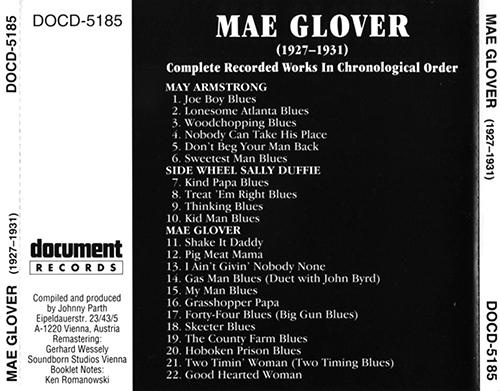
2.2.25
GENE CAMPBELL — Complete Recorded Works In Chronological Order 1929-1931 | DOCD-5151 (1993) RM | FLAC (tracks+.cue), lossless
 Virtually nothing is known about vocalist-guitarist Gene Campbell other than the fact he recorded 24 solo selections. 22 are on this CD with the other two being lost. Campbell is heard on five dates recorded in Dallas and Chicago recorded within a 14-month period. A fine if not overly memorable singer, Campbell is expressive on such numbers (probably mostly his own originals) as "Mama, You Don't Mean Me No Good No How," "Somebody's Been Playing Papa," "Levee Camp Man Blues," the two-part "Freight Train Yodeling Blues," "Married Life Blues" and "Crooked Woman Blues." Although not quite essential, this is certainly the definitive Gene Campbell CD! But what happened to him after the final Jan. 23, 1931 record date is not known. Scott Yanow
Abridged from this album’s original booklet notes. Gene Campbell remains a complete biographical cipher. The few people who have written about Campbell suggested that Texas was his home or that he spent part of his adult life there. In Western Plain Blues (C-5708) he describes himself as “born in Texas, raised in Texas, too”. More specifically, it would seem that East or Central Texas was his residence during the 1920s. This supposition is underscored by the fact that he recorded at Dallas, Texas, field sessions held in late 1929 and again one year later. At the first session, he was in the same company as such known Texan’s as Blind Norris and Sammy Price. I also think that his references in Levee Camp Man Blues (C-5707-A) to working with mules on the levee, while pan-Southern, are more likely to have occurred in eastern or central Texas where such construction was more commonplace along the Red, Sabine, or Trinity Rivers. Several of his songs, such as Don’t Leave Me Blue Blues (DAL-6789-A) contain references to other cities (Waco, Fort Worth and San Antonio) in eastern and central Texas. His voice has some of the relaxed qualities – an expressive, though easy drawl – that one hears on the recordings of Willard “Rambling” Thomas and Jesse Thomas, for example. These two men worked around the Ar-La-Tex (the tristate area where Arkansas. Louisiana, and Texas meet), meandering as far west as Dallas. Campbell’s vocal inflections are restricted in their range, almost always less than an octave, and his diction is unusually clear. In addition, his penchant for descending vocal phrases calls Dennis “Little Hat” Jones to mind. Campbell’s picking is also reminiscent of other Texas players; his arrpegiated breaks remind me of Blind Lemon Jefferson, though he lacks Jefferson’s technical facility. His technical ability to provide a moderately interesting chordal accompaniment is heard to good advantage on Doggone Mean Blues (DAL-6790-A). His guitar phrasing the short, rhythmic, breaks on Main Papa’s Blues (C-72520-A), for instance], also recalls the work of King Solomon Hill, who lived just east of Shreveport, Louisiana, not far from the Texas border. Like so many bluesmen of the late 1920s, Campbell listened closely to the recordings of Lonnie Johnson. He emulates some of Johnson’s musical ideas, particularly the way he strongly attacks guitar phrases at the very beginning of instrumental breaks. Clifford Gibson is another non-Texas bluesman who comes to mind when listening to Campbell. His voice has some of Gibson’s mannerisms, though it is less nasal; he also lacks Gibson’s ability to turn a pithy or ironic phrase, though Gene Campbell almost succeeds with lines such as:
Going to find my baby, she’s got to meet me face-to-face (x2) And tell me why she let another man take my place.
In short, Gene Campbell seems to have absorbed influences from many sources. Some of them are no doubt from other local, almost certainly unknown bluesmen, whom Campbell met during his ramblings. Campbell was also part of the larger east/central Texas scene from which many of my comparisons are drawn. Finally, there are the clear inspiration from phonograph records by several artists, most notably the unambiguous Jimmy Rodgers‘ mannerisms on Freight Train Yodeling Blues – Parts 1 & 2 (C-5709/10). You mix these together with Gene Campbell‘s own creative impulses and you have a regional bluesman of the second tier, whose interesting records are illustrative of his musical times and cultural milieu. DOCD-5151
Tracklist :
1 Mama, You Don't Mean Me No Good No How 2:58
2 Bended Knee Blues 2:55
3 Wandering Blues 2:41
4 Somebody's Been Playin' Papa 3:02
5 Wash And Iron Woman Blues 2:15
6 Robbin' And Stealin' Blues 2:42
7 I Wish I Could Die 2:51
8 Lazy Woman Blues 2:50
9 Levee Camp Man Blues 3:09
10 Western Plain Blues 2:43
11 Freight Train Yodeling Blues – Part 1 2:38
12 Freight Train Yodeling Blues – Part 2 2:58
13 Don't Leave Me Blue Blues 2:31
14 Doggone Mean Blues 2:38
15 Married Life Blues 2:30
16 Fair Weather Woman Blues 2:26
17 Lonesome Nights Blues 2:38
18 Wedding Day Blues 2:26
19 Main Papa's Blues 3:02
20 Face To Face Blues 3:07
21 Crooked Woman Blues 2:41
22 Overalls Papa Blues 3:10
JAZZ GILLUM — Complete Recorded Works In Chronological Order ★ Volume 1 • 1936-1938 | DOCD-5197 (1993) RM | FLAC (tracks), lossless

Abridged from this album’s original booklet notes. Like so many others living in the black ghettos of Chicago, Jazz Gillum had been born in the south; in Indianola, Mississippi, to be exact, on September 11th 1904. He was one of an indeterminate number of children born to Irving Gillum and Celia Buchanan. When both these parents died in his early childhood Bill, or Jazz as he was already nicknamed, along with his brothers fell under the control of their mother’s brother, the church deacon, Ed Buchanan. It was now that Gillum’s interest in music came to the fore and he taught himself to play the harmonium and badgered his brothers into teaching him the harmonica. However, either because of Buchanan’s religious convictions or naturally harsh nature life under this new regime was pretty unbearable and Jazz was only seven when he followed the example of his brothers and ran away to join relatives in Charleston, Mississippi. By the time he was eleven or twelve Gillum ran away again to work as a field hand in Minter City, Mississippi. In 1918 he got himself a job in a drug store in Greenwood, Mississippi. All this time he had continued with his music and had progressed to working the streets to supplement his income. Finally, in 1923, he followed the developing black drift and moved north to Chicago. In the Windy City Gillum kept up his casual involvement in music and gradually became a part of the local scene. Eventually he started working in clubs where his ability as a singer brought him somewhat to the fore. Through this work he came into contact with many other musicians, one of whom was the hustling Big Bill Broonzy. It may have been through this connection that Jazz Gillum made his first appearance in a Bluebird recording studio in June, 1934. Working with Big Bill and a pianist who was probably Black Bob he produced an instrumental Harmonica Stomp and sung Early In The Morning. These tracks were released as the two sides of BB B5565 (Document DOCD-5574) Jazz Gillum was still in the company of Big Bill Broonzy when he returned to the studio and this disc opens with the four recordings he made for Bluebird in April 1936. Their first number, in praise of Gillum’s “cross-eyed consumptive Sara Jane” is also well known in the white rural tradition of the period and illustrates just how well Gillum and Broonzy worked together. In June of that year Gillum followed a practice common at the time and “moonlighted”, recording for another company under an assumed name. In this case he became Bill McKinley for ARC but either because he was badly treated at ARC or because Victor reminded him of his contractual obligations, he had returned to the fold by October of 1938. Jazz or Bill Gillum’s Jazz Boys appeared at this time spreading their existence over some ten titles. Initially they were just Big Bill’s guitar and Blind John Davis‘ piano augmented by an unknown drummer but on the second of the two dates utilising the name Washboard Sam took over as percussionist and extra sophistication was introduced with George Barnes‘ electric guitar. DOCD-5197
Tracklist :
1 Jazz Gillum– Sarah Jane 3:01
Double Bass – Unknown Artist
Guitar – Big Bill Broonzy
Vocals, Harmonica – Jazz Gillum
2 Jazz Gillum– I Want You By My Side 3:21
Double Bass – Unknown Artist
Guitar – Big Bill Broonzy
Vocals, Harmonica – Jazz Gillum
3 Jazz Gillum– Jockey Blues 2:47
Double Bass – Unknown Artist
Guitar – Big Bill Broonzy
Vocals, Harmonica – Jazz Gillum
4 Jazz Gillum– Don't You Scandalize My Name 2:18
Double Bass – Unknown Artist
Guitar – Big Bill Broonzy
Vocals, Harmonica – Jazz Gillum
5 Bill McKinley– She Keeps On Rickin' 2:48
Double Bass – Unknown Artist
Guitar [possibly] – Big Bill Broonzy
Vocals, Harmonica – Jazz Gillum
6 Bill McKinley– I Went To The Gypsy 2:48
Double Bass – Unknown Artist
Guitar [possibly] – Big Bill Broonzy
Vocals, Harmonica – Jazz Gillum
7 Bill Gillum And His Jazz Boys– My Old Lizzie 3:20
Drums – Unknown Artist
Guitar – Big Bill Broonzy
Piano [probably] – Blind John Davis
Vocals, Harmonica – Jazz Gillum
8 Bill Gillum And His Jazz Boys– Alberta Blues 2:50
Drums – Unknown Artist
Guitar – Big Bill Broonzy
Piano [probably] – Blind John Davis
Vocals, Harmonica – Jazz Gillum
9 Bill Gillum And His Jazz Boys– My Old Suitcase 2:59
Drums – Unknown Artist
Guitar – Big Bill Broonzy
Piano [probably] – Blind John Davis
Vocals – Jazz Gillum
10 Bill Gillum And His Jazz Boys– Birmingham Blues 3:19
Drums – Unknown Artist
Guitar – Big Bill Broonzy
Piano [probably] – Blind John Davis
Vocals, Harmonica – Jazz Gillum
11 Jazz Gillum And His Jazz Boys– Just Like Jesse James 2:47
Double Bass – Unknown Artist
Electric Guitar – George Barnes
Guitar – Big Bill Broonzy
Vocals, Harmonica – Jazz Gillum
Washboard [probably] – Washboard Sam
12 Jazz Gillum And His Jazz Boys– Reefer Head Woman 2:59
Double Bass – Unknown Artist
Electric Guitar – George Barnes
Guitar – Big Bill Broonzy
Vocals, Harmonica – Jazz Gillum
Washboard [probably] – Washboard Sam
13 Jazz Gillum And His Jazz Boys– Gillum's Windy Blues 2:25
Double Bass – Unknown Artist
Electric Guitar – George Barnes
Guitar – Big Bill Broonzy
Vocals, Harmonica – Jazz Gillum
Washboard [probably] – Washboard Sam
14 Jazz Gillum And His Jazz Boys– New "Sail On, Little Girl" 3:03
Double Bass – Unknown Artist
Electric Guitar – George Barnes
Guitar – Big Bill Broonzy
Vocals, Harmonica – Jazz Gillum
Washboard [probably] – Washboard Sam
15 Jazz Gillum And His Jazz Boys– Sweet, Sweet Woman 2:51
Double Bass – Unknown Artist
Electric Guitar – George Barnes
Guitar – Big Bill Broonzy
Vocals, Harmonica – Jazz Gillum
Washboard [probably] – Washboard Sam
16 Jazz Gillum And His Jazz Boys– Boar Hog Blues 2:47
Double Bass – Unknown Artist
Electric Guitar – George Barnes
Guitar – Big Bill Broonzy
Vocals, Harmonica – Jazz Gillum
Washboard [probably] – Washboard Sam
17 Jazz Gillum And His Jazz Boys– Worried And Bothered 3:19
Double Bass – Unknown Artist
Guitar – Big Bill Broonzy
Vocals, Harmonica – Jazz Gillum
Washboard [probably] – Washboard Sam
18 Jazz Gillum And His Jazz Boys– I'm That Man Down In The Mine 2:46
Double Bass – Unknown Artist
Guitar – Big Bill Broonzy
Vocals, Harmonica – Jazz Gillum
Washboard [probably] – Washboard Sam
19 Jazz Gillum And His Jazz Boys– Uncertain Blues 2:54
Double Bass – Unknown Artist
Guitar – Big Bill Broonzy
Vocals, Harmonica – Jazz Gillum
Washboard [probably] – Washboard Sam
20 Jazz Gillum And His Jazz Boys– Good Old 51 Highway 2:33
Double Bass – Unknown Artist
Guitar – Big Bill Broonzy
Vocals, Harmonica – Jazz Gillum
Washboard [probably] – Washboard Sam
21 Jazz Gillum And His Jazz Boys– You're Laughing Now 2:42
Double Bass – Unknown Artist
Guitar – Big Bill Broonzy
Vocals, Harmonica – Jazz Gillum
Washboard [probably] – Washboard Sam
22 Jazz Gillum And His Jazz Boys– I'm Gonna Get It 2:38
Double Bass – Unknown Artist
Guitar – Big Bill Broonzy
Vocals, Harmonica – Jazz Gillum
Washboard [probably] – Washboard Sam
23 Jazz Gillum And His Jazz Boys– Mule Blues 3:13
Double Bass [probably] – Ransom Knowling
Guitar [probably] – Big Bill Broonzy
Piano [probably] – Joshua Altheimer
Vocals, Harmonica – Jazz Gillum

JAZZ GILLUM — Complete Recorded Works In Chronological Order ★ Volume 2 • 1938-1941 | DOCD-5198 (1993) RM | FLAC (tracks), lossless

Although a minor figure in blues history, Jazz Gillum recorded 100 selections during 1934-49 as a leader plus an album in 1961. Of those 100, the first two seem to be completely lost but the other 98 have all been reissued on four Document CDs. An expressive singer and an effective harmonica player, Gillum, holds his own with his better-known sidemen which on Vol. 2 include guitarist Big Bill Broonzy, pianist Joshua Altheimer, bassist Ransom Knowing, Washboard Sam and (on one session) a so-so tenor-saxophonist. Among the better selections from these performances covering the 1938-41 period are such numbers as "Get Away Old Woman," "Keyhole Blues," "Hard Drivin' Woman," "Key To The Highway" and "Is That A Monkey You Got?" Scott Yanow
Abridged from this album’s original booklet notes. When Jazz Gillum made his first recordings the influence of his country background was still strong upon him. His dark but clear voice and piping high-register harp were redolent of the country juke joint or small town street corner. Gillum’s uncomplicated straight ahead style continued to sell records and attempts to render his image more hip by the use of an electric guitar seemed to have been modestly successful. For his recording date in May 1939 Gillum played his harmonica alongside a tenor-sax player who is tentatively identified as one John Cameron. This trend towards big city sophistication was general among the group of Chicago musicians of which Gillum was a member and would see its final fruition, after a fresh injection from the south, as the bar blues which dominated the post-war Chicago scene. In May of 1940 Gillum cut one of his most successful and at the same time controversial numbers; Key To The Highway was to become a blues standard and both Jazz Gillum and Big Bill Broonzy claimed authorship. Investigations over the years would seem to indicate that Gillum had the stronger case. Gillum himself was not above swiping a good tune, say that generally known as Dust My Broom (common property and used on the uptempo Against My Will), or a whole song (like everybody else he was to take a swing at Casey Bill Weldon‘s Outskirts of Town) or even a stylistic tag such as Peetie Wheatstraw‘s “Oh well, well”. His own compositions often tended to hark back to his days in the south. On Mule Blues from his December 1938 session Gillum had boasted that he could “look at forty acres of cotton and tell you every bale you’ll make” and this preoccupation with southern concerns continued with his hymn in praise of the Mississippi steam boat Big Katy Adams and his invocation of the folk-hero Stavin Chain. Strangely when he recorded I’m Still Walking The Hi-Way, to cash in on the success Key To The Highway, with which it shared the same tune, in March 1941 – a month before Big Bill Broonzy recorded the latter number – the writer credit was made out to … “Broonzy”! It was at Broonzy’s May 1941 session for Okeh, when his version of Key To The Highway was cut, that “Bill McKinley“, reappeared as Jazz Gillum took the opportunity to lay down a couple of, extracurricular, tracks himself, including the mildly salacious Is That A Monkey You Got?, which, possibly for contractual reasons, did not see release until the compact disc age of the 1990s. DOCD-5198
Tracklist :
1 Jazz Gillum And His Jazz Boys– Let Her Go 2:53
Double Bass [probably] – Ransom Knowling
Guitar [probably] – Big Bill Broonzy
Piano [probably] – Joshua Altheimer
Vocals, Harmonica – Jazz Gillum
2 Jazz Gillum And His Jazz Boys– Get Away, Old Woman 2:50
Double Bass [probably] – Ransom Knowling
Guitar [probably], Speech [vocal responses, probably] – Big Bill Broonzy
Piano [probably] – Joshua Altheimer
Vocals, Harmonica – Jazz Gillum
3 Jazz Gillum And His Jazz Boys– Stavin' Chain 2:27
Double Bass [probably] – Ransom Knowling
Guitar [probably] – Big Bill Broonzy
Piano [probably] – Joshua Altheimer
Vocals, Harmonica – Jazz Gillum
4 Jazz Gillum And His Jazz Boys– She Won't Treat Me Kind 2:34
Double Bass [probably] – Ransom Knowling
Guitar [probably] – Big Bill Broonzy
Piano [probably] – Joshua Altheimer
Vocals, Harmonica – Jazz Gillum
5 Jazz Gillum And His Jazz Boys– I'll Get Along Somehow 2:21
Double Bass [probably] – Ransom Knowling
Guitar [probably] – Big Bill Broonzy
Piano [probably] – Joshua Altheimer
Vocals, Harmonica – Jazz Gillum
6 Jazz Gillum– Got To Reap What You Sow 3:01
Guitar – Big Bill Broonzy
Piano [probably] – Joshua Altheimer
Tenor Saxophone [possibly] – John Cameron
Vocals, Harmonica – Jazz Gillum
7 Jazz Gillum– Big Katy Adams 2:57
Guitar – Big Bill Broonzy
Piano [probably] – Joshua Altheimer
Tenor Saxophone [possibly] – John Cameron
Vocals, Harmonica – Jazz Gillum
8 Jazz Gillum– Against My Will 3:04
Guitar – Big Bill Broonzy
Piano [probably] – Joshua Altheimer
Tenor Saxophone [possibly] – John Cameron
Vocals, Harmonica – Jazz Gillum
9 Jazz Gillum– Keyhole Blues 2:57
Guitar – Big Bill Broonzy
Piano [probably] – Joshua Altheimer
Tenor Saxophone [possibly] – John Cameron
Vocals, Harmonica – Jazz Gillum
10 Jazz Gillum– Talking To Myself 2:48
Guitar – Big Bill Broonzy
Piano [probably] – Joshua Altheimer
Tenor Saxophone [possibly] – John Cameron
Vocals, Harmonica – Jazz Gillum
11 Jazz Gillum– Hard Drivin' Woman 3:08
Guitar – Big Bill Broonzy
Piano [probably] – Joshua Altheimer
Tenor Saxophone [possibly] – John Cameron
Vocals – Jazz Gillum
12 Jazz Gillum– Somebody Been Talking To You 3:03
Guitar – Big Bill Broonzy
Piano [probably] – Joshua Altheimer
Tenor Saxophone [possibly] – John Cameron
Vocals, Harmonica – Jazz Gillum
13 Jazz Gillum– One Time Blues 2:58
Guitar – Big Bill Broonzy
Piano [probably] – Joshua Altheimer
Tenor Saxophone [possibly] – John Cameron
Vocals, Harmonica – Jazz Gillum
14 Jazz Gillum– It Sure Had A Kick 2:27
Guitar – Big Bill Broonzy
Vocals, Harmonica – Jazz Gillum
Washtub Bass [possibly] – Al Collins
Washtub Bass [probably] – Alfred Elkins
15 Jazz Gillum– She Belongs To Me 2:52
Guitar – Big Bill Broonzy
Vocals, Harmonica – Jazz Gillum
Washtub Bass [possibly] – Al Collins
Washtub Bass [probably] – Alfred Elkins
16 Jazz Gillum– Longest Train Blues 2:27
Guitar – Big Bill Broonzy
Vocals, Harmonica – Jazz Gillum
Washtub Bass [possibly] – Al Collins
Washtub Bass [probably] – Alfred Elkins
17 Jazz Gillum– Key To The Highway 2:39
Guitar – Big Bill Broonzy
Vocals, Harmonica – Jazz Gillum
Washtub Bass [possibly] – Al Collins
Washtub Bass [probably] – Alfred Elkins
18 Jazz Gillum– I'm Still Walking The Hi-Way 2:54
Guitar – Big Bill Broonzy
Vocals, Harmonica – Jazz Gillum
Washboard – Washboard Sam
Washtub Bass [probably] – Alfred Elkins
19 Jazz Gillum– Get Your Business Straight 2:49
Guitar – Big Bill Broonzy
Vocals, Harmonica – Jazz Gillum
Washboard – Washboard Sam
Washtub Bass [probably] – Alfred Elkins
20 Jazz Gillum– Muddy Pond Blues 2:58
Guitar – Big Bill Broonzy
Vocals, Harmonica – Jazz Gillum
Washboard – Washboard Sam
Washtub Bass [probably] – Alfred Elkins
21 Jazz Gillum– Little Woman 2:59
Guitar – Big Bill Broonzy
Vocals, Harmonica – Jazz Gillum
Washboard – Washboard Sam
Washtub Bass [probably] – Alfred Elkins
22 Bill McKinley– Poor Boy Blues 2:53
Double Bass – Unknown Artist
Guitar – Big Bill Broonzy
Vocals, Harmonica – Jazz Gillum
Washboard – Washboard Sam
23 Bill McKinley– Is That A Monkey You Got? 2:43
Double Bass – Unknown Artist
Guitar – Big Bill Broonzy
Vocals, Harmonica – Jazz Gillum
Washboard – Washboard Sam
24 Jazz Gillum– Riley Springs Blues 3:08
Guitar – Big Bill Broonzy
Vocals, Harmonica – Jazz Gillum
Washboard – Amanda Sorter*
Washtub Bass [possibly] – Al Collins
Washtub Bass [probably] – Alfred Elkins
25 Jazz Gillum– That's What Worries Me 2:49
Guitar – Big Bill Broonzy
Vocals, Harmonica – Jazz Gillum
Washboard – Amanda Sorter
Washtub Bass [possibly] – Al Collins
Washtub Bass [probably] – Alfred Elkins
+ last month

.jpg)


JOSEPH GABRIEL RHEINBERGER : Organ Works • 2 (Wolfgang Rübsam) (2001) The Organ Encyclopedia Series | Two Version | WV (image+.tracks+.cue), lossless
Organist, conductor, composer and teacher, Rheinberger was born in Vaduz, in Liechtenstein, where he held his first appointment as organist....
