Mostrando postagens com marcador Lonnie Johnson. Mostrar todas as postagens

28.2.26

PEETIE WHEATSTRAW — Complete Recorded Works In Chronological Order Volume 5 · 1937- 1938 | DOCD-5245 (1994) RM | FLAC (tracks), lossless

Peetie Wheatstraw's complete recordings were reissued during the '90s by the Document label in an unprecedented seven-CD series. Vol. 5, which covers a timeline from March 1937 through October 1938 and features some fine guitar work by Kokomo Arnold and Lonnie Johnson, contains several songs inspired by the harsh realities in the St. Louis area during a time when an already disenfranchised African American working class faced difficult working conditions, low wages, job insecurity, unemployment, poverty, and homelessness. "Working on the Project" and its sequel describe what it was like to try and subsist on the lean earnings awarded to laborers who signed up with the Federal relief program known as the Works Progress (and later Work Projects) Administration, or W.P.A. While during the '30s various blues musicians referenced this program on their records (Big Bill Broonzy, Casey Bill Weldon, and Merline Johnson, for example), few laid down as many consecutive W.P.A.-related tunes as Peetie Wheatstraw did in 1937 and 1938. The context for "304 Blues" lies in a slip of paper that would appear in your pay envelope when your job was being terminated. "The Wrong Woman" has as its subtitle the straightforward message: "Lost My Job on the Project." Appropriately, the photograph on the cover of this album, which first appeared in the St. Louis Post-Dispatch on February 25, 1936, depicts a group of workers standing at the riverfront which was in the process of being radically altered; before the project was over with, the workers had to go on strike in order to be provided with hip boots while working in standing water. "Third Street's Going Down" is a poignant account of what happened to entire neighborhoods when highways were installed smack on top of areas where people lived and worked. In Peetie's case, this hit very close to home, because he lived on Third Street in East St. Louis, which was at the heart of "The Valley," a rough section of town largely consisting of gin joints, gambling dens, and houses of prostitution. While the city, state, and federal authorities obviously saw nothing wrong with evicting the inhabitants and razing many of the buildings to make way for a new highway, Peetie felt strongly enough about it to devote an entire song to the subject. Another tune in this set that references part of the urban landscape is "Cake Alley," one of three short thoroughfares that ran "from Blair Avenue on out to Fifteenth Street," According to Wheatstraw biographer Paul Garon, this existed at the edge of one of St. Louis' biggest African American ghettos, near Biddle Street and the red light district known as Deep Morgan. The alley was named for a bakery that once stood on the corner at Blair. According to the lyrics, Wheatstraw lived there at some point, but by the time he immortalized it with a song, the neighborhood had become so dangerous that visitors were likely to get assaulted and robbed, leading him to declare: "I don't go there no more." arwulf arwulf
Tracklist :
1.    Crapshooter's Blues 3:08
Bass [String Bass] – Unknown Artist
Guitar – Unknown Artist

2.    Would You Would You Mama 2:50
Bass [String Bass] – Unknown Artist
Guitar – Unknown Artist

3.    Give Me Black Or Brown 2:55
Guitar – Kokomo Arnold
4.    Working On The Project 3:01
Guitar – Kokomo Arnold
5.    Sick Bed Blues 3:11
Bass [String Bass] – Unknown Artist
Guitar [Possibly] – Charlie Jordan

6.    I'm Gonna Cut Out Everything 2:55
Bass [String Bass] – Unknown Artist
Guitar [Possibly] – Charlie Jordan

7.    New Working On The Project 3:02
Bass [String Bass] – Unknown Artist
Guitar [Possibly] – Charlie Jordan

8.    Baby Lou, Baby Lou 3:02
Bass [String Bass] – Unknown Artist
Guitar [Possibly] – Charlie Jordan

9.    Devilment Blues 3:06
Bass [String Bass] – Unknown Artist
Guitar [Possibly] – Charlie Jordan

10.    Third Street's Going Down 3:03
Bass [String Bass] – Unknown Artist
Guitar [Possibly] – Charlie Jordan

11.    304 Blues 3:04
Bass [String Bass] – Unknown Artist
Guitar – Lonnie Johnson

12.    The Wrong Woman (Lost My Job On The Project) 3:03
Bass [String Bass] – Unknown Artist
Guitar – Lonnie Johnson
 
13.    Hard Headed Black Gal 3::12
Bass [String Bass] – Unknown Artist
Guitar – Lonnie Johnson 

14.    Banana Man 3:11
Bass [String Bass] – Unknown Artist
Guitar – Lonnie Johnson

15.    Shack Bully Stomp 2:31
Bass [String Bass] – Unknown Artist
Drums – Unknown Artist
Guitar – Lonnie Johnson 

16.    Road Tramp Blues 2>59
Bass [String Bass] – Unknown Artist
Guitar – Lonnie Johnson
 
17.    Sweet Lucille 3:09
Bass [String Bass] – Unknown Artist
Guitar – Lonnie Johnson 

18.    Saturday Night Blues 3:11
Bass [String Bass] – Unknown Artist
Guitar – Lonnie Johnson

19.    Good Little Thing 2:58
Bass [String Bass] – Unknown Artist
Guitar – Lonnie Johnson 

20.    Cake Alley 3:00
Bass [String Bass] – Unknown Artist
Guitar – Lonnie Johnson

21.    What More Can A Man Do? 3:02
Bass [String Bass] – Unknown Artist
Drums – Unknown Artist
Guitar – Lonnie Johnson 

22.    Truckin' Thru Traffic 2:23
Drums – Unknown Artist
Guitar – Lonnie Johnson 

23.    Hot Springs Blues (Skin And Bones) 2:56
Drums – Unknown Artist
Guitar – Lonnie Johnson 

24.    A Man Ain't Nothin' But A Fool 3:04
Drums – Unknown Artist
Guitar – Lonnie Johnson 

Credits : 
Compiled By, Producer – Johnny Parth
Liner Notes – Paul Garon
Remastered By – Gerhard Wessely
Vocals, Piano – Peetie Wheatstraw

PEETIE WHEATSTRAW — Complete Recorded Works In Chronological Order Volume 6 · 1938- 1940 | DOCD-5246 (1994) RM | FLAC (tracks+.cue), lossless

Vol. 6 in the complete works of Peetie Wheatstraw as reissued by Document covers a timeline from October 1938 to April 1940, opening with the last three recordings on which he ever played piano and following his progress through a fine swing-inflected session that took place in New York with pianist Sammy Price, guitarist Teddy Bunn, and drummer O'Neil Spencer; a real Chicago blues outing with guitarist Lonnie Johnson and harmonica handler Rhythm Willie Hood, and the first five titles from a phenomenally satisfying date featuring three of New York's greatest jazz musicians: trumpeter Jonah Jones, pianist Lil Hardin Armstrong, and drummer Big Sid Catlett. While Peetie had previously made records that ventured into jazz territory (see "Throw Me in the Alley" with trombonist Ike Rodgers on Vol. 2), interacting with musicians of this caliber was a fresh development and hearing him in this company is a treat not to be missed. Note that Sam Price dutifully played Wheatstraw's signature intro on the first version of "Possum Den Blues," then abandoned it on take two and never looked back. Why did Peetie cease playing piano for keeps on his own records in 1939? According to an informed theory advanced by his biographer Paul Garon, Peetie's relations with the musicians' union might have deteriorated to the point where he was permitted to sing in a recording studio but not to play any instruments. In any case, what you get here is an excellent sampler of Peetie Wheatstraw's later work that taps into four decidedly different sessions, including the only date he ever shared with a jazz trumpeter. "I Want Some Sea Food" was partly inspired by Fats Waller's recording of "Hold Tight (Want Some Seafood Mama)," which was cut about nine months earlier. Peetie's tune references vaginal pungency even more directly than his 1936 recording (see Vol. 3) of "The First Shall Be Last and the Last Shall Be First," which contains a reference to limburger cheese. arwulf arwulf
Tracklist :
1.    Black Horse Blues 3:08
Drums – Unknown Artist
Guitar – Lonnie Johnson 
Vocals, Piano – Peetie Wheatstraw

2.    Sugar Mama 3:06
Drums – Unknown Artist
Guitar – Lonnie Johnson
Vocals, Piano – Peetie Wheatstraw

3.    Me No Lika You 3:04
Drums – Unknown Artist
Guitar – Lonnie Johnson 
Vocals, Piano – Peetie Wheatstraw

4.    Possum Den Blues (take A) 2:50
Drums – O'Neil Spencer
Piano – Sam Price
Vocals – Peetie Wheatstraw

5.    Possum Den Blues (take B) 2:54
Drums – O'Neil Spencer
Guitar [Uncredited] – Teddy Bunn
Piano – Sam Price
Vocals – Peetie Wheatstraw

6.    Little Low Mellow Mama 2:56
Drums – O'Neil Spencer
Guitar – Teddy Bunn
Piano – Sam Price
Vocals – Peetie Wheatstraw

7.    A Working Man's Blues 2:54
Drums – O'Neil Spencer
Guitar – Teddy Bunn
Piano – Sam Price
Vocals – Peetie Wheatstraw

8.    One To Twelve (Just As Show) 3:06
Drums – O'Neil Spencer
Guitar – Teddy Bunn
Piano – Sam Price
Vocals – Peetie Wheatstraw

9.    Let's Talk Things Over 2:48
Drums – O'Neil Spencer
Guitar – Teddy Bunn
Piano – Sam Price
Vocals – Peetie Wheatstraw

10.    Sinking Sun Blues 2:52
Drums – O'Neil Spencer
Guitar – Teddy Bunn
Piano – Sam Price
Vocals – Peetie Wheatstraw

11.    Easy Way Blues 2:48
Drums – O'Neil Spencer
Guitar – Teddy Bunn
Piano – Sam Price
Vocals – Peetie Wheatstraw

12.    Machine Gun Blues 2:46
Drums – O'Neil Spencer
Guitar – Teddy Bunn
Piano – Sam Price
Vocals – Peetie Wheatstraw

13.    Beer Tavern 2:30
Drums – Unknown Artist
Guitar [Prob.] – Lonnie Johnson 
Piano [Poss.] – Lee Brown
Vocals – Peetie Wheatstraw

14.    You Can't Stop Me From Drinking 2:31
Drums – Unknown Artist
Guitar [Prob.] – Lonnie Johnson 
Harmonica [Prob.] – Rhythm Willie
Piano [Poss.] – Lee Brown
Vocals – Peetie Wheatstraw

15.    I Want Some Sea Food 2:32
Drums – Unknown Artist
Guitar [Prob.] – Lonnie Johnson 
Harmonica [Prob.] – Rhythm Willie
Piano [Poss.] – Lee Brown
Vocals – Peetie Wheatstraw

16.    Rolling Chair 2:30
Drums – Unknown Artist
Guitar [Prob.] – Lonnie Johnson 
Harmonica [Prob.] – Rhythm Willie
Piano [Poss.] – Lee Brown
Vocals – Peetie Wheatstraw

17.    Love Bug Blues 2:37
Drums – Unknown Artist
Guitar [Prob.] – Lonnie Johnson
Harmonica [Prob.] – Rhythm Willie
Piano [Poss.] – Lee Brown
Vocals – Peetie Wheatstraw

18.    Confidence Man 2:23
Drums – Unknown Artist
Guitar [Prob.] – Lonnie Johnson 
Harmonica [Prob.] – Rhythm Willie
Piano [Poss.] – Lee Brown
Vocals – Peetie Wheatstraw

19.    Big Apple Blues 2:55
Drums – Sid Catlett
Piano – Lil Armstrong
Trumpet – Jonah Jones
Vocals – Peetie Wheatstraw

20.    Big Money Blues 2:52
Drums – Sid Catlett
Piano – Lil Armstrong
Trumpet – Jonah Jones
Vocals – Peetie Wheatstraw

21.    Chicago Mill Blues 2:45
Drums – Sid Catlett
Piano – Lil Armstrong
Trumpet – Jonah Jones
Vocals – Peetie Wheatstraw

22.    Five Minutes Blues 2:49
Drums – Sid Catlett
Piano – Lil Armstrong
Trumpet – Jonah Jones
Vocals – Peetie Wheatstraw

23.    Two Time Mama 3:02
Drums – Sid Catlett
Piano – Lil Armstrong
Trumpet – Jonah Jones
Vocals – Peetie Wheatstraw
 

26.2.26

GEORGIA WHITE — Complete Recorded Works In Chronological Order Volume 3 · 1937-1939 (1994) DOCD-5303 | RM | FLAC (tracks), lossless

Throughout the late 1930s Georgia White made a whole lot of swinging blues records for the Decca label with instrumental accompaniments by pianists Richard M. Jones and Sammy Price, guitarists Lonnie Johnson, and Teddy Bunn and bassist John Lindsay. Volume three in her complete recorded works on Document provides access to 22 titles cut between October 1937 and May 1939. White was keenly aware of the tradition within which she was operating, and chose her material wisely, reviving old favorites like W.C. Handy's "Careless Love," Porter Grainger's "'Tain't Nobody's Bizness If I Do," and Perry Bradford's "Crazy Blues" and "Fare Thee Honey Fare Thee Well" which were both premiered in 1920 by Mamie Smith. What you get on this disc constitutes some of White's very best performances on record. Her backup musicians swing hard with a boogie-woogie beat whenever necessary, and she expresses herself powerfully on "Strewin' Your Mess," "Holding My Own," "The Blues Ain't Nothin' But...???," and "The Stuff Is Here," a lively tea pad tune that has been reissued on a brimming handful of party blues collections ever since its rediscovery during the '70s by the producers of the Stash record label. The relaxed and very sensual "Rock Me Daddy" has a beautiful solo by an unidentified alto saxophonist, while "Alley Boogie" (attributed to both White and her contemporary, Lucille Bogan) cooks to a jelly like there's no tomorrow. arwulf arwulf
Tracklist :
1.    Georgia Man 2:41
Bass [String Bass] – John Lindsay
Guitar [Prob.] – Ikey Robinson
Piano – Richard M. Jones
Vocals – Georgia White

2.    All Night Blues 3:03
Bass [String Bass] – John Lindsay
Guitar [Prob.] – Ikey Robinson
Piano – Richard M. Jones
Vocals – Georgia White

3.    Away All The Time 2:42
Bass [String Bass] – John Lindsay
Guitar [Prob.] – Ikey Robinson
Piano – Richard M. Jones
Vocals – Georgia White

4.    The Stuff Is Here 2:51
Bass [String Bass] – John Lindsay
Guitar [Prob.] – Ikey Robinson
Piano – Richard M. Jones
Vocals – Georgia White

5.    Strewin' Your Mess 2:35
Bass [String Bass] – John Lindsay
Guitar [Prob.] – Ikey Robinson
Piano – Richard M. Jones
Vocals – Georgia White

6.    Fare Thee Honey Fare Thee Well 2:43
Bass [String Bass] – John Lindsay
Guitar [Prob.] – Ikey Robinson
Piano – Richard M. Jones
Vocals – Georgia White

7.    Careless Love 3:07
Alto Saxophone [Prob.] – Edgar Saucier
Drums – Unknown Artist
Guitar [Prob.] – Lonnie Johnson 
Piano – Richard M. Jones
Vocals – Georgia White

8.    Rock Me Daddy 3:06
Alto Saxophone [Prob.] – Edgar Saucier
Drums – Unknown Artist
Guitar [Prob.] – Lonnie Johnson 
Piano – Richard M. Jones
Vocals – Georgia White

9.    Red Cap Porter 2:38
Alto Saxophone [Prob.] – Edgar Saucier
Drums – Unknown Artist
Guitar [Prob.] – Lonnie Johnson 
Piano – Richard M. Jones
Vocals – Georgia White

10.    Alley Boogie 2:31
Drums – Unknown Artist
Guitar [Prob.] – Lonnie Johnson 
Piano – Richard M. Jones
Vocals – Georgia White

11.    I'm Blue And Lonesome 2:36
Bass [String Bass] – Unknown Artist
Guitar – Lonnie Johnson 
Vocals, Piano – Georgia White

12.    Almost Afraid To Love 2:59
Bass [String Bass] – Unknown Artist
Guitar – Lonnie Johnson 
Vocals, Piano – Georgia White

13.    Too Much Trouble 2:29
Bass [String Bass] – Unknown Artist
Guitar – Lonnie Johnson 
Vocals, Piano – Georgia White

14.    Crazy Blues 2:38
Bass [String Bass], Drums – Unknown Artist
Guitar – Lonnie Johnson
Vocals, Piano – Georgia White

15.    'Tain't Nobody's Business If I Do 2:41
Bass [String Bass], Drums – Unknown Artist
Guitar – Lonnie Johnson 
Vocals, Piano – Georgia White

16.    Holding My Own 2:57
Bass [String Bass], Drums – Unknown Artist
Guitar – Lonnie Johnson 
Vocals, Piano – Georgia White

17.    The Blues Ain't Nothin' But...??? 2:35
Bass [String Bass] – John Lindsay
Electric Guitar – Lonnie Johnson 
Vocals – Georgia White

18.    Dead Man's Blues 2:43
Bass [String Bass] – John Lindsay
Electric Guitar – Lonnie Johnson 
Vocals – Georgia White

19.    Love Sick Blues 2:58
Bass [String Bass] – John Lindsay
Electric Guitar – Lonnie Johnson 
Vocals – Georgia White

20.    My Worried Mind Blues 2:42
Bass [String Bass] – John Lindsay
Electric Guitar – Lonnie Johnson 
Vocals – Georgia White

21.    The Way I'm Feelin' 3:11
Bass [String Bass] – John Lindsay
Guitar – Teddy Bunn
Piano – Sammy Price
Vocals – Georgia White

22.    Married Woman Blues 3:14
Bass [String Bass] – John Lindsay
Guitar – Teddy Bunn
Piano – Sammy Price
Vocals – Georgia White
 

20.2.26

MARTHA COPELAND — Complete Recorded Works In Chronological Order Volume 2 · 1927-1928 + IRENE SCRUGGS — The Remaining Titles 1926-1930 | DOCD-5373 (1995) FLAC (tracks+.cue), lossless

One of many early blues and jazz women who were overshadowed and ultimately eclipsed by Ma Rainey, Ethel Waters, and Bessie Smith, Martha Copeland made about three dozen recordings during the 1920s that were reissued seven decades later on two CDs by the Document label. The second volume traces her Columbia recording activity from October 1927 to August 1928. Her little backing group, billed as her Smokey City Trio on December 6, 1927, was named after Copeland's home town of Pittsburgh, PA. "Wylie Avenue Blues" refers to the main drag in the Lower Hill District where the city's African-American population was concentrated. Her pianists during this period were Porter Grainger (tracks one through six); Rube Bloom (on "I Can't Give You Anything But Love" and "My Daddy Can't Do Nothin' Bad"); James P. Johnson (on "Somethin' Goin' on Wrong" and "Desert Blues"); and J.C. Johnson, who is joined by cornetist Bubber Miley on "Mama's Well Has Done Gone Dry" and "I Ain't Your Hen Mister Fly Rooster." The second half of this compilation holds a smattering of records cut by St. Louis blues woman Irene Scruggs between April 1926 and August 1930. On "Home Town Blues" and "Sorrow Valley Blues," Scruggs was backed by King Oliver's Dixie Syncopators, a rough-edged little group that included trombonist Kid Ory and clarinetist Albert Nicholas; at the same session, Oliver's band backed Georgia Taylor as she sang "Jackass Blues." Scruggs is heard with guitarist Lonnie Johnson on tracks 15 and 16, and the disc closes with five titles recorded for Gennett in Richmond, IN, at the end of the summer of 1930. Anyone seeking more recordings by Irene Scruggs ought to investigate her collaborations with Blind Blake and Little Brother Montgomery, all dating from 1930. arwulf arwulf
Tracklist :
1.    Martha Copeland–    Shootin' Star Blues 2:44
Clarinet – Bob Fuller
Piano – Porter Grainger
Vocals – Martha Copeland

2.    Martha Copeland–    Good Time Mama Blues
Clarinet – Bob Fuller
Piano – Porter Grainger
Vocals – Martha Copeland

3.    Martha Copeland, Acc. Her Smokey City Trio–    Wylie Avenue Blues 2:40
Alto Saxophone – Andrew Mead
Piano – Porter Grainger
Violin – Ralph Jones 
Vocals – Martha Copeland

4.    Martha Copeland, Acc. Her Smokey City Trio–    Everybody Does It Now 3:02
Alto Saxophone – Andrew Mead
Piano – Porter Grainger
Violin – Ralph Jones 
Vocals – Martha Copeland

5.    Martha Copeland–    Bank Failure Blues 2:53
Piano – Porter Grainger
Vocals – Martha Copeland

6.    Martha Copeland–    Second-Hand Daddy 2:42
Piano – Porter Grainger
Vocals – Martha Copeland

7    Martha Copeland–    I Can't Give You Anything But Love 3:16
Cornet – Irving Peskin
Piano – Rube Bloom
Vocals – Martha Copeland

8.    Martha Copeland–    My Daddy Can't Do Nothin' Bad 3:04
Cornet – Irving Peskin
Piano – Rube Bloom
Vocals – Martha Copeland

9.    Martha Copeland–    Somethin' Goin' On Wrong 3:25
Clarinet – Clarence Adams
Piano – James P. Johnson
Vocals – Martha Copeland

10.    Martha Copeland–    Desert Blues 3:13
Clarinet – Clarence Adams
Piano, Speech – James P. Johnson
Vocals – Martha Copeland

11.    Martha Copeland–    Mama's Well Has Done Gone Dry 3:03
Cornet – Bubber Miley
Piano – J.C. Johnson
Vocals – Martha Copeland

12.    Martha Copeland–    I Ain't Your Hen Mister Fly Rooster 2:45
Cornet – Bubber Miley
Piano – J.C. Johnson
Vocals – Martha Copeland

13.    Irene Scruggs–    Home Town Blues 2:46
Alto Saxophone [Prob.] – Billy Paige
Banjo – Bud Scott
Clarinet, Soprano Saxophone – Albert Nicholas
Cornet – King Oliver
Drums – Paul Barbarin
Piano – Luis Russell
Trombone – Kid Ory
Vocals – Irene Scruggs

14.    Irene Scruggs–    Sorrow Valley Blues (C-230) 2:34
Alto Saxophone [Prob.] – Billy Paige
Banjo – Bud Scott
Clarinet, Soprano Saxophone – Albert Nicholas
Cornet – King Oliver
Drums – Paul Barbarin
Piano – Luis Russell
Trombone – Kid Ory

Vocals – Irene Scruggs
15.    Irene Scruggs–    Lonesome Valley Blues 3:17
Guitar – Lonnie Johnson 
Piano – DeLoise Searcy
Vocals – Irene Scruggs

16.    Irene Scruggs–    Sorrow Valley Blues (80820) 3:10
Guitar – Lonnie Johnson 
Piano – DeLoise Searcy
Vocals – Irene Scruggs

17.    Dixie Nolan - Johnnie Hardge–    Worried Love - Part 1 2:55
Guitar – Unknown Artist, Unknown Artist
Vocals – Irene Scruggs
Vocals, Piano [Prob.] – Johnny Hodges 

18.    Dixie Nolan - Johnnie Hardge–    Worried Love - Part 2 2:57
Guitar – Unknown Artist, Unknown Artist
Vocals – Irene Scruggs
Vocals, Piano [Prob.] – Johnny Hodges 

19.    Irene Scruggs–    You've Got What I Want 2:51
Piano [Poss.] – J. Norman Ebron
Vocals – Irene Scruggs

20.    Irene Scruggs–    I Want You To Give Me Some 2:57
Guitar – Unknown Artist
Piano [Poss.] – J. Norman Ebron
Vocals – Irene Scruggs

21.    Irene Scruggs–    My Back To The Wall 2:48
Guitar – Unknown Artist
Vocals – Irene Scruggs

22.    Irene Scruggs–    Borrowed Love 2:44
Guitar – Unknown Artist
Vocals – Irene Scruggs

23.    Irene Scruggs–    The Voice Of The Blues 2:52
Guitar – Unknown Artist
Vocals – Irene Scruggs

4.2.25

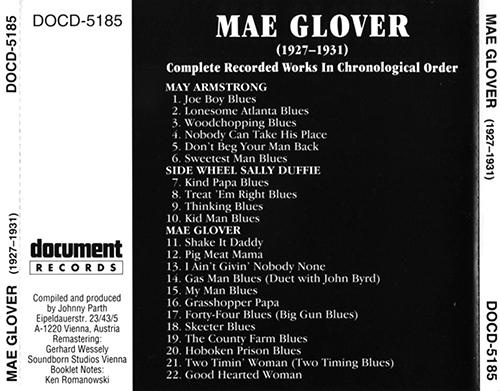
MAE GLOVER – Inc. MAY ARMSTRONG, SIDE WHEEL SALLY DUFFIE — Complete Recorded Works In Chronological Order 1927-1931 | DOCD-5185 (1993) RM | FLAC (tracks+.cue), lossless

Born September 9, 1907 in Columbia, Tennessee, Lillie Mae Glover ran away from home in 1920 when she was only 13 to join the Tom Simpson Traveling Medicine Show. Her father was a preacher and she wanted to sing the blues, so that was that. She worked in several road shows before landing in Memphis, Tennessee in the late '20s, becoming a regular performer on the city's famed Beale Street, where she was known as "the Mother of Beale Street." She recorded and performed under several different names, including Lillian Mae Glover, Mae Glover, and Big Memphis Ma Rainey, the name under which she tracked a few sides for Sun Records in 1953. She died in 1985 at Tishomingo County Hospital in Iuka, Mississippi at the age of 77. Steve Leggett
 
Abridged from this album’s original booklet notes. Mae Glover was probably one of many professional or semi-professional female singers working the tent shows and vaudeville stages in the 1920s. In order to survive, these entertainers had to be versatile, as they might perform for a rural audience one week and a more sophisticated city crowd the next. Like most of these singers, Glover was reliant upon outside musicians for her backing, and the availability of good accompanists was not guaranteed. In John Byrd she found an ideal partner. Byrd was from rural Jefferson County in south Mississippi and was known to have performed on occasion with Tommy Johnson in Jackson, an active musical centre in the state. He reportedly moved from town to town playing for the sawmill workers in that vicinity (Blues Unlimited No. 142, Summer 1982 interviews with Ishmon Bracey and Johnny Temple). Although Dixon and Godrich (Blues & Gospel Records 1902-1943) are reluctant to identify Walter Taylor as Washboard Walter, John Byrd is listed as having recorded with both entities and an association with Taylor’s small string band from Louisville, Kentucky is probable. As “Walter And Byrd” they recorded a tribute to Blind Lemon Jefferson: Wasn’t It Sad About Lemon for Paramount (Document DOCD-5641 ‘Rare Country Blues Vol 2 1929 – 1943’). Byrd’s only issued solo efforts were the intriguing blues ballads Billy Goat Blues and Old Timbrook Blues (DOCD-5641) which suggest he was a songster from the pre- blues generation. When he recorded his duets with Mae Glover in July 1929 Byrd also cut two religious titles for Gennett which were credited to Rev. George Jones And Congregation (DOCD-5641). It is possible that the Sister Jones appearing on this record is Mae Glover, and this speculation coupled with the genuine rapport on their duets is fuel for a theory that their relationship was more than professional. Byrd’s powerful twelve string guitar playing (an uncommon choice of instrument for a Mississippian) and Glover’s strong vocals appear to be overloading the recording microphone, creating a hot signal on the verge of distortion on the duet titles. All four are outstanding, but of particular interest are the blue yodel Pigmeat Mama, which attests to the enormous popularity of country star Jimmie Rodgers among both white and black audiences, and Gas Man Blues, a hilarious battle of the sexes loaded with double-entendre in the vaudeville style popularized on records by Butterbeans and Susie. It is most unfortunate that Glover didn’t have more inspired accompaniment for her session in February 1931. Pianist Charles O’Neil and trumpet player James Parker never rise above mere competence, and Parker’s lacklustre singing on the vocal duet Grasshopper Papa spoils a potentially good number. Glover’s version of “Forty-Four Blues” is, as Paul Oliver points out in Screening The Blues, the first recording of that theme by a woman and is related to the versions by Lee Green. The last verse: “I got the blues, will last me nine months from today” (presumably a reference to pregnancy) supports Oliver’s theory that “Fourty-Four” (at least the Lee Green version) was originally sung by a woman and that Glover’s version is closer to the original form. It’s just a pity that a pianist the calibre of Roosevelt Sykes or Little Brother Montgomery wasn’t present to help Glover out on her version. Whether May Armstrong and Side Wheel Sally Duffie were pseudonyms for May Glover is a question open for discussion. They were both strong vocalists in the raw and rugged Ma Rainey fashion and Duffie had the benefit of solid piano backing from Will Ezell, a Paramount scout and recording artist who had recently supplied sympathetic accompaniment at sessions with Ora Brown, Lucille Bogan, Elzadie Robinson, and Bertha Henderson. Whatever their true identities may have been, Armstrong and Duffie were fine vocalists and this is a welcomed opportunity to hear their impossibly rare discs. DOCD-5185
Tracklist :
1    May Armstrong–    Joe Boy Blues 3:14
Piano [Poss.] – Lonnie Johnson
Violin – Unknown Artist
Vocals – May Armstrong

2    May Armstrong–    Lonesome Atlanta Blues 2:31
Piano [Poss.] – Lonnie Johnson
Violin – Unknown Artist
Vocals – May Armstrong

3    May Armstrong–    Woodchopping Blues 2:39
Guitar [Erroneous] – Unknown Artist
Mandolin – Unknown Artist
Piano [Poss.] – Lonnie Johnson
Vocals – May Armstrong

4    May Armstrong–    Nobody Can Take His Place 2:57
Guitar [Erroneous] – Unknown Artist
Mandolin – Unknown Artist
Piano [Poss.] – Lonnie Johnson
Vocals – May Armstrong

5    May Armstrong–    Don't Beg Your Man Back 3:09
Guitar [Erroneous] – Unknown Artist
Mandolin – Unknown Artist
Piano [Poss.] – Lonnie Johnson
Vocals – May Armstrong

6    May Armstrong–    Sweetest Man Blues 2:33
Piano [Poss.] – Lonnie Johnson
Vocals – May Armstrong

7    Side Wheel Sally Duffie–    Kind Papa Blues 2:35
Piano – Will Ezell
Vocals – Side Wheel Sally Duffie

8    Side Wheel Sally Duffie–    Treat 'Em Right Blues 2:36
Piano – Will Ezell
Vocals – Side Wheel Sally Duffie

9    Side Wheel Sally Duffie–    Thinking Blues 2:48
Piano – Will Ezell
Vocals – Side Wheel Sally Duffie

10    Side Wheel Sally Duffie–    Kid Man Blues 2:42
Piano – Will Ezell
Vocals – Side Wheel Sally Duffie

11    Mae Glover–    Shake It Daddy 2:50
Guitar, Speech – John Byrd
Vocals – Mae Glover

12    Mae Glover–    Pig Meat Mama 2:46
Guitar – John Byrd
Vocals, Yodeling – Mae Glover

13    Mae Glover–    I Ain't Givin' Nobody None 2:45
Guitar, Speech – John Byrd
Vocals – Mae Glover

14    Mae Glover–    Gas Man Blues 2:45
Guitar, Vocals – John Byrd
Vocals – Mae Glover

15    Mae Glover–    My Man Blues 2:58
Piano – Charles O'Neil
Trumpet – James Parker
Vocals – Mae Glover

16    Mae Glover–    Grasshopper Blues 2:38
Piano – Charles O'Neil
Vocals – James Parker, Mae Glover

17    Mae Glover–    Forty-Four Blues (Big Gun Blues) 2:18
Piano – Charles O'Neil
Trumpet – James Parker
Vocals – Mae Glover

18    Mae Glover–    Skeeter Blues 2:48
Piano – Charles O'Neil
Trumpet – James Parker
Vocals – Mae Glover

19    Mae Glover–    The Country Farm Blues 2:38
Piano – Charles O'Neil
Trumpet – James Parker
Vocals – Mae Glover

20    Mae Glover–    Hoboken Prison Blues 2:29
Piano – Charles O'Neil
Trumpet – James Parker
Vocals – Mae Glover

21    Mae Glover–    Two Timin' Woman (Two Timing Blues) 2:46
Piano – Charles O'Neil
Vocals – Mae Glover

22    Mae Glover–    Good Hearted Woman 2:49
Piano – Charles O'Neil
Vocals – Mae Glover

27.10.23

DUKE ELLINGTON AND HIS ORCHESTRA – 1928 | The Classics Chronological Series – 550 (1990) FLAC (tracks+.cue), lossless

During 1928, the main stars of Duke Ellington's orchestra (in addition to the leader/pianist/composer/arranger) were trumpeter Bubber Miley, trombonist Joe Tricky Sam Nanton, clarinetist Barney Bigard, and (starting in June) altoist Johnny Hodges. All of the master takes (including ones for different labels) are being reissued in the Classics series. This disc is highlighted by "Black Beauty" (particularly Ellington's solo piano version), the heated "Hot and Bothered" (featuring guest guitarist Lonnie Johnson and singer Baby Cox), "Louisiana," and "I Can't Give You Anything but Love." Two songs feature singer Ozie Ware backed by a small combo taken from Ellington's big band. This CD has plenty of timeless classics, most of which are also available in other reissue programs. Scott Yanow  Tracklist :

DUKE ELLINGTON AND HIS ORCHESTRA – 1928-1929 | The Classics Chronological Series – 559 (1990) FLAC (tracks+.cue), lossless

 The main change for the Duke Ellington Orchestra during this period was that the increasingly unreliable Bubber Miley (an alcoholic) was fired by Ellington in January 1929 and quickly replaced by Cootie Williams. Otherwise, the personnel was stable, featuring trombonist Joe Tricky Sam Nanton, altoist Johnny Hodges, and clarinetist Barney Bigard as key soloists along with trumpeters Miley, Arthur Whetsol, and Freddie Jenkins. Most of the selections from this era border on the classic, with highlights including Miley's spot on "Bandanna Babies," "I Must Have That Man," "Harlemania," and a two-part version of "Tiger Rag." Scott Yanow    Tracklist + Credits :

16.8.23

EDDIE LANG – 1927-1932 | The Chronogical Classics – 1357 (2004) FLAC (tracks+.cue), lossless

This delightful set collects the earliest sides released by jazz guitarist Eddie Lang under his own name (or as Blind Willie Dunn, but more on that in a moment), which means it doesn't include any of his famous duets with fellow guitarist Lonnie Johnson, since all of those were officially released under Johnson's name. Lang does play with Johnson here on two tracks, though, under the name Blind Willie Dunn as part of the Gin Bottle Four (which also included pianist J.C. Johnson and horn man King Oliver), and his two striking duets with guitarist Carl Kress ("Pickin' My Way" and "Feeling My Way") are also here. One can't help but wonder where Lang might have gone on his instrument as the era of the electric guitar dawned, but his early death leaves nothing but "what if" conjecture on that subject. Lang was a much sought-after session player during his short life, and the sides released under his own name aren't necessarily his most influential, but it's nice to have them all in one set like this. Steve Leggett
Tracklist + Credits :


7.8.23

McKINNEY'S COTTON PICKERS – 1928-1929 | The Chronogical Classics – 609 (1991) FLAC (tracks+.cue), lossless

 This is the first of three Classics CDs featuring all of the master takes by McKinney's Cotton Pickers, one of the finest big bands of the late '20s. The inventive arrangements of leader Don Redman (who also plays alto and clarinet in addition to taking some vocals) are even better than the individual solos. Highlighted by such numbers as "Four or Five Times," "Milenberg Joys," "Cherry," "Don't Be Like That," "There's a Rainbow 'Round My Shoulder," and a surprisingly hard-swinging version of "It's a Precious Little Thing Called Love," the Cotton Pickers feature tight ensembles, spirited vocals, and concise, hot solos. All three of their Classics CD's are well worth picking up. Scott Yanow
Tracklist + Credits :

4.7.23

HELEN HUMES – 1927-1945 | The Classics Chronological Series – 892 (1996) FLAC (tracks+.cue), lossless

When she was just 13 and 14 years old, Helen Humes made her recording debut, cutting ten risque, double entendre-filled blues, naughty tunes that she later claimed to understand at the time. Until the release of this Classics CD in 1996, those numbers (which have backup in various settings by either De Loise Searcy or J.C. Johnson on piano, and Lonnie Johnson or the guitar duo team of Sylvester Weaver and Walter Beasley) had never been reissued on the same set before. Humes sounds fairly mature on the enjoyable blues sides. Her next session as a leader would not take place until 15 years later, when she was 28 and a veteran of Count Basie's Orchestra. The singer is heard here with groups in 1942 and 1944-1945, performing three numbers with altoist Pete Brown's sextet (a band including trumpeter Dizzy Gillespie, who unfortunately does not solo), Leonard Feather's Hiptet (which has some rare solos from trumpeter Bobby Stark), and Bill Doggett's spirited octet. The latter date is highlighted by classic renditions of "He May Be Your Man" and "Be-Baba-Leba." Highly recommended. Scott Yanow
Tracklist + Credits :

31.5.23

JIMMIE NOONE – 1934-1940 | The Classics Chronological Series – 651 (1992) FLAC (tracks+.cue), lossless

On the fifth of Jimmie Noone's five CDs on the Classics label, the New Orleans clarinetist is heard on his final 24 selections as a leader (with the exception of a slightly later live session). The first six numbers close the book on his Apex Club Orchestra, featuring Eddie Pollack (in Joe Poston's old place) playing the melody on alto and sometimes baritone behind Noone's solos; trumpeter Jimmy Cobb and pianist Zinky Cohn get some solo space. Noone is also heard in 1936 with a freewheeling New Orleans group featuring trumpeter Guy Kelly and trombonist Preston Jackson, holding his own the following year with the dynamic young trumpeter Charlie Shavers and altoist Pete Brown, and doing his best in 1940 to overcome the weak cornet playing of Natty Dominique. The final four numbers (also from 1940) are dominated by Ed Thompson's dated vocals. No matter what the setting, Noone (who passed away in 1944) is heard in prime form. Scott Yanow  
Tracklist + Credits :

5.5.23

CLARENCE WILLIAMS – 1930-1931 | The Classics Chronological Series – 832 (1995) FLAC (tracks+.cue), lossless

This CD is the ninth in an extensive series that reissues all of the recordings led by pianist/composer Clarence Williams. Since Williams headed a wide variety of exciting small groups in the 1920s and '30s that utilized the playing of many top jazz players, all of the CDs are worth acquiring by collectors of classic jazz. The 22 selections on this particular CD range from novelty Williams solo performances to groups featuring trumpeters Red Allen and Ed Allen, Albert Socarras on several reeds (including flute), clarinetists Buster Bailey and Cecil Scott, Prince Robinson doubling on clarinet and tenor, pianist Herman Chittison, Ikey Robinson on banjo, the great tuba player Cyrus St. Clair, singer Eva Taylor, Floyd Casey on washboard, the Bingie Madison big band and Williams himself on vocals, piano and jug. Highlights of this spirited program include "You're Bound to Look like a Monkey When You Get Old," "High Society Blues," "Hot Lovin, '" "Baby, Won't You Please Come Home" and four different versions of "Shout Sister Shout." Scott Yanow  
Tracklist :
1    Clarence Williams' Novelty Band–    He Wouldn't Stop Doin It 2:56
Vocals – Clarence Williams
Written-By – Hill, Williams

2    Clarence Williams' Novelty Band–    You're Bound To Look Like A Monkey When You Get Old 3:03
Vocals – Clarence Williams
Written-By – Hill, Williams

3    Clarence Williams–    You Rascal You 3:38
Vocals – Clarence Williams
Written-By – Sam Theard

4    Clarence Williams–    Michigan Water Blues 3:20
Vocals – Clarence Williams
Written-By – Clarence Williams

5    Lazy Levee Loungers–    If I Could Be With You (One Hour Tonight) 3:11
Vocals – Clarence Williams
Written-By – Creamer, Johnson

6    Lazy Levee Loungers–    Shout, Sister, Shout! 2:48
Vocals – Clarence Williams
Written-By – Hill, Williams, Brymn

7    Clarence Williams’ Washboard Band–    Where That Ol' Man River Flows 3:03
Vocals – Eva Taylor
Written By – West / Verges

8    Clarence Williams’ Washboard Band–    Shout, Sister, Shout! 2:59
Vocals – Eva Taylor
Written-By – Hill, Williams, Brymn

9    Clarence Williams And His Jazz Kings–    High Society Blues 3:01
Written-By – Clarence Williams
10    Clarence Williams And His Jazz Kings–    Lazy Levee Loungers 2:45
Written-By – Willard Robison
11    Clarence Williams' Jug Band–    Sitting On Top Of The World 2:59
Written-By – Young, Henderson, Lewis
12    Clarence Williams' Jug Band–    Kansas City Man Blues 2:57
Written-By – Johnson, Williams
13    Clarence Williams And His Orchestra–    Hot Lovin' 2:58
Vocals – Clarence Todd, Clarence Williams, Eva Taylor, Ward Pinkett
Written-By – Charles Warfield
14    Clarence Williams And His Orchestra–    Papa De-Da-Da 3:00
Vocals – Clarence Todd, Clarence Williams, Eva Taylor, Ward Pinkett
Written-By – Todd, Williams, Williams

15    Clarence Williams And His Orchestra–    Baby, Won't You Please Come Home? 2:39
Vocals – Clarence Todd, Clarence Williams, Eva Taylor
Written-By – Warfield, Williams

16    Clarence Williams’ Washboard Band–    Kentucky 2:53
Written-By – Clarence Williams
17    Clarence Williams’ Washboard Band–    Papa De-Da-Da 3:12
Written-By – Todd, Williams, Williams
18    Clarence Williams’ Washboard Band–    Loving 3:00
Written-By – Charles Warfield
19    Clarence Williams And His Orchestra–    Shout, Sister, Shout! 2;43
Vocals – Eva Taylor
Written-By – Hill, Williams, Brymn

20    Clarence Williams And His Jazz Kings–    Shout, Sister, Shout! 2:48
Vocals – Bingie Madison, Clarence Williams, Fred Skerritt, Goldie Lucas
Written-By – Hill, Williams, Brymn

21    Clarence Williams And His Jazz Kings–    Papa De-Da-Da 3:24
Vocals – Bingie Madison, Fred Skerritt, Ward Pinkett
Written-By – Todd, Williams, Williams

22    Clarence Williams And His Jazz Kings–    Baby, Won't You Please Come Home? 2:53
Vocals – Clarence Williams
Written-By – Warfield, Williams

Credits :    
Alto Saxophone – Henry Jones (tracks: 13 to 15, 19 to 22)
Alto Saxophone, Baritone Saxophone – Fred Skerritt (tracks: 13 to 15, 19 to 22)
Banjo – Ikey Robinson (tracks: 1, 2), Leroy Harris (tracks: 5, 6, 9, 10)
Banjo, Guitar – Goldie Lucas (tracks: 13 to 15, 19 to 22)
Brass Bass – Cyrus St. Clair (tracks: 5, 6), Unknown Artist (tracks: 9, 10)
Brass Bass, Bass [String Bass] – Richard Fullbright (tracks: 13 to 15, 19 to 22)
Clarinet – Cecil Scott (tracks: 1, 2)
Clarinet, Alto Saxophone – Buster Bailey (tracks: 16 to 18)
Clarinet, Alto Saxophone, Flute – Albert Socarras (tracks: 5, 6, 9, 10)
Clarinet, Alto Saxophone, Tenor Saxophone – Unknown Artist (tracks: 9 to 12)
Clarinet, Tenor Saxophone – Arville Harris (tracks: 9, 10), Bingie Madison (tracks: 13 to 15, 19 to 22), Prince Robinson (tracks: 5 to 8, 16 to 18)
Cornet – Ed Allen (tracks: 7, 8, 11, 12, 16 to 18)
Drums – Bill Beason (tracks: 13 to 15, 19 to 22)
Guitar – Lonnie Johnson (tracks: 11, 12)
Jug – Clarence Williams (tracks: 1, 2, 11, 12)
Piano – Clarence Williams (tracks: 3 to 10, 16 to 18), Gene Rodgers (tracks: 13 to 15, 19 to 22), Herman Chittison (tracks: 1, 2), Unknown Artist (tracks: 11, 12)
Tenor Saxophone – Unknown Artist (tracks: 9, 10)
Trombone – Jimmy Archey (tracks: 13 to 15, 19 to 22), Unknown Artist (tracks: 5, 6)
Trombone [?] – Charlie Irvis (tracks: 11, 12)
Trumpet – Bill Dillard (tracks: 13 to 15, 19 to 22), Charlie Gaines (tracks: 5, 6), Unknown Artist (tracks: 5, 6), Ward Pinkett (tracks: 13 to 15, 19 to 22)
Trumpet [Or] – Charlie Gaines (tracks: 9, 10), Henry "Red" Allen (tracks: 9, 10), Roy Eldridge (tracks: 9, 10)
Washboard – Floyd Casey (tracks: 7, 8, 16 to 18)

10.9.21

LOUIS ARMSTRONG & HIS HOT FIVE & HOT SEVEN - 1926-1927 {CC, 585} (1991) FLAC (tracks+.cue), lossless

Louis Armstrong's Hot Five was the most influential jazz band of the mid-'20s. The first volume of Armstrong's complete works reissued by Classics followed this group's trail of recordings from November of 1925 through those made almost exactly one year later. Opening this second volume of vintage Armstrong, the Hot Five's last three records of 1926 are peppered with hot vocals intended to entertain and amuse. May Alix shouts the lyrics to "Sunset Cafe Stomp" and Armstrong puts across an interesting tune referencing two downtrodden ethnic groups, Irish and Afro-American. "You Made Me Love You" is not the venerable vaudeville number recorded by Al Jolson in 1913, but a punchy Armstrong original similar to the quaint syncopated love songs he had cooked up with Lil Hardin when they were still working for King Oliver. In May 1927 Armstrong expanded his ensemble for the first time to become the Hot Seven. The addition of Pete Briggs on tuba and Baby Dodds at the drums resulted in a full-bodied sound that made "Willie the Weeper" and "Potato Head Blues" so remarkably and enduringly potent. Armstrong's version of Fats Waller's "Alligator Crawl" is a miracle of perfect timing and immaculate ease. If Lil Hardin Armstrong's references to domestic violence seem a bit reckless during "That's When I'll Come Back to You," listeners should be advised that Afro-American music has always caused consternation by openly referring to topics usually swept under the rug. During the autumn and winter of 1927 Armstrong scaled his band back to five pieces, revisiting Kid Ory's 1922 novelty rag "Ory's Creole Trombone," adding a sixth player in guitarist Lonnie Johnson on "I'm Not Rough," and introducing to the world one of Lil Hardin Armstrong's all-time greatest compositions, "Struttin' with Some Barbecue." by arwulf arwulf
Tracklist :
1     Sunset Cafe Stomp 2:53
Louis Armstrong / Percy Venable
2     You Made Me Love You 2:59
Louis Armstrong / Percy Venable
3     Irish Black Bottom 2:45
Louis Armstrong / Percy Venable
4     Willie the Weeper 3:10
Marty Bloom / Walter Melrose / Grant Rymal
5     Wild Man Blues 3:17
Louis Armstrong / Jelly Roll Morton
6     Chicago Breakdown 3:27
Big Maceo Merriweather / Jelly Roll Morton
7     Alligator Crawl 3:05
Joe Davis / Andy Razaf / Fats Waller
8     Potato Head Blues 2:58
Louis Armstrong
9     Melancholy Blues 3:04
Marty Bloom / Walter Melrose / Elmer Schoebel
10     Weary Blues 3:03
Artie Matthews
11     Twelfth Street Rag 3:12
Euday L. Bowman
12     Keyhole Blues 3:31
Wesley Wilson
13     S.O.L. Blues 2:59
Louis Armstrong
14     Gully Low Blues 3:22
Louis Armstrong
15     That's When I'll Come Back to You 3:00
F. Biggs / Frank Biggs
16     Put 'Em Down Blues 3:12
E. Bennett / E.J. Bennett
17     Ory's Creole Trombone 3:06
Edwin H. Morris / Kid Ory
18     The Last Time 3:27
Bill Ewing / Sara Martin
19     Struttin' with Some Barbecue 3:04
Lil Hardin Armstrong / Louis Armstrong / Lil Hardin / Don Raye
20     Got No Blues 3:22
Lil Hardin Armstrong / Lil Hardin
21     Once in a While 3:14
William Butler
22     I'm Not Rough 2:59
Lil Hardin
23     Hotter Than That 3:01
Lil Hardin Armstrong / Lil Hardin
24     Savoy Blues 3:24
Kid Ory


27.12.19

LONNIE JOHNSON — Complete Recorded Works In Chronological Order ★ Volume 1 • 1925-1926 | DOCD-5063 (1991) RM | FLAC (image+.cue), lossless

Abridged from this album’s original booklet notes. In 1925, Alonzo “Lonnie” Johnson won a talent contest sponsored by Okeh, and acquired a seven year contract with them as a result. Male singers playing guitar were about to make the breakthrough on race records; Blind Lemon Jefferson was beginning to record about the same time as Lonnie. Nevertheless, Johnson seems to have been anxious to show his versatility on these first dates; on this album, he plays violin on more numbers than he does guitar, as well as switching to piano, banjo and harmonium. His contract with Okeh required him to work as a staff musician as well as a name artist, and he may have wanted to impress the company with his range. He also seems to have wished to promote brother James, who was at all Lonnie’s sessions until April 1927, also making some recordings of his own. James, like Lonnie, was a multi-instrumentalist, playing violin, banjo, guitar and piano. “He was better than me,” Lonnie remembered proudly in 1960, and certainly they blended admirably together, whether playing violin and guitar, violin and banjo, two guitars, or even two fiddles, as on Very Lonesome Blues.

As an accomplished professional, Lonnie didn’t limit himself to blues; the irresistible, if enigmatically named Nile Of Genago is a waltz for two guitars, straight from the 19th Century parlour tradition. From the same session, the crazily syncopated Johnson Trio Stomp crosses hillbilly music with silent movie piano. Nevertheless, from the first Lonnie Johnson made his mark as a blues singer, and one with an impeccably poised, elegant guitar style, the melody tripping along over rich chords in support of his clear, bittersweet vocals.

Already a master musician, Lonnie Johnson was also a lyricist of considerable originality, and one with decided views on the complexities of human affairs. Often, he was misogynistic: “To find a good woman, is like finding a dime in a bed of sand… Men, love will make you drink and gamble, and stay out all night long.”

Ah, you don’t see into these blues like me  I can see further into the blues, than a fish can in the deep blue sea

he proclaimed, and his appeal to his audience seems to have derived as much from his ability to analyse his and their concerns, and write coherent responses, delivered with conviction and sincerity, as from his instrumental proficiency. DOCD-5063
Tracklist :
1    Lonnie Johnson–    Mr. Johnson's Blues 2:40
Piano – John Arnold
Vocals, Guitar – Lonnie Johnson

2    Lonnie Johnson–    Falling Rain Blues  3:03
Piano – John Arnold
Vocals, Violin – Lonnie Johnson

3    Lonnie Johnson–    Very Lonesome Blues 2:57
Piano – De Loise Searcy
Violin – James Johnson
Vocals, Violin – Lonnie Johnson

4    Lonnie Johnson–    When I Was Lovin' Changed My Mind Blues 2:58
Piano – De Loise Searcy
Violin – James Johnson
Vocals – Lonnie Johnson

5    Lonnie Johnson–    Sun To Sun Blues 2:30
Piano – James Johnson
Vocals, Guitar – Lonnie Johnson

6    Lonnie Johnson–    Bed Of Sand 2:59
Piano – James Johnson
Vocals, Guitar – Lonnie Johnson

7    Lonnie Johnson–    Lonesome Jail Blues 3:06
Piano – James Johnson
Vocals, Violin – Lonnie Johnson

8    James "Steady Roll" Johnson–    No Good Blues 2:43
Banjo – Lonnie Johnson
Piano – De Loise Searcy
Vocals, Violin – James "Steady Roll" Johnson

9    James "Steady Roll" Johnson–    Newport Blues 2:43
Kazoo – Lonnie Johnson
Piano – De Loise Searcy
Vocals, Banjo – James "Steady Roll" Johnson

10    Lonnie Johnson–    Love Story Blues 2:28
Vocals, Guitar – Lonnie Johnson
11    Lonnie Johnson–    Nile Of Genago 2:40
Guitar – James Johnson, Lonnie Johnson
12    Lonnie Johnson–    Five O'Clock Blues 2:58
Banjo – James Johnson
Piano – De Loise Searcy
Violin, Kazoo – Lonnie Johnson

13    Lonnie Johnson–    Johnson's Trio Stomp 2:58
Piano – James Johnson
Violin – Lonnie Johnson

14    Lonnie Johnson–    Woman Changed My Life 3:10
Piano – James Johnson
Vocals, Violin – Lonnie Johnson

15    Lonnie Johnson–    Lonnie's Got The Blues 3:07
Piano – James Johnson
Vocals, Guitar – Lonnie Johnson

16    Lonnie Johnson–    Good Old Wagon 3:29
Piano – James Johnson
Vocals, Violin – Lonnie Johnson

17    Lonnie Johnson–    A Good Happy Home 3:15
Piano – James Johnson
Vocals, Violin – Lonnie Johnson

18    Lonnie Johnson–    Baby You Don't Know My Mind 3:12
Piano – James Johnson
Vocals, Violin – Lonnie Johnson

19    Lonnie Johnson–    I Have No Sweet Woman Now 3:13
Piano – James Johnson
Vocals, Guitar – Lonnie Johnson

20    Lonnie Johnson–    You Drove A Good Man Away 2:40
Violin – James Johnson
Vocals, Piano – Lonnie Johnson

21    Lonnie Johnson–    Ball And Chain Blues 3:01
Violin – James Johnson
Vocals, Piano – Lonnie Johnson

22    Lonnie Johnson–    You Don't See Into The Blues Like Me 2:41
Violin – James Johnson
Vocals, Piano – Lonnie Johnson

23    Lonnie Johnson–    There's No Use Of Lovin' 3:20
Vocals – Victoria Spivey
Vocals, Piano – Lonnie Johnson

24    Lonnie Johnson–    Baby, Please Tell Me 2:45
Vocals, Piano – Lonnie Johnson
25    Lonnie Johnson–    I'm Gonna Dodge The Blues Just Wait And See 3:14
Violin – James Johnson
Vocals, Harmonium – Lonnie Johnson

LONNIE JOHNSON — Complete Recorded Works In Chronological Order ★ Volume 2 • 1926-1927 | DOCD-5064 (1991) RM | FLAC (image+.cue), lossless

Lonnie Johnson came into his own during the period of time covered by this CD. A brilliant blues-oriented guitarist, Johnson is heard on such instrumentals as "To Do This, You Got to Know How," "I Done Tole You," "Steppin' on the Blues," "Four Hands Are Better Than Two," and "Woke Up With the Blues in My Fingers." He is also heard backing blues singers Helen Humes (who was 13 at the time), Joe Brown, and Raymond Boyd and singing his own variety of low-down blues. Recommended.  Scott Yanow

Abridged from this album’s original booklet notes. Lonnie Johnson closed the eight title session of 13 August 1926 with two blues, one backed by the strange combination of his own harmonium and his brother James’s violin, the other with just his own guitar. This marked the end of the bewildering display of instrument switching to be heard on Volume 1 (DOCD-5063); not for nearly three years was Lonnie to accompany himself on any instrument but guitar. As if to confirm this decision, he dropped into the studio the next day, Saturday, to cut the dazzling guitar solo To Do This, You Got To Know How, based on a lose 12 bar structure, but in practice owing little to the blues. 1927 found the two brothers back in the studio, both playing guitar; I Done Tole You, unissued at the time, hints at the revolutionary series of instrumental duets Lonnie was soon to cut with Eddie Lang. (So, too, had the chromaticisms on Sweet Woman, See For Yourself.) As ever, Johnson’s lyrics were carefully structured, thoughtful essays, often on his favourite subject of the ways of women and men, and sometimes moralising (Treat ‘Em Right) or sentimental (A Broken Heart That Never Smiles). South Bound Water was testimony to his song writing ability, for it was produced even as the 1927 flood was devastating Mississippi. (In May, Johnson recorded a better known song about the flood, Backwater Blues, which had been recorded by Bessie Smith in February and released in March, before the disaster, and which was, not surprisingly, selling well.) As April gave way to May, he accompanied the 13 year old, but very assured, Helen Humes on the first of her many recordings, and backed the amateur-sounding Joe Brown and Raymond Boyd (whom he may have talent-scouted) on what proved to be their only sessions. He was continuing to cut virtuoso instrumentals, too, though Okeh seem to have been reluctant to issue them; nor did they release the ballad I Love You Mary Lou, perhaps dedicated to his wife Mary, whom he had married in 1925. 12-bar blues formed the remainder of Johnson’s recordings in August 1927. Johnson, may have been happy to work in orthodox structures on 11th and 12th August, as a rest from accompanying the wayward Texas Alexander. “He was a very difficult singer to accompany,” Lonnie told Paul Oliver. “He was liable to jump a bar, or five bars, or anything … When you been out there with him, you done nine days work in one!” Irene Higginbotham‘s Mean Old Bed Bug Blues was being hawked around race record producers at this time by publisher Joe Davis; they seem to have liked its witty lyric, for it was cut by Lonnie, Bessie Smith, Furry Lewis, Kitty Waters and Betty Gray between August and October 1927. Roaming Rambler Blues and Stay Out Of Walnut Street Alley are Johnson originals, though, with unmistakably acerbic lyrics. DOCD-5064
Tracklist :
1    Lonnie Johnson–    Oh! Doctor The Blues    2:43
2    Lonnie Johnson–    Sweet Woman, See For Yourself    2:54
3    Lonnie Johnson–    To Do This, You Got To Know How    3:07
4    Lonnie Johnson–    South Bound Water    2:43
5    Lonnie Johnson–    Treat 'Em Right    3:12
6    Lonnie Johnson–    Baby, Will You Please Come Home?    2:45
7    Lonnie Johnson–    I Done Tole You    2:56
8    Lonnie Johnson–    Steppin' On The Blues    2:51
9    Lonnie Johnson–    A Broken Heart That Never Smiles    3:17
10    Helen Humes–    Black Cat Blues    3:08
11    Helen Humes–    A Worried Woman's Blues    2:56
12    Joe Brown–    Superstitious Blues    3:07
13    Joe Brown–    Cotton Patch Blues    3:01
14    Raymond Boyd–    Blackbird Blues    2:38
15    Raymond Boyd–    Unkind Mama    3:01
16    Lonnie Johnson–    Four Hands Are Better Than Two    3:15
17    Lonnie Johnson–    Woke Up With The Blues In My Fingers    3:08
18    Lonnie Johnson–    Back-Water Blues    3:35
19    Lonnie Johnson–    I Love You, Mary Lou    3:03
20    Lonnie Johnson–    Sweet Woman, You Can't Go Wrong    2:49
21    Lonnie Johnson–    Mean Old Bed Bug Blues    2:52
22    Lonnie Johnson–    Lonesome Ghost Blues    3:07
23    Lonnie Johnson–    Fickle Mamma Blues    2:59
24    Lonnie Johnson–    Roaming Rambler Blues    3:02
25    Lonnie Johnson–    Stay Out Of Walnut Street Alley    3:10
Credits :
Guitar – James Johnson (tracks: 4 to 8), Lonnie Johnson (tracks: 2 to 25)
Harmonium – Lonnie Johnson (tracks: 1)
Liner Notes – Chris Smith
Piano – De Loise Searcy (tracks: 12 to 15), John Erby (tracks: 18), Jack Erby (tracks: 9), Lazy Harris (tracks: 16)
Piano [Poss.] – De Loise Searcy (tracks: 10, 11)
Piano [Prob.] – John Erby (tracks: 8)
Speech [Prob.] – Lonnie Johnson (tracks: 8)
Violin – James Johnson (tracks: 1)
Vocals – Helen Humes (tracks: 10, 11), Joe Brown (tracks: 12, 13), Lonnie Johnson (tracks: 1, 2, 4 to 6, 9, 18 to 25), Raymond Boyd (tracks: 14, 15)

LONNIE JOHNSON — Complete Recorded Works In Chronological Order ★ Volume 3 • 1927-1928 | DOCD-5065 (1991) RM | FLAC (tracks+.cue), lossless

Abridged from this album’s original booklet notes. When Lonnie Johnson returned to Okeh’s New York studio in October 1927, he began with an account of the cyclone that had just struck St. Louis, where he had until recently been living. Elzadie Robinson recorded the same song that November, but Lonnie’s version was made a mere four days after the storm, which took 84 lives in five minutes, and caused immense damage. In a very different mood was Bedbug Blues Part 2, a sequel to the popular “Mean Old Bed Bug Blues” that he’d cut in August (see DOCD-5064). October and November found Johnson cutting more of his elegant instrumentals, and Okeh still reluctant to issue them, apparently preferring his imaginative stories in song like Life Saver Blues and Blue Ghost Blues (and, in Bitin’ Fleas Blues, yet another attempt to exploit the craze for blues about parasites). It may have been frustration with Okeh that led Lonnie Johnson to make extra contractual recordings for Gennett in December, with the pianist Jimmy Blythe. He was careful to do deep disguise; the record labels credited him as Bud Wilson or George Jefferson (and Blythe as Duke Owens or Willie Woods), while the company files noted that Wilson / Jefferson was one James O’Brien! The masquerade is transparent, though, as Lonnie spans his range; from blues, both homiletic and narrative, to hot instrumental, to sentimental ballad. Less than a week after the Gennett sessions, Johnson was back on Okeh, guesting with Louis Armstrong’s Hot Five, and furthering his campaign to define the role of the guitar as a soloing instrument in jazz. The same day, he made Sweet Potato Blues, lyrically a foretaste of the hokum duets on which he was shortly to collaborate with Spencer Williams; it’s unfair, perhaps, to compare it with “I’m Not Rough” and “Savoy Blues”. The two part Kansas City Blues, evidently recorded at Okeh’s behest in the wake of Jim Jackson’s success for Vocalion, starts with Lonnie sounding unenthusiastic, but he can be heard to warm to the song’s possibilities as it goes on. Lonnie Johnson adopts a rougher, countrified violin sound on Memphis Stomp, but is his more usual suave self on Violin Blues. More firmly blues orientated than Hayes & Prater were the vocalist “Keghouse” (possibly Gordon Keghouse) and his piano playing partner, Thomas “Jaybird” Jones, who were joined by Lonnie’s guitar (and, on an unissued title, violin). From Memphis, the unit travelled to San Antonio, where Johnson was reunited with Texas Alexander. Before recording 11 superb accompaniments to Alexander, however, he made four glorious guitar solos, very different from his work with Alexander, but equally fine; perhaps in the wake of his guest appearances with the Hot Five, Okeh seem finally to have committed themselves to Lonnie Johnson in this role, issuing all four. DOCD-5065
Tracklist :
1    Lonnie Johnson–    St. Louis Cyclone Blues    3:03
2    Lonnie Johnson–    Bedbug Blues Part 2    3:00
3    Lonnie Johnson–    6/88 Glide    2:58
4    Lonnie Johnson–    Tin Can Alley Blues    2:40
5    Lonnie Johnson–    Bitin' Flea Blues    3:16
6    Lonnie Johnson–    Life Saver Blues    3:04
7    Lonnie Johnson–    Blue Ghost Blues    3:08
8    Lonnie Johnson–    Untitled    2:46
9    Lonnie Johnson–    The St. Louis Train Kept Passing By    2:53
10    Lonnie Johnson–    When A Man Is Treated Like A Dog    2:56
11    Lonnie Johnson–    It's Hot --- Let It Alone    2:42
12    Lonnie Johnson–    Bearcat Blues    2:44
13    Lonnie Johnson–    Why Should I Grieve After You've Gone    2:48
14    Lonnie Johnson–    Low Land Moan    3:11
15    Lonnie Johnson–    Sweet Potato Blues    2:56
16    Lonnie Johnson–    Kansas City Blues -- Part 1    3:13
17    Lonnie Johnson–    Kansas City Blues -- Part 2    3:17
18    Johnson, Hayes, Prater–    Memphis Stomp    2:52
19    Johnson, Hayes & Prater–    Violin Blues    3:24
20    Keghouse–    Keghouse Blues    3:17
21    Keghouse–    Shifting' My Gear Blues    3:11
22    Lonnie Johnson–    Playing With The Strings    2:59
23    Lonnie Johnson–    Stompin' 'Em Along Slow    2:53
24    Lonnie Johnson–    Away Down In The Alley Blues    2:48
25    Lonnie Johnson–    Blues In G    2:48
Credits :
Guitar – Lonnie Johnson (tracks: 1 to 17, 20 to 25), Nap Hayes (tracks: 18, 19)
Liner Notes – Chris Smith
Mandolin – Matthew Prater (tracks: 18, 19)
Piano – Jimmy Blythe (tracks: 10 to 13), Porter Grainger (tracks: 1, 2), "Jaybird"
Piano [Poss.] – John Erby (tracks: 3, 4)
Piano [Prob.] – De Loise Searcy (tracks: 15)
Speech – "Jaybird" (tracks: 20)
Vocals – Keghouse (tracks: 20, 21), Lonnie Johnson (tracks: 1, 2, 4 to 7, 10, 13 to 17, 19), "Jaybird" (tracks: 21)

YANN TIERSEN – 11 5 18 2 5 18 (2022) FLAC (tracks), lossless

Though Yann Tiersen's music is no stranger to electronics, they've never been the focus of his music quite the way they are on 11 5 ...