This solo soprano saxophone album presents Steve Lacy playing material from one of his practice books -- the "S" book, to be exact -- including material spanning the '70s through the '90s. Recorded in Lacy's home, excellent sound and acoustics bring the horn up close. Extremely lyrical, the pieces progress at a steady, unhurried pace. In fact, the whole album flows without much differentiation (with the obvious exception of track nine, on which wife and longtime collaborator Irene Aebi sings): similar mood, similar tempo, and few pauses. But if it seems rather like a medley, or has the feel of a comfortable demonstration, that's because this recording is, essentially, Lacy practicing. Sands, however, can be quite helpful for students or any fan who wants to hear the method behind the skill of this modern master. Joslyn Layne
Tzadik is proud to release a new recording by Steve Lacy, MacArthur Fellow and for 40 years the undisputed master of the soprano saxophone.
Recorded at his home in Paris from February to April 1998, Sands is Steve Lacy's most personal and remarkable solo document, and explores a wide variety of musical and dramatic subjects. Portraits of close friends Barney Wilen and William Burroughs; collaborations with the texts of Allen Ginsberg and Samuel Beckett; and of course his own peculiar take on identity and Jewish heritage, which he characterizes in his most recent composition "Jewgitive." The music of Lacy, like Judaism itself, is a praxis, a question, a floating anxiety, and Sands is one of Lacy's most poignant and intense recordings. Tzadik
Tracklist :
1. Who Needs It? 2:47
2. Gloompot 4:08![]()
3. Jewgitive 4:45
4. Naufrage 7:11
5. The Dumps 4:17
6. Sands (1) Stand 6:47
7. Sands (2) Jump 5:15
8. Sands (3) Fall 5:40
9. Song 7:11
Lyrics By – Allen Ginsberg
Voice – Irene Aebi
10. On Vous Demande 3:46
11. Morning Joy 5:06
Credits :
Artwork [Cover Art] – Mark Rothko
Irene Aebi: Voice
Design – Ikue Mori
Executive-Producer – John Zorn
Soprano Saxophone, Music By, Liner Notes – Steve Lacy
26.1.26
STEVE LACY — Sands (1998) Serie Radical Jewish Culture – 24 | Two Version | APE + FLAC (image+.tracks+.cue), lossless
10.1.26
TERRY RILEY : Autodreamographical Tales (2010) Composer Series | FLAC (tracks+.cue), lossless
Tzadik's Terry Riley: Autodreamographical Tales brings together two
works, recorded 10 years apart: the title work, Autodreamographical
Tales (1996) and The Hook Lecture (2006). On both pieces, Riley plays
everything, making deft, hip use of digital sampling and audio collage
in the first work and playing piano in the second. But what is unusual
about this disc is that Riley also makes extensive use of his own voice,
a surprising change for a performer who was noted for his silence on
that front in concerts, speaking only at the beginning to explain that
"there is nothing recorded on this tape machine that you see. It is used
to create a delay and all of the music you will be hearing I will be
playing live." Riley's Autodreamographical Tales derives from a dream
diary Riley began to interact with musically, carrying the dream's
content into a whirlwind of sampled sound beds and even singing a
little. It takes a minute to get used to Riley's singing, but it has a
lot of variety and interest in tonal color for a fellow who doesn't sing
much; perhaps this shouldn't be too surprising given Riley's strong
connection to legendary Indian vocalist Pandit Pran Nath, his settings
of poetry by Michael McClure, and his Uncle Jard, where the saxophone
quartet is also required to sing a little bit. However, it is the
speaking that communicates the most; the topics of his texts are very
personal and his delivery quite personable, informal, and
unselfconscious. Riley dreams about things you might expect him to dream
about: milliseconds of delay time, concerts, the charisma of a
conductor, musical intervals become like characters in the story. The
Hook Lecture uses the commentary to link together several piano pieces
that are alternately in the style of Bill Evans or more Riley's own
minimalistic style; the suite concludes with an account of Evans' We
Will Meet Again. This is the most generous example of Riley's piano
playing that we've had since New Albion's 1995 release Lisbon Concert,
and in his electronic keyboard playing it's the nature of the beast that
we can't really hear Riley's keyboard chops; here, Riley not only shows
that he still has them, but also gives voice to his personal connection
to Evans, who likewise influenced the British minimalists.
Tzadik's
Terry Riley: Autodreamographical Tales is a thoroughly entertaining and
revelatory journey taken with one of American music's great
visionaries. Moreover, this is one album of contemporary music that
might be of appeal to the kids; both Riley's narration and music have
the quality of the kindly, amusing uncle who's amazingly talented and
knowledgeable, and children might find themselves captivated by it even
if they don't understand everything he says. Uncle Dave Lewis
Autodreamographical Tales (26:38)
1. Dwarf 2:20
2. Long Bus Ride 1:41
4. The Miracle 1:51
5. Zuchinni 3:02
6. Black Woman 3:50
7. The Faquir 7:09
8. The War On The Poor 4:25
The Hook Lecture (49:24)
9. The Hook 1 1:42
10. The Royal 88 8:32
11. A Dervesh In The Nursery 13:50
12. The Hook 2 1:32
13. The Ecstacy 4:33
14. Turning 4:13
15. The Hook 3 1:49
16. Ebony Horns 9:43
17. We Will Meet Again 3:31
Credits :
Artwork [Drawings] – Terry Riley
Composed By – Bill Evans (tracks: 17), Terry Riley (tracks: 1 to 16)
Design – Heung-Heung Chin
Instruments [All], Voice – Terry Riley (tracks: 1 to 8)
Piano, Voice – Terry Riley (tracks: 9 to 17)
Producer, Recorded By – Terry Riley
19.11.25
MORTON FELDMAN : Patterns In A Chromatic Field (Charles Curtis · Aleck Karis) (1996) Composer Series | FLAC (tracks+.cue), lossless
Composed
in 1981, the year Feldman wrote the vast Triadic Memories for solo
piano, Patterns in a Chromatic Field shares that work's expansiveness
and some of its subdued coloration, but goes beyond it in terms of
rhythmic activity and variety of combinations. Feldman's small,
interlocking gestures -- inspired by designs in Asian carpets -- are
spun out through a convoluted process of repetition, layering, and
alternation with contrasting sonorities and shapes, and these juxtaposed
figures cycle over 80 minutes to mesmerizing effect. This 2004 release
features cellist Charles Curtis and pianist Aleck Karis, who follow the
score as precisely as possible (in light of Feldman's puzzling
microtonal notation), and they sustain the work's air of mystery with
expectant, hushed playing. Instead of conventional liner notes, the
booklet provides insightful quotations from Feldman on his work and the
sources of his inspiration, a valuable aid because his explanations of
his concepts are pertinent and revealing. Tzadik's sound is fine, but a
little close to the musicians, so this CD should be played at a moderate
volume for best enjoyment Blair Sanderson MORTON FELDMAN (1926-1987)
1. Patterns In A Chromatic Field (1981) 1:20:44
Cello – Charles Curtis
Piano – Aleck Karis
21.10.25
MARTY EHRLICH'S DARK WOODS ENSEMBLE — Sojourn (2000) Serie Radical Jewish Culture – 36 | FLAC (tracks), lossless
One of the most respected and versatile reed players in New Music, Marty has been an integral member in the units of Julius Hemphill, Oliver Lake, Anthony Braxton and Bobby Bradford, among others. He has released many critically-acclaimed CDs on a variety of labels, but none more touching or personal as Sojourn, his contribution to Tzadik’s series of Radical Jewish Culture. Exploring the roots of his own Jewish heritage, Marty take us on a new path with his intimate Dark Woods ensemble, touching upon Coltrane and Klezmer on his journey. Sojourn is a very special release by one of today’s most accomplished composer/performers. A musician’s musician, his compositions are contrapuntally more complex and have a delightful folklike simplicity. Tzadik
Tracklist :
1. The Open Return 8:02
Composed By – Marty Ehrlich
2. Eliahu: 2nd Variation 6:52

Composed By – Marty Ehrlich
3. Blind Willie McTell 5:31
Composed By – Bob Dylan
4. The Git Go 4:17
Composed By – Marty Ehrlich
5. The Secret Of Light 7:31
Composed By – Marty Ehrlich
6. Hillel's Riddle 5:31
Composed By – Marty Ehrlich
7. Sojourn 5:17
Composed By – Marty Ehrlich
8. The Modzitzer Nigun 3:36
– Traditional
Arranged By [Arr. By] – Marty Ehrlich
Credits :
Bass [Marty Ehrlich's Dark Woods Ensemble] – Mark Helias
Cello [Marty Ehrlich's Dark Woods Ensemble] – Erik Friedlander
Clarinet, Soprano Saxophone [Marty Ehrlich's Dark Woods Ensemble] – Marty Ehrlich
Design – Ikue Mori
Ensemble – Marty Ehrlich's Dark Woods Ensemble
Executive-Producer – John Zorn
Guest [Special Guest], Guitar – Marc Ribot
20.10.25
MARTY EHRLICH — Fables (2010) Serie Radical Jewish Culture – 155 | Two Version | FLAC (image+.tracks+.cue), lossless
Marty Ehrlich is one of jazz's most acclaimed contemporary multi-instrumentalists. Hankus Netsky is a renown Jewish klezmer and scholar, and founder of the Klezmer Conservatory Band. Friends for decades, these two master musicians join forces for the first time in a fabulous program of original music that meets in the nexus of Jazz and the Jewish tradition. Exciting, touching and soulful, Fables is a real tour de force. One of jazz's greatest voices on the saxophone and one of the world's greatest experts on Jewish Music in a unique and exciting duo project! Tzadik
Tracklist :
1. Scroll No. 1 5:15
2. The Thimble And The Thread 3:24
Tuba – Marcus Rojas
3. Es Felt 6:13
Bass Guitar [Acoustic] – Jerome Harris
4. Wednesday's Waltz 4:06
5. Rozo D'Shabbos 5:25
6. Scroll No. 2 4:30
7. The Mirror Waltz 3:32
8. The Lion's Tanz 3:36
Tuba – Marcus Rojas
9. I'm Growing Into My Hat 3:35
10. Scroll No. 3 5:22
Tuba – Marcus Rojas
Credits :
Clarinet, Bass Clarinet, Flute, Alto Saxophone, Soprano Saxophone – Marty Ehrlich
Piano, Accordion – Hankus Netsky
23.7.25
DAVID SHEA — Hsi-Yu Chi (2000) Composer Series | FLAC (tracks+.cue), lossless
A sprawling, defyingly integrated work fashioned from bits of Chinese,
country & western, pop, jazz, rock, and even Celtic musics. Shea's
reliance on the sampler is less pronounced here, instead scoring dense,
acutely musical numbers ably executed by John Zorn, Marc Ribot, Jim
Pugliese, Zeena Parkins, Kato Hideki, and others. Based on a massive
16th-century allegorical text chronicling the journey of the Taoist
priest Hsuan-Tsang from India to China. Sean Cooper
Tracklist :
1 Temple / Sai Teen / Tai Tsung / Chang'an / Sun Wu Kung 9:06
2 Three Elements 3:20
3 Five Fingers 4:32
4 Fists Of Fury / Canton Opera Blues / Enter The Dragon / The Underworld 8:19
5 The Woodcutter And The Fisherman 4:09
6 Silk Road / Black Wind Cave / The Weapons 6:38
7 Mara / Five Villages West / Two Sisters Wedding 5:46
8 Two Elements 1:45
9 Rouge 1:58
10 Orchid Tree 4:13
11 Holy Mountain / Jetvana / Pure Land 5:41
Credits :
Alto Saxophone – John Zorn
Bass – Kato Hideki
Drums, Percussion – Jim Pugliese, Sim Cain
Guitar, Banjo – Marc Ribot
Harmonica, Whistle, Percussion – Alex Tobias
Harp, Piano, Accordion – Zeena Parkins
Pipa – Wu Man
Producer, Composed By, Sampler, Piano, Turntables – David Shea
Vocalese – Rebecca Wilson 
13.3.25
SUSIE IBARRA — Flower After Flower (2000) FLAC (tracks), lossless
Flower After Flower will be somewhat of a surprise if you've only heard Susie Ibarra's storming drumming with the David S. Ware and Matthew Shipp groups. This album, her first heading a larger group, is closer to the more delicate and spacious music of Ibarra's releases (such as Radiance) on her own Hopscotch label. Flower After Flower works best when listened to as a whole since the four short fractals (all solos) act as interludes between the four longer compositions.
The album sets a steady, somewhat restrained mood with the opening cut, "Illuminations," a septet piece including the other two members of her trio, pianist Cooper-Moore (who also plays flute) and violinist Charles Burnham, as well as bassist John Lindberg, the two clarinetists featured in the title track (see below), and trumpeter Wadada Leo Smith, to whom this composition is dedicated. The first solo interlude then follows, "Fractal 1," a multi-colored drum solo from Ibarra that focuses individually on cymbals, skins, sticks, and their combinations. This leads into "The Ancients," a piece that opens with a slow interaction between clarinetist Chris Speed and bass clarinetist Assif Tsahar. Soon the duo are joined by the brighter sounds of the kulintang (a multi-gong instrument of the Philippines) played by Ibarra and, eventually, the rest of the musicians (except for Pauline Oliveros) join in for a lovely piece of music that has a meditative motion, seemingly without beginning or end.
The title track is framed by two moving solos from Oliveros (on accordion) and Cooper-Moore (on piano), respectively, and opens with a playful, upbeat mood -- Burnham occasionally plucking his violin for a bent-banjo sound and Ibarra galloping along with her brushes -- contrasted sharply with a sparse setting of held-note and small sounds. In all, this first session for the Tzadik label from drummer and leader Susie Ibarra leaves the listener with impressions of patience, clarity, and quietude. Joslyn Layne
Tracklist :
1 Illumination 13:31
2 Fractal 1 2:14
3 The Ancients 9:20
Flute – Cooper-Moore
Gong [Kulintang] – Susie Ibarra
Percussion [Brushes] – Wadada Leo Smith
4 Fractal 2 3:19
Accordion – Pauline Oliveros
5 Flower After Flower 9:48
6 Fractal 3 4:22
7 Human Beginnings 12:07
Accordion – Pauline Oliveros
8 Fractal 4 2:40
Credits :
Bass – John Lindberg (tracks: 1, 3, 5, 7)
Bass Clarinet – Assif Tsahar (tracks: 1, 3, 5, 7)
Clarinet – Chris Speed (tracks: 1, 3, 5, 7)
Drums, Percussion – Susie Ibarra (tracks: 1, 2, 5, 7, 8)
Executive-Producer – John Zorn
Percussion – Cooper-Moore (tracks: 6, 7)
Piano – Cooper-Moore (tracks: 1)
Producer, Composed By – Susie Ibarra
Recorded By – Jim Anderson
Trumpet – Wadada Leo Smith (tracks: 1, 7)
Violin – Charles Burnham (tracks: 1, 3, 5, 7)
27.9.24
SATOKO FUJII 藤井郷子 — Kitsune-bi (1999) Serie New Japan | FLAC (tracks+.cue), lossless
Pianist Satoko Fujii leads a beautiful date featuring solo pieces, duets with soprano saxophonist Sachi Hayasaka, and trio numbers with eminent bassist Mark Dresser and ingenious percussionist Jim Black. Kitsune-Bi sounds great the first time through, and becomes more wildly impressive with each listen, revealing multi-layered depths. The pieces are all originals (except Jimmy Giuffre's "Moonlight"). The album opens with "Hizumi," a trio tune that begins with the musicians feeling each other out. They gel within the first minute, and Dresser soon starts performing double duty, moving around rhythmically with Black while simultaneously interacting with Fujii. The clincher is Dresser's ability to mimic all the sounds of the piano theme; it's mind-boggling that he can create these sounds with a bass. "Sound of Stone" is a solo piano piece that Fujii opens by musically chalking out the boundaries. A dark chord signals the end of the sketching, and she proceeds to fill the piece with dramatic runs and stalls, momentous build-up and thinning-out contrasts, and clusters that move up the scale followed by single notes that tinkle back down. This excellent melodic piece showcases her ability without turning into a show of empty virtuosity. "Zauzy" is a duet between piano and soprano saxophone; Fujii and Hayasaka play foil to each other, giving the impression of notes flying from a large, spinning music wheel. About 18 minutes into the trio piece "Past of Life," the group recalls the groove and interaction of Tim Berne's Bloodcount. Altogether, Kitsune-Bi is a stunning album filled with amazing interplay and stellar compositions. The astonishing skill and distinctive style on display here is somewhat surprising, considering that this is only Satoko Fujii's second U.S. release. Kitsune-Bi is an achievement of constantly flowing brilliance and creativity. Joslyn Layne
Tracklist :
1 Hizumi 6:26
Composed By – Satoko Fujii
2 Sound Of Stone 4:56
Composed By – Satoko Fujii
3 Zauzy 2:08
Composed By – Satoko Fujii
4 Past Of Life 6:34
Composed By – Satoko Fujii
5 Bal-lad 3:02 |
Composed By – Satoko Fujii
6 Drops 7:09
Composed By – Satoko Fujii
7a Moonlight 9:00
Composed By – Jimmy Giuffre
7b Sola
Composed By – Satoko Fujii
8 Kitsune-bi 8:10
Composed By – Satoko Fujii
9 This Is The Thing That I Have Forgotten 4:32
Composed By – Satoko Fujii
Credits :
Design – Ikue Mori
Double Bass – Mark Dresser
Drums – Jim Black
Executive-Producer – John Zorn
Painting [Cover] – Ichiji Tamura
Piano – Satoko Fujii
Soprano Saxophone [Soprano Sax] – Sachi Hayasaka (tracks: 3, 5, 8)
21.9.24
MARC RIBOT — Exercises in Futility (2008) Composer Series | Two Version | APE + FLAC (image+.tracks+.cue), lossless
Heretical new music for solo guitar composed and performed by the radical maverick Marc Ribot, who has worked with everyone from Elvis Costello, Maryanne Faithful and Tom Waits to Bill Frisell and Sun Ra. Conceived as impossible etudes and exercises on a variety of finger busting guitar techniques, this astonishing suite will forever change your concept of what the guitar is capable (or not capable) of. Also included are a variety of compositions for solo guitar, making this the definitive collection of Ribot’s expressive and virtuosic solo music. Twisted, mangled and tortured, this instrumental tour-de-force is musical sacrilege at its best. TZADIK
Tracklist :
1 Etude #1 Five Gestures 5:42
3 Etude #3 Elvis 4:01
4 Etude #4 Bombasto 2:52
5 Etude #5 Lame 3:46
6 Etude #6 Cowboy 1:43
7 Etude #7 Ballad 2:50
8 Etude #8 Groove? 3:11
9 Etude #9 Morton 2 3:19
10 Etude #10 Min 1:22
11 Etude #11 Ascending 2:02
12 Etude # 12 Mirror 4:20
13 Etude #13 Wank 4:19
14 Etude #14 Event On The 10th Avenue 1:16
15 The Joy Of Repetition 9:49
Credits :
Guitar, Composed By, Producer, Edited By – Marc Ribot
20.9.24
JOHN ZORN | BILL LASWELL — The Cleansing (2022) Spectrum Series – 37 | FLAC (tracks+.cue), lossless
Zorn and Laswell have been friends and musical compatriots since they first met in 1978, and have been responsible for some of the most intense and memorable music in the late 20th and early 21st centuries. Recorded in early 2021, near the end of the year’s pandemic lockdown, it marks the first time Zorn had touched the saxophone in over fifteen months. Laswell had spent most of the year locked in his apartment. Something
special was happening that day—and after the session Laswell felt rejuvenated—as if all the toxins and poisons had left his body. Soulful and essential, "The Cleansing" is an historic meeting—and the first recorded duo project by these two Downtown magicians. TZADIK
Tracklist :
1 Brion Gysin 10:04
2 Aleister Crowley 6:52
3 Austin Osman Spare 6:47
4 William Burroughs 10:19
5 Alejandro Jodorowsky 8:56
6 The Cleansing 3:41
Credits :
Alto Saxophone, Producer, Liner Notes – John Zorn
Bass – Bill Laswell
16.9.24
TENKO | IKUE MORI — Death Praxis : Mystery (1998) Serie New Japan | FLAC (image+.cue), lossless
For over twenty years, Ikue Mori and Tenko have been on the forefront of new music, both in the U.S. and in Japan. These mavericks are veterans of countless classic bands from DNA to Dragon Blue, and have collaborated with just about every musician in the new music underground; Kim Gordon, Arto Lindsay, Bill Laswell, Derek Bailey, the Boredoms, Haino Keiji and Fred Frith to name just a few.
Their newest collaboration is a tribute to the world’s greatest writers of suspense stories. Mystery brings these two masters of musical suspense together with many special guests to create a new collection of sound compositions for voice and modern ensembles.
Also included as bonus tracks: their first duo recording from 1990, Death Praxis, unavailable for years. TZADIK
Tracklist :
1 Monkey Puzzle 3:45
2 Demon In My View 3:19
3 The Cat Who Wasn't There 2:03
5 Devices And Desires 3:34
6 Scold's Bridle 2:37
7 Payment In Blood 2:36
8 Deer Leap 3:04
9 I Is For Innocent 4:33
10 Blood Shot 1:45
11 Elegy For Soprano 2:54
12 Bum Steer 6:21
Death Praxis (Bonus Tracks)
13 Magic 3:14
14 Bad Seed 2:34
15 Metal Dream 2:24
16 Economic Noise 2:54
17 Fortune Cookie 0:34
18 Rain 4:05
19 Glow Worm 7:10
20 Lullaby 2:25
21 When The Sun Shines I Can See Your Mind 2:11
22 I Know You 4:29
Credits :
Cello – Erik Friedlander
Executive-Producer – John Zorn
Organ – Anthony Coleman
Producer, Recorded By, Music By – Death Praxis
Sampler, Drum Machine [Drummachines], Design – Ikue Mori
Violin – Eyvind Kang
Vocals – Tenko
29.2.24
JOHN ZORN — 444 (2023) Archival Series | FLAC (tracks+.cue), lossless
In 2020 Brian Marsella joined the heavy metal organ trio “Simulacrum” to spawn the astonishing fusion quartet “Chaos Magick”. This fourth CD in their ever-expanding legacy is a magical collection of instrumental music at its finest. Tighter and wilder than ever, Medeski, Hollenberg, Grohowski, and Marsella perform with a remarkable rapport in this provocative new direction from Downtown alchemist John Zorn, who has been exploring new musical worlds and confounding expectations since the 1970s!
"444 is among the best things I’ve ever done." —John Zorn tzadik
Tracklist :
1 Splendour Solis 4:26
2 Retort 7:36
3 In Sulphur And In Flame 3:00
4 Astral Projection 7:31
5 Civil Disobedience 3:29
6 With Blood I Summon Thee 5:49
7 Salt And Mercury 5:38
8 Tayy Al-Ard 9:12
Personnel :
Brian Marsella: Electric Piano
John Medeski: Organ
Kenny Grohowski: Drums, Percussion
Matt Hollenberg: Electric Guitar
6.2.23
EVAN PARKER - Time Lapse (2006) FLAC (tracks+.cue), lossless
Evan Parker sounds like no one else. He has developed a singular approach to playing and improvisation on the soprano saxophone that still has people scratching their heads wondering, "How does he do that?" His solo style often sounds like there's more than one player, and on Time Lapse he takes that style a step further by overdubbing himself on about half the pieces. This isn't the first time he has taken this approach (Process and Reality dates to the early '90s) and these pieces were recorded between 1999 and 2001. Parker composes through improvisation, and the overdubbed pieces are fascinating in the way he assembles the pieces, adding a part here or elaborating on a figure there. Of course, his solo playing is equally fascinating, and although he says in the liner notes that the overdubbed pieces alternate with the solo pieces, there are times when the listener would be hard-pressed to differentiate between the two. Time Lapse doesn't really offer anything new to the Parker book, but it's an excellent recording that provides stellar examples of his solo playing as well as showcasing his relatively rare work overdubbing himself. It's a captivating listen by one of improvised music's giants. Sean Westergaard
Tracklist :
1 Ak-Kok-Deer 4:30
2 Monkey's Fist 6:46
3 Threnody For Steve Lacy 2:43
4 Gees Bend 3:50
5 Those Doggone Dogon 6:37
6 Time Lapse 3:25
7 Pulse And The Circulation Of The Blood 3:29
8 Organ Point 4:10
9 The Burden Of Time 3:37
10 Alone On A Long Hard Road 10:24
11 Chorus After Alaric 1 Or 2 For Gavin Bryars 4:11
Credits :
Artwork [Sculpture] – Roger Ackling
Executive-Producer – John Zorn
Saxophone, Organ, Producer, Liner Notes, Written-By – Evan Parker
5.2.23
EVAN PARKER — House Full Of Floors (2009) Key Series | FLAC (tracks), lossless
On an inside panel of the booklet for House Full of Floors, Evan Parker’s second release for John Zorn’s Tzadik imprint (and his third album of 2009), he writes simply of the session as if framing a poem: “The plan was to / record the trio. / Aleks Kolkowski / came to make some / wax cylinder recordings / and he stayed / to play some / quartet pieces.” The truth of the matter is, this is hardly disingenuous. The recording actually sounds exactly like its description. Parker, guitarist John Russell, and bassist John Edwards are featured on the majority of this beautiful set in a series of trios and duets that are knotty, subtle, and deeply intuitive improvisational pieces. Kolkowski joins them on a Stroh viola, the saw, and wax cylinder recorder on two tracks as well. Parker’s signature as an improviser is immediate. Whether it’s a series of single-note lines and phrases or tonal clusters rushing out of his tenor or soprano, the control is total. A prime example is “Ca-la-ba-son,” an 11-minute trio piece where we first hear Russell’s acoustic guitar before some breathy elongated tones on Parker’s tenor. Edwards is hammering ever so lightly on the strings of his bass as an empathic rhythmic force. Parker’s sense of “melody” quickly asserts itself and Russell is then coloring the spaces between. It’s a very fast shift, but one that is so precise and intuitive that it could have been scripted. Of course, exchanges happen here, and Parker doesn’t need to control the language of his partners. Players take turns bleeding out the edge with unique techniques in order to follow the sound in the very moment it’s being created.
The soundscapes created by Kolkowski on “Figure Dancing” and “Aka AK” are seamlessly integrated. The informal approach of the viola creating new textures for Parker’s tonal investigations is unique, haunting, and beautiful on the former track -- with some gorgeous, almost lyrical colors and shapes emanating from the quartet -- and cartoony (thanks to the saw, no doubt) and dizzying on the latter one. The title piece, near the end of the album, is also its longest. The most halting of phrases comes from Parker and Russell simultaneously and is underlined haltingly by Edwards at first. The sparse manner of stepping onto new ground quickly and deftly becomes a firm way forward. The stutter, stop, and start movements of the sax and guitar in the middle are accompanied by a droning note by Edwards, who follows it in a “solo” cluster of chords patch, ever so briefly, before the entire group comes together as before, though they're more assertive and ever more labyrinthine as they go in. The album’s final track, "Wind Up," is a spooky, lovely thing. Because of the wax cylinder overdub backing the trio, there are infinitely greater series of tonal possibilities, but these three don’t need them; they work their way into the wax recording, finding an entirely different direction on the way there than the one they previously recorded. There are so many records by Parker at this point that it can feel anticlimactic when a new one appears. But that shouldn’t be, simply because he records when he is looking for something or, as in the case here, simply to record to see what happens. And here, just as is evidenced by the vast majority of his albums, plenty does.
-> This comment is posted on Allmusic by Thom Jurek, follower of our blog 'O Púbis da Rosa' <-
Tracklist :
1 Three Of A Kind 5:52
2 Donne's Banjo 4:45
3 Ca-la-ba-son 11:05
4 Figure Dancing 6:14
5 Aka AK 3:09
6 Kabala-sum-sum-sum 12:34
7 Shown Jot 4:58
8 House Full Of Floors 13:00
9 Wind Up 2:19
Credits :
Bass – John Edwards (pistas: 1, 3 to 8)
Guitar – John Russell (pistas: 1 to 8)
Tenor Saxophone, Soprano Saxophone, Producer – Evan Parker
Viola [Stroh Viola], Saw, Instruments [Wax Cylinder Recorder] – Aleks Kolkowski (pistas: 4, 5)
4.2.23
MARK NAUSEEF · IKUE MORI · EVAN PARKER · BILL LASWELL — Near Nadir (2011) Key Series | FLAC (tracks+.cue), lossless
Tracklist :
1. Majuu 3:33
Bill Laswell / Ikue Mori / Mark Nauseef / Evan Parker
2. Valhalla 4:22
Bill Laswell / Ikue Mori / Mark Nauseef / Evan Parker
3. In Gold Mesh 4:01
Bill Laswell / Ikue Mori / Mark Nauseef / Evan Parker
4. Orbs 2:14
Bill Laswell / Ikue Mori / Mark Nauseef / Evan Parker
5. Nooks 3:06
Bill Laswell / Ikue Mori / Mark Nauseef / Evan Parker
6. Funnel Drone 2:23
Bill Laswell / Ikue Mori / Mark Nauseef / Evan Parker
7. Yuga Warp 6:42
Bill Laswell / Ikue Mori / Mark Nauseef / Evan Parker
8. Near Nadir 5:35
Bill Laswell / Ikue Mori / Mark Nauseef / Evan Parker
9. Ternary Rite + 4:34
Bill Laswell / Ikue Mori / Mark Nauseef / Evan Parker
10. Flo Vi Ru Dub 8:54
Bill Laswell / Ikue Mori / Mark Nauseef / Evan Parker
Credits :
Bass [Basses] – Bill Laswell
Electronics – Ikue Mori
Percussion [Bent Metal], Bells [Meditation Bells], Drums [Chinese Drums], Wood Block [Woodblocks], Tom Tom [Tom-tom] – Mark Nauseef
Soprano Saxophone – Evan Parker
29.12.22
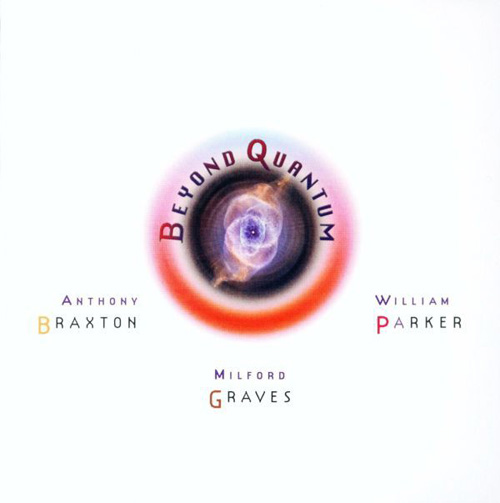
ANTHONY BRAXTON | MILFORD GRAVES | WILLIAM PARKER - Beyond Quantum (2008) FLAC (tracks+.cue), lossless
If ever a recording needed to be trumpeted from the rooftops, it's this one, and perhaps we all owe a debt of gratitude to John Zorn for making it happen. This initial trio meeting of saxophonist Anthony Braxton, drummer Milford Graves, and ubiquitous bassist William Parker is a vanguard jazz fan's dream come true. Beyond Quantum places these three modern legends in a completely improvised setting in producer Bill Laswell's studio for 63 minutes of pure inspirational, communicative fire. First is the fact that Graves performs seldom and records even less. Secondly, he's never appeared with either of these men before.
The five selections on Beyond Quantum are all "meetings," ordered one through five, showcasing the three individuals as part of one dynamic, dramatic, and profoundly inventive unit that moves inside and outside the constraints of modal, melodic, and harmonic improvisation with a seemingly effortless groove. So much so in fact, that even fans of straighter, more structured jazz composition and improvisation will almost willingly accept this as proof that not only is free jazz not "dead," but this entry into its historical annals may offer some proof of it entering a new phase of creativity. Braxton plays alto, sopranino, bass, and concert bass saxophones, one at a time -- though he often employs more than a single horn in a selection. His playing is far from the more sparse theoretical articulations, and moves effortlessly between his more aggressive tonal investigations and spiritually (even cosmically) inspired expression. Check his wild bass clusters on "Second Meeting," his snake charming sopranino on "Third Meeting," and the nearly boppish blues sopranino streams on "Fourth Meeting." Parker uses all of his tricks here. Whether it's creating riff-like phrases or single high note pulses on his contrabass as he does on "First Meeting," the Eastern scalar repetitions as he does in the middle of "Second Meeting," the beautiful high chord repetitions near the end of "Third Meeting," or his amazing arco work in dialogue with Braxton on "Fourth Meeting," he is always the pinnacle of energy and focus, always supporting, always insisting on "further." Graves is just something else to behold here. He is a drummer who never pauses, each idea comes fluidly either from the one immediately preceding, or the one being articulated in the moment. He uses his sticks to be sure, but also brushes, his hands, and on "Second Meeting" in particular -- though in other places as well -- his voice as both a lyric(less) and percussive device. (Think of Leon Thomas with Pharoah Sanders, or better yet, Sanders and John Coltrane on Live in Seattle and you get the idea.) Graves is never overwhelming in his stream of "motion" ideas; he is a layered drummer, working cymbals and snares or toms with an instinctive -- by this point inspired -- lyricism inside one another in open-ended loops.
An added treat on this set is in the final or "Fifth Meeting," when Parker joins Braxton (on sopranino) on a double reed instrument. Both men begin speaking streams of lyric and chant-like ideas, accenting the spiritual fire between them. Graves moves into them both on his deep-toned tom toms as the horn phrases become a call and response dialogue. Though it's over an hour, Beyond Quantum is over all too quickly. It never once feels like an endurance test, and the flood of creativity, passion, and direct communication between participants leaves the listener not breathless, but astonished. This is a serious contender for vanguard jazz recording of 2008.
-> This comment is posted on Allmusic by Thom Jurek, follower of our blog 'O Púbis da Rosa' <-
Tracklist :
1 First Meeting 14:49
2 Second Meeting 10:48
3 Third Meeting 16:34
4 Fourth Meeting 16:08
5 Fifth Meeting 5:11
Credits :
Bass – William Parker
Percussion – Milford Graves
Producer – Bill Laswell, John Zorn
Saxophone – Anthony Braxton
1.7.22
JOHN ZORN — Astaroth : Book Of Angels Volume 1 (Jamie Saft Trio Plays Masada Book Two) (2005) Archival Series | Two Version | FLAC (image+.tracks+.cue), lossless
Coleman) on bass and Ben Perowsky (Uri Caine, John Scofield) on drums. Playing with the fire and passion one has come to expect from the Masada family, this soulful and imaginative trio sets new standards for versatility and excellence in the piano trio format. This group is pure magic and they have created one of the most exciting and enjoyable CDs in the Tzadik catalog. Absolutely breathtaking. TZADIK Tracklist :
1 Shalmiel 5:26

2 Ygal 3:09
3 Astaroth 6:10
4 Ezeqeel 4:21
5 Ariel 6:28
6 Sturiel 5:05
7 Baal-Peor 7:10
8 Pursan 2:22
9 Lelahel 9:02
10 Beleth 5:59
Credits :
Piano – Jamie Saft
Bass – Greg Cohen
Drums – Ben Perowsky
Composed, Producer – John Zorn
Illustration – Jarrault
JOHN ZORN — Azazel : Book of Angels, Vol. 2 (Masada String Trio Plays Masada Book Two) (2005) Archival Series | Two Version | FLAC (image+.tracks+.cue), lossless
The first new studio recording in almost ten years by one of the most exhilarating ensembles in the ever growing Masada family. Together since 1994, their breathtaking virtuosity, extraordinary passion and telepathic interplay has increased over the years and now their performances set a new standard for excitement, concentration and commitment. Performing thirteen new compositions from Zorn’s legendary Book of Angels, these three brilliant musicians, under the “baton” of the
composer himself present a varied program of delicate lyricism, poignant ballads and driving blasts of energy. New music for the new millennium drawing upon classical, jazz and gypsy folk traditions through the postmodern lens of Radical Jewish Culture. TZADIK
Tracklist :
1 Tufiel 6:22
2 Mibi 1:53
3 Tabaet 6:46
4 Symnay 5:23
5 Mastema 6:39
6 Bethor 5:25
7 Uriel 4:37
8 Gurid 1:52
9 Gazziel 4:04
10 Azazel 5:26
11 Rssasiel 2:36
12 Garzanal 5:22
13 Abiel 3:47
Credits :
Bass – Greg Cohen
Cello – Erik Friedlander
Violin – Mark Feldman
Illustration – Jarrault
Composed, Producer, Conductor – John Zorn 
JOHN ZORN – Malphas : Book Of Angels Vol. 3 (Mark Feldman and Sylvie Courvoisier Play Masada Book Two) (2006) Archival Series | Two Version | FLAC (image+.tracks+.cue), lossless
A spectacular presentation of eleven new compositions from Zorn’s Book of Angels by two passionate virtuosos whose work together is never less than perfection itself. Contextualizing the music into a classical recital for violin and piano, this is the chamber music of the future. Exciting and breathtaking, Mark and Sylvie have put together a program filled with imagination, lyricism and an intense energy.
New Jewish music by one of the greatest violin/piano pairings ever. This is a whole new all-encompassing direction for classical music. TZADIK
Tracklist :
1 Azriel 4:12
2 Basus 3:27
3 Rigal 4:15
4 Kafziel 4:23
5 Labariel 6:20
6 Zethar 1:44
7 Paschal 5:21
8 Boel 4:35
9 Sammael 3:05
10 Padiel 6:27
11 Sretil 2:49
Credits :
Piano, Arranged – Sylvie Courvoisier
Violin, Arranged – Mark Feldman
Composed, Producer – John Zorn
Illustration – Jarrault
+ last month
ARILD ANDERSEN · PAOLO VINACCIA · TOMMY SMITH — In-House Science (2018) FLAC (tracks+.cue), lossless
Norwegian master bassist Arild Andersen’s trio with big-toned tenorist Tommy Smith and powerhouse drummer Paolo Vinaccia is one of the most ...


