Mostrando postagens com marcador Henry Coker. Mostrar todas as postagens

26.12.25

COUNT BASIE AND HIS ORCHESTRA — April in Paris (1955) RM | Two Version | Original Master Recording, Ultradisc II Series + Verve Master Edition, Clef Series | WV + FLAC (image+.tracks+.cue), lossless

One of the staples in the Count Basie discography, April in Paris is one of those rare albums that makes its mark as an almost instant classic in the jazz pantheon. April in Paris represents the reassembly of the original Count Basie orchestra that define swing in the 1930s and 1940s. The title track has come to define elegance in orchestral jazz. Though only ten tracks in its original release, seven alternate takes have now been incorporated into Verve's re-release of the original session tapes. Other key tracks include "Corner Pocket" and "Magic," both of which are also featured in the alternate takes. Recorded in 1955 and 1956, April in Paris proved Count Basie's ability to grow through modern jazz changes while keeping the traditional jazz orchestra vital and alive. Christopher Fielder
Tracklist :
1.    April In Paris 3:47
Arranged By – Wild Bill Davis
Composed By – E.Y. Harburg, Vernon Duke
2.    Corner Pocket 5:15
Composed By, Arranged By – Freddie Green
3.    Didn't You? 4:43
Composed By, Arranged By – Frank Foster
4.    Sweetie Cakes 3:58
Composed By, Arranged By – Ernie Wilkins
5.    Magic 3:06
Composed By, Arranged By – Frank Wess
6.    Shiny Stockings 5:14
Composed By, Arranged By – Frank Foster
7.    What Am I Here For? 3:19
Arranged By – Frank Foster
Composed By – Duke Ellington
8.    Midgets 3:13
Composed By, Arranged By – Joe Newman
9.    Mambo Inn 3:23
Arranged By – Frank Foster
Composed By – Bobby Woodlen, Edgar Sampson, Mario Bauzá
10.    Dinner With Friends 3:05
Composed By, Arranged By – Neal Hefti
11.    April In Paris [2nd Take] 3:45
Arranged By – Wild Bill Davis
Composed By – E.Y. Harburg, Vernon Duke
12.    Corner Pocket [2nd Take] 4:59
Composed By, Arranged By – Freddie Green
13.    Didn't You? [3rd Take] 4:50
Composed By, Arranged By – Frank Foster
14.    Magic [1st Take] 3:42
Composed By, Arranged By – Frank Wess
15.    Magic [2nd Take] 3:50
Composed By, Arranged By – Frank Wess
16.    What Am I Here For? [1st Take] 4:06
Arranged By – Frank Foster
Composed By – Duke Ellington
17.    Midgets [4th Take] 3:11
Composed By, Arranged By – Joe Newman
Credits :
Bass – Eddie Jones
Clarinet, Saxophone [Alto] – Marshal Royal (tracks: 1 to 7, 10 to 16)
Drums – Sonny Payne
Flute, Clarinet, Saxophone [Alto], Saxophone [Tenor] – Frank Wess
Guitar – Freddie Green
Percussion – Jose Mangual (tracks: 9), Ubaldo Nieto (tracks: 9)
Piano – Count Basie
Saxophone [Alto] – Bill Graham (tracks: 1 to 7, 10 to 16)
Saxophone [Baritone] – Charlie Fowlkes (tracks: 1 to 7, 10 to 16)
Saxophone [Tenor], Clarinet – Frank Foster (tracks: 1 to 7, 10 to 16)
Trombone – Benny Powell (tracks: 1 to 7, 10 to 16), Bill Hughes (tracks: 1 to 7, 10 to 16), Henry Coker (tracks: 1 to 7, 10 to 16)
Trumpet – Joe Newman, Reunald Jones (tracks: 1 to 7, 10 to 16), Thad Jones (tracks: 1 to 7, 10 to 16), Wendell Culley (tracks: 1 to 7, 10 to 16) 

16.7.24

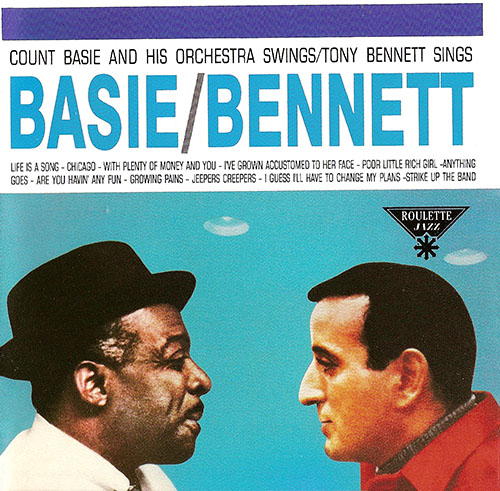
BASIE | BENNETT — Count Basie And His Orchestra Swings, Tony Bennett Sings (1959-1990) FLAC (tracks+.cue), lossless

The Roulette half of the two Bennett/Basie sessions is a band singer's paradise, with the Basie band caught at a robust and swinging peak and Bennett never sounding happier or looser in front of a microphone. The Count himself, alas, appears on piano only on two numbers ("Life Is a Song" and "Jeepers Creepers"), while Bennett's perennial pianist Ralph Sharon takes over on the remaining ten tracks and does all the charts. Yet Sharon writes idiomatically for the Count's style, whether on frantic rave-ups like "With Plenty of Money and You" and "Strike Up the Band" or relaxed swingers like "Chicago." Though not a jazz singer per se, the flavor of jazz is everywhere in Bennett's voice, which in those days soared like a trumpet. The 1990 CD included an atmospheric unissued Neal Hefti ballad "After Supper," but even this bonus track does little to extend the skimpy playing time (about 31 minutes) of what is still a great, desirable snapshot from American showbiz of the late 1950s. Richard S. Ginell
Tracklist :
1    Life Is A Song 2:55
Written By – Fred Ahlert, Joe Young
2    Plenty Of Money 1:35
Written By – Al Dubin, Harry Warren
3    Jeepers Creepers 2:09
Written By – Harry Warren, Johnny Mercer
4    Are You Havin' Any Fun 2:48
Written By – Jack Yellen, Sammy Fain
5    Anything Goes 2:21
Written By – Cole Porter
6    Strike Up The Band 1:34
Written By – George Gershwin, Ira Gershwin
7    Chicago 2:08
Written By – Fred Fisher
8    I've Grown Accustomed To Her Face 3:04
Written By – Alan Jay Lerner, Frederick Lowe
9    Poor Little Rich Girl 3:33
Written By – Noel Coward
10    Growing Pains 3:36
Written By – Arthur Schwartz, Dorothy Fields
11    I Guess I'll Have To Change My Plans 1:45
Written By – Arthur Schwartz, Howard Dietz
12    After Supper 3:36
Written By – Neil Hefti
Credits :
Arranged By – Ralph Sharon
Baritone Saxophone – Charlie Fowlkes
Bass – Eddie Jones
Drums – Sonny Payne
Guitar – Freddie Green
Piano – Count Basie (tracks: 1, 3), Ralph Sharon (tracks: 2, 4 to 12)
Tenor Saxophone – Billy Mitchell
Trombone – Al Grey, Benny Powell, Henry Coker
Trumpet – Joe Newman, Snooky Young, Thad Jones, Wendell Culley
Vocals – Tony Bennett

17.4.24

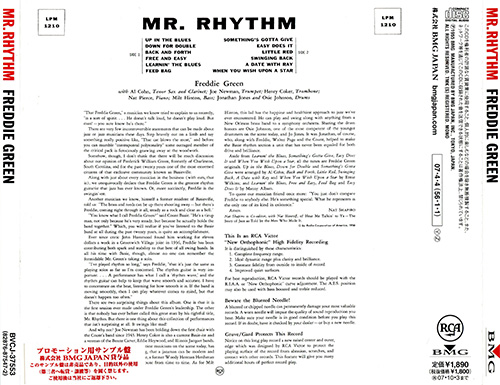
FREDDIE GREEN — Mr. Rhythm (1955-2007) RM | MONO | BMG Prime Jazz Series | FLAC (tracks+.cue), lossless


Freddie Green seldom led sessions and seldom played lead. Instead, he formed part of the classic rhythm section that gave the Count Basie band its steady pulse. This rare date finds Green with tenor Al Cohn, trumpeter Joe Newman, trombonist Henry Coker, pianist Nat Pierce, bassist Milt Hinton, and either Jo Jones or Osie Johnson on drums. Mr. Rhythm, in fact, will remind many of a good Basie set. The steady drums, bass, and guitar on "Back and Forth" and "Something's Gotta Give" push the music forward, swinging ever so lightly. Nat Pierce's minimalist piano work also owes something to Basie. He adds small flourishes to the rhythm of pieces like "Easy Does It," and only a scattering of tastefully chosen notes on his solo. Coker and Cohn deliver nice solos on "When You Wish Upon a Star," with the trombone's lovely tone and the tenor's deep, mellow pitch complimenting the romanticism of the piece. Newman offers a concise, discerning solos on "Free and Easy" and "Learnin' the Blues." He uses a mute for both solos, perfectly capturing a calm, bluesy mood. Of course Green doesn't solo, and while his guitar is often barely audible, his presence is always felt. This album shows him to be a fine leader who is happy to remain in his role as rhythm guitarist. For fans of Green, and for those who enjoy swinging jazz with great soloists, Mr. Rhythm is a fine release. Ronnie D. Lankford, Jr.
Tracklist :
1    Up In The Blues    2:34

 Freddie Green
2    Down For Double    3:58

 Freddie Green
3    Back And Forth    2:17
 Freddie Green
4    Free And Easy    3:25
 Freddie Green
5    Learnin The Blues    3:28
 Freddie Green / Delores Vicki Silvers
6    Feed Bag    2:58
 Freddie Green
7    Something's Gotta Give    2:51
 Freddie Green
8    Easy Does It    3:42
 Freddie Green / Sy Oliver / Trummy Young
9    Little Red    2:08
 Freddie Green
10    Swinging Back     3:21
 Freddie Green
11    A Date With Ray    4:52
 Freddie Green
12    When You Wish Upon A Star    2:38
 Freddie Green / Leigh Harline
Credits
Bass – Milt Hinton
Drums – Jo Jones, Osie Johnson
Guitar – Freddie Green
Piano – Nat Pierce
Tenor Saxophone, Clarinet – Al Cohn
Trombone – Henry Coker
Trumpet – Joe Newman

12.9.23

ILLINOIS JACQUET – 1945-1946 | The Chronogical Classics – 948 (1997) FLAC (tracks+.cue), lossless

Although the Delmark label has done a fine job of reissuing Illinois Jacquet's Apollo recordings, a genuine understanding of this exciting music requires a more systematic appraisal of the recorded evidence. Being able to digest an entire segment of Jacquet's career, with the recordings chronologically arranged and garnished with complete discographical information, is a major treat for anyone wishing to place the music in context. This also expands the picture well beyond Apollo to include material recorded for the Philo, Savoy, and ARA labels, and clears up a few mysteries regarding personnel. The first four tracks were recorded in July of 1945 and set a standard for modern jump music combining elements that would soon be tagged as bebop and R&B. The steamy "Flying Home" was carefully arranged to fit on two sides of a 10" 78-rpm record. "Uptown Boogie" features pianist Sir Charles Thompson bolstered by excellent rhythmic support from drummer Johnny Otis. Illinois himself was always a commanding presence whether laying down a cool blues, smoothing out a ballad, or applying a blowtorch to one of his rowdy jump tunes. Trumpeter Russell Jacquet is heard singing the only two vocal tracks on the entire album, "Throw It Out of Your Mind Baby" and "Wondering and Thinking of You." The two Apollo sessions from August 1945 are driven by the pulsing bass of young Charles Mingus, Bill Doggett's double-fisted piano, and some feisty drumming by Al "Cake" Wichard. For a precious glimpse into the developing ballad philosophy of Mr. Mingus, listen carefully to his accompaniment behind Jacquet's passionate sax on "Memories of You" and "Ghost of a Chance." Ming walks briskly through "Bottoms Up," a rocking re-bop dance with howling horns and strutting rhythm. "Merle's Mood" seems to have been based upon "Paper Moon," and Mingus crowds the microphone to provide extra pushes during Bill Doggett's "What's This." Two sides waxed for ARA at the end of the same month and issued as by the Jacque Rabbits are graced with the return of Sir Charles, whose composition "Ladies Lullaby" is actually another jump tune fortified with bop ideas. "Illinois Stomp" is a very sophisticated bounce. The closing eight tracks were originally issued bearing the Savoy label, and feature trumpeter Emmett Berry, an interesting blend with the salty and often florid Mr. Jacquet. (The last three selections in fact were issued under the name of Emmett Berry's Hot Six.) "Don't Blame Me" is one of this saxophonist's great triumphs of ballad artistry. The spicy "Jumpin' Jacquet" is driven by rhythm guitarist Freddie Green, bassist John Simmons, and master percussionist Shadow Wilson, while Berry percolates using a mute. "Blue Mood" is a meditative masterpiece. Every single track on this CD is strongly presented and well worth experiencing again and again, with best wishes for loosening up, nodding your head, popping your fingers, and cracking a smile. arwulf arwulf     Tracklist :

ILLINOIS JACQUET – 1947-1951 | The Chronogical Classics – 1254 (2002) FLAC (tracks+.cue), lossless

These recordings from Illinois Jacquet all showcase him in the context of his name orchestra recording for Bluebird and Apollo. Tadd Dameron arranged all of this material -- most of which was written by Jacquet. The band's varying personnel on these stellar sides includes Sir Charles Thompson, J.J. Johnson, J.C. Heard, John Lewis, Henry Coker, Red Callender, Shadow Wilson, Carl Perkins, Oscar Moore, and others. Standout cuts form these sides include "Symphony in Sid," "Riffin' at 24th Street," "Slow Down Baby," "My Old Gal," and a smoking rendition of Count Basie's "Mutton Leg."
-> This comment is posted on Allmusic by Thom Jurek, follower of our blog 'O Púbis da Rosa' <-
Tracklist + Credits :

17.5.23

EDDIE HEYWOOD – 1944-1946 | The Classics Chronological Series – 1038 (1998) FLAC (tracks+.cue), lossless

The second installment in the Classics Eddie Heywood chronology traces the pianist's progression from a successful Commodore leader and accompanist (see the first installment as well as Billie Holiday's later Commodore material) into a Decca recording artist via a pair of V-Disc performances cut on November 13, 1944. This compendium of amiable, sophisticated, and mature swing music features alto saxophonists Lem Davis and Marshall Royal as well as trombonists Vic Dickenson, Henry Coker, and Young Lion Britt Woodman, who is heavily featured on "Pom Pom." If the artistic high point of the entire album is Heywood's interpretation of Duke Ellington's gorgeous melody "I Didn't Know About You" (a prelude to later renditions by Johnny Hodges, Lee Konitz, Thelonious Monk, and Rahsaan Roland Kirk), the toy surprise in this package is a very hip-sounding Bing Crosby, featured on five tracks recorded in Los Angeles near the end of the summer of 1945. Bing seems unusually comfortable in this company, and for this reason these tracks should be counted among the best jazz recordings he ever participated in. arwulf arwulf
Tracklist :

EDDIE HEYWOOD – 1946-1947 | The Classics Chronological Series – 1219 (2001) FLAC (tracks+.cue), lossless

The Eddie Heywood sextet had largely run their course by mid-1946. In fact, his group had expanded to a septet (with two trombones) when the first of the recordings on this CD were made. Six selections feature that melodic group (the best is "Temptation") and they back the Andrews Sisters on three other songs. The remainder of this CD is from 1947, with Heywood mostly being featured in a trio (with Peggy Mann taking vocals on three songs). He is also featured backing organist Roy Ross on "Jitterbug Waltz," leading a sextet on two songs, and accompanying singer Bob Eberly (formerly with Jimmy Dorsey) on two ballads. Overall this is an interesting variety of formerly rare performances by Eddie Heywood, closing in December 1947, right before an ailment knocked him out of action for a couple years. Scott Yanow
Tracklist : 

STEFANO BATTAGLIA · PIERRE FAVRE — Omen (2000) FLAC (tracks+.cue), lossless

Italian pianist Stefano Battaglia is known for his excellent technique and sensitive touch. So is percussionist Pierre Favre. It comes as no...