 Document's The Complete Paramounts (1929-1931) is an invaluable Charlie Spand anthology, reissuing all of the pianist's early sides for Paramount. Classic performances include "Got to Have My Sweetbread," "Soon This Morning Blues," "Hastings Street," and his seminal duet with Blind Blake on "Moanin' the Blues." Still, it's not an exhilarating, start-to-finish listen -- the long running time, chronological sequencing, and poor fidelity, make it hard to digest. The more serious, intellectual blues listener will find all these factors to be positive, but enthusiasts and casual listeners will find that the collection is of marginal interest for those very reasons. Thom Owens
Abridged from this album’s original booklet notes. Charlie Spand’s recordings have long been recognized by both blues and jazz enthusiasts as a “special vintage” of African-American music. The combination of a blues poet, notable for his carefully thought-out lyrics, with inspired piano playing is indeed irresistible, yet little has been written about him apart from a brief musical study by Bob Hall and Richard Noblett in Blues Unlimited. On Hastings Street, named for a street in Detroit’s black entertainment district and issued originally under Blind Blake’s name, the guitarist teases Spand about his homesickness for Detroit and in particular for his obsession with 169 Brady Street. This address is in the same district of Detroit and may be guessed to have been the residence of a lady in whom the pianist had an interest. His first recording, Soon This Morning, was popular enough to justify the recording of a Soon This Morning No. 2 fifteen months later. His presence on the Hometown Skiffle sampler is a further testimony to Paramount’s sales expectations. Blind Blake is somewhat under-recorded on Soon This Morning but comes into his own on its session mate and on the August session, which immediately preceded the recording of Hastings St. The instrumental passages on Ain’t Gonna Stand For That in particular demonstrate considerable empathy. However, it has been suggested that the prominently featured guitarist on Good Gal is Josh White. The remainder of Charlie Spand‘s Paramount recordings feature him as a solo performer, the guitarist noted by discographers on Soon This Morning No. 2 is wholly inaudible. He addresses standard blues topics like faithless and wrong-doing women and sexual needs:
I like it in the morning, I like it late at night, Now if I don’t get my sweetbread, you know I don’t feel right. (Got To Have My Sweetbread) Financial worries loomed and he twice alludes to the difficulty of surviving without resort to crime, in Hard Time Blues and Room Rent Blues, where he complains: I ain’t got no money, I ain’t got no job, Now if something don’t happen, I’ll have to steal or rob. The jaunty and exuberant She’s Got Good Stuff takes the pianist into hokum territory with a song credited to “Lamoore“, a name which appears on forty-odd Paramounts of the era. It may conceal the identity of a member of the A&R staff, or sharp practice. Spand’s Paramount career ended with the doom-laden Evil Woman Spell. He re-emerged briefly to record for OKeh in 1940. Rumours of subsequent sightings in California appear to be just rumours. DOCD-5108
Tracklist :
1 Charlie Spand– Soon This Morning Blues 2:55
Guitar – Blind Blake
2 Charlie Spand– Fetch Your Water 2:27
Guitar – Blind Blake
3 Charlie Spand– Good Gal 3:17
Guitar [Possibly] – Joshua White
4 Charlie Spand– Ain't Gonna Stand For That 3:07
Guitar [Possibly] – Joshua White
5 Charlie Spand– Moanin' The Blues 3:14
Guitar [Possibly] – Blind Blake
6 Charlie Spand– Back To The Woods Blues 3:20
Guitar [Possibly] – Blind Blake
7 Blind Blake– Hastings St. 3:12
Piano – Charlie Spand
8 Charlie Spand– In The Barrel Blues 3:05
9 Charlie Spand– Levee Camp Man 3:01
10 Charlie Spand– Breakdown 1:48
11 Charlie Spand– Mississippi Blues 2:40
12 Charlie Spand– 45th St. Blues 2:35
13 Charlie Spand– Got To Have My Sweetbread (Take 3) 3:15
14 Charlie Spand– Got To Have My Sweetbread (Take 4) 2:51
15 Charlie Spand– Room Rent Blues 3:13
16 Charlie Spand– Mistreatment Blues 2:59
17 Charlie Spand– Soon This Morning – No. 2 2:56
18 Charlie Spand– She's Got Good Stuff 2:58
19 Charlie Spand– Thirsty Woman Blues 3:00
20 Charlie Spand– Dreamin' The Blues 2:46
21 Charlie Spand– Big Fat Mama Blues 2:52
22 Charlie Spand– Hard Time Blues 2:34
23 Charlie Spand– Georgia Mule Blues 2:26
24 Charlie Spand– Tired Woman Blues 2:32
25 Charlie Spand– Evil Woman Spell 2:42
9.2.25
CHARLIE SPAND – The Complete Paramounts In Chronological Order 1929-1931 | DOCD-5108 (1992) RM | FLAC (tracks), lossless


8.2.25
MERLINE JOHNSON — The Yas Yas Girl : Complete Recorded Works In Chronological Order ★ Volume 1 • 1937-1938 | DOCD-5292 (1994) RM | FLAC (tracks), lossless

Back in the middle of the 1990s, the Vienna-based Document label reissued 71 tasty blues recordings made during the years 1937-1940 by Mississippi native Merline Johnson. Each of the three volumes is superb, and once you've caught her act you might find yourself seeking out the entire set. Volume one covers the first 11 months of her five-year reign as one of Chicago's most prolific prewar blues women. Backed by trumpeter Alfred Bell, clarinet and saxman Bill Owsley, guitarists Lonnie Johnson, Big Bill Broonzy, Willie Bee (James) and George Barnes; pianists Eddie Miller, Horace Malcolm, Blind John Davis and Joshua Altheimer, and drummer Fred Williams, Merline Johnson wrestles and wrangles with the human condition, from domestic relationships and law enforcement to government sponsored work programs, subterranean mining in the deep south, self-medication using hard liquor, and a pact with the devil himself. The first six titles were recorded on May 4, 1937 and issued on the Victor subsidiary Bluebird label. Beginning with "Sold It to the Devil," all of her recordings (issued on the ARC and Vocalion labels) identified her as the "Yas Yas Girl." Right from her opening performance, a fine version of "I'd Rather Drink Muddy Water," this woman's gutsy warmth is difficult to resist. Note that "Pallet on the Floor" is not the familiar traditional tune about sneaking around and dogging one's mate, but a straightforward answer song devised by Merline Johnson herself. "Jelly Bean Blues" was written by Ma Rainey, who recorded it in 1924 with Louis Armstrong and a little group led by Fletcher Henderson. Merline's marvelous cover, recorded on April 7, 1938, is greatly enhanced by the electrically amplified guitar of 16-year-old prodigy George Barnes. arwulf arwulf
Tracklist :
1 New Muddy Water Blues 3:03 (A)
2 He Roars Like A Lion 3:21 (A)
3 I'm Leavin' You 3:07 (A)
4 My Baby Left Me 2:59 (A)
5 Pallet On The Floor 2:49 (A)
6 Mean Mistreatin' Daddy 2:54 (A)
7 Sold It To The Devil 2:59 (B)
8 Grandpa And Grandma 3:12 (B)
9 I'd Rather Be Drinking Muddy Water, No. 2 2:59 (B)
10 Blues Everywhere 2:50 (C)
11 Working On The Project 2:55 (D)
12 I Drink Good Whiskey 3:09 (D)
13 Patrol Wagon Blues 2:47 (D)
14 Got A Man In The 'Bamma Mines 3:04 (D)
15 Jackass For Sale 2:52 (E)
16 You Got To Pay 2:49 (E)
17 My Independent Man 2:47 (F)
18 He May Be Your Man 2:39 (F)
19 New Drinking My Blues Away 2:52 (G)
20 Crime Don't Pay 2:44 (G)
21 Please Come Back To Me (Take 5) 2:34 (H)
22 Love Shows Weakness (Take 4) 2:38 (H)
23 About My Time To Check 2:49 (H)
24 Squeeze Me Tight 2:50 (H)
25 Jelly Bean Blues 2:44 (H)
26 My Man Is Gone 2:38 (H)
7.2.25
MERLINE JOHNSON — The Yas Yas Girl : Complete Recorded Works In Chronological Order ★ Volume 2 • 1938-1939 | DOCD-5293 (1994) RM | FLAC (tracks), lossless

If the first volume of Merline Johnson's complete recordings was highly rewarding, volume two is utterly essential, as it contains some of her all-time best, most exciting, and jazz-infused performances. Susceptible listeners may find it difficult to remain seated during "Running Down My Man" (which sounds a lot like one of Washboard Sam's upbeat creations), as a fine trumpeter (possibly Punch Miller) and a tenor saxophonist (probably Bill Owsley) swing like mad atop a well-oiled rhythm section that includes pianist Blind John Davis and electrically amplified guitarist George Barnes. This level of enjoyment is maintained during a kicking cover of Louis Armstrong's "Ol' Man Mose" and a brusque version of "Don't You Leave Me Here," previously recorded by Monette Moore with Charlie Johnson's Original Paradise Ten in 1927 and by wandering Texas guitarist Henry Thomas in 1929. Identified as the Louisiana Kid on Vocalion C-2296 ("Separation Blues"), Punch puts his horn down and sings a duet with the Yas Yas Girl. Sometimes billed as the Rhythm Rascals, Merline's bands as heard on this collection were mightily stoked by players like guitarists Big Bill Broonzy and Willie B. James; steel guitarist Casey Bill Weldon, saxophonist Buster Bennett, and trumpeters Alfred Bell, Walter Williams, and venerable Lee Collins, a New Orleans legend who made records with Jelly Roll Morton in 1924. Collins is heard here on tracks 17-22 as a member of the Yas Yas Girl's Jazz Boys, an ensemble anchored by bass vocalist Alfred Elkins, who sounds like he might have been blowing across a whiskey jug, old style. While Merline Johnson was quite capable of whipping up her own ideas, the occasional cover tunes pack a wallop, as does Billie Holiday's "Fine and Mellow" and New Orleans guitarist Danny Barker's "Don't You Make Me High," which he wrote for his wife Blue Lu Barker, who made her soon-to-be-famous recording for Decca only weeks before Merline Johnson took it on accompanied by Buster Bennett's persuasive soprano sax. Decades later, diminutive Maria Muldaur enjoyed a spate of success with her sultry update of this naughty little masterpiece. arwulf arwulf

Tracklist :
1 Running Down My Man 2:53 (A)
2 Ol' Man Mose 2:57 (B)
3 Don't You Leave Me Here 2:55 (B)
4 Separation Blues 2:56 (C)
5 You Can't Shoot Your Pistol 2:40 (D)
6 Whiskey Fool 2:40 (E)
7 Don't You Make Me High 2:40 (F)
8 Love With A Feeling 2:52 (F)
9 Some Day I'll Be Gone Away 2:42 (G)
10 Easy Towing Mama 2:40 (G)
11 Grieving Heart Blues 2:43 (G)
12 Reckless Life Blues 2:27 (G)
13 Breakin' 'Em Down Tonight 2:32 (H)
14 Someone To Take Your Place 2:48 (H)
15 Got A Mind To Ramble 2:30 (H)
16 True Love 2:41 (H)
17 Fine And Mellow 2:55 (I)
18 Nobody Knows How I Feel 2:54 (I)
19 I Need You By My Side 2:51 (I)
20 You Can't Have None Of That 2:46 (I)
21 I Got To Have It Daddy 2:47 (I)
22 Don't Have To Sing The Blues 2:47 (I)
MERLINE JOHNSON — The Yas Yas Girl : Complete Recorded Works In Chronological Order ★ Volume 3 • 1939-1940 | DOCD-5294 (1994) RM | FLAC (tracks), lossless

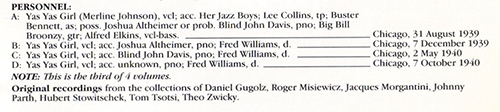 Tracklist :
1 You're a Pain in the Neck to Me 2:52 (A)
2 I'd Rather Be Drunk 2:38 (A)
3 I Just Keep on Drinking 2:45 (A)
4 Front Door Blues 2:37 (B)
5 I'll Try to Forget 2:44 (B)
6 Want to Woogie Some More 2:48 (B)
7 You Don't Know My Mind 2:42 (B)
8 Mama's Bad Luck Child 2:50 (B)
9 Black Gypsy Blues 3:01 (C)
10 Screaming the Blues 2:48 (C)
11 Yellow Basket Blues 2:46 (C)
12 I'm Not Your Fool 3:02 (C)
13 I Won't Sell My Love 2:45 (C)
14 Don't Forget It 2:41 (C)
15 Stop and Listen 2:39 (C)
16 You Know It Ain't Right 2:36 (D)
17 Man to Man 2:51 (D)
18 Evil Old Nightmare 2:45 (D)
19 See Saw Blues 3:01 (D)
20 Black Ghost Blues 2:52 (D)
21 Worried Heart Blues 2:51 (D)
22 Milkman Blues 2:51 (D)
23 Got the Blues for My Baby 2:38 (D) 
6.2.25
RAMBLIN' THOMAS & THE DALLAS BLUES SINGERS — Complete Recorded Works 1928-1932 In Chronological Order | DOCD- 5107 (1992) RM | APE (image+.cue), lossless

Guitarist Willard "Ramblin'" Thomas was born in Logansport, LA in 1902. In 1945, he was struck down by tuberculosis while in Memphis, TN, leaving behind about 18 recordings, 16 of which have been reissued on one disc by Document along with assorted tidbits by four other bluesmen, most of whom recorded in Dallas during the late '20s. Whereas Willard's timing, texture, and technique suggest the influence of Lonnie Johnson and Tampa Red, his work is also stylistically linked with that of Blind Lemon Jefferson, Texas Alexander, Ed Bell, Furry Lewis, Funny Paper Smith, and Little Hat Jones -- all substantial Southern blues musicians. After hooking up with talent scouts in Dallas, Ramblin' Thomas cut his first 14 sides for Paramount in Chicago in February and November, 1928. "Ground Hog Blues" and "Shake It Blues" (also known as "Shake It Gal") were recorded for Victor in Dallas on February 9, 1932. "Ground Hog Blues No. 2" and "Little Old Mama Blues" were waxed at the same session but are not included on this collection. What follows are four sides cut in Dallas on August 10, 1929 by Willard's little brother, Jesse "Babyface" Thomas. "My Heart's a Rolling Stone" is structurally a bit different from the formula regularly used by Willard, as is "Blue Goose Blues," a performance that resembles the work of eastern bluesmen Blind Boy Fuller, Blind Blake, and Blind Willie McTell. On the same day and again two months later, Jesse Thomas and pianist K.D. Johnson made about ten recordings altogether as accompanists for Bessie Tucker, and these may be found on Document's edition of her complete recorded works. The deep voice heard singing the lullaby waltz "Good Night" belonged to one Troy Ferguson. This recording, which was made in Atlanta, GA in November 1929, was included here because the person whistling is listed as Jesse Thomas -- although various blues historians have since insisted that this was not the same person as Jesse "Babyface" Thomas. Recorded on August 9, 1929, "Cryin' for You Blues" and "Needin' My Woman Blues" are performed by Sammy Hill backed by a second guitarist by the name of McKeno. "Walking Blues" and "You'll Like My Loving" were recorded in Dallas in December 1928 by Otis Harris. Over the years, these old recordings have resurfaced from time to time on vintage blues collections; in 2010 a couple of the Harris and Hill selections were included on the Fantastic Voyage box set Let Me Tell You About the Blues. arwulf arwulf
Abridged from this album’s original booklet notes. Willard Thomas and his younger brother Jesse were born in Logansport, Louisiana, Willard probably in 1902, Jesse in 1911. Both brothers became accomplished guitarists but Jesse consciously adopted a different style, avoiding the bottleneck technique favoured by Willard. Thirty miles to the north of Logansport is the city of Shreveport, stamping ground of the young Leadbelly and, later, slide guitarist Oscar Woods, ‘The Lone Wolf’. Both Thomas brothers gravitated towards this musical centre. Willard was probably there around the end of World War I and his frequent travels between Shreveport and Dallas, earned him the nickname ‘Ramblin’’ Thomas. In Dallas Willard met up with Blind Lemon Jefferson and they played together down in ‘Deep Ellum’. Evidence of this association can be heard in Thomas’s No Baby Blues which has a Jefferson-like guitar line. It was probably through Jefferson who started a very successful recording career in 1925, that he came to the attention of talent scout R. T. Ashford, who had a record shop in Dallas, and was recommended to the Paramount label which brought him up to Chicago to record 8 sides early in 1928. A further session later that year produced 6 titles but by the time his records were being issued, through 1929/30, record sales were slowing as the Depression tightened its grip on the nation. Fortunately copies of all his Paramount records have survived. Another recording opportunity came his way when the Victor company visited Dallas in February, 1932 and cut four sides by Thomas, two of which were versions of his Ground Hog Blues. The rarity of the 2 resulting records (only one has so far been recovered) suggests very modest sales. A few weeks after Willard’s second session, Otis Harris was making his only record in Dallas. Such an excellent coupling suggests a regular performer who may well have played with Thomas in that city. Ramblin’ Thomas grows in stature the more one listens to him and he must be rated one of the best bluesmen of his generation. Through Ashford, brother Jesse secured an audition for Paramount around 1928 but he wasn’t recorded. His only pre-war recording session (as Jesse ‘Babyface’ Thomas) was for Victor in Dallas in 1929. In addition to his own four sides Victor list him as backing singer Troy Ferguson on Good Night, although Jesse himself denies the identification. He does, however, confirm his presence on two Bessie Tucker titles, Better Boot That Thing and Katy Blues (DOCD-5070). His early sides reflect influences from Blind Blake and Lonnie Johnson, as Jesse himself readily admits. Blue Goose Blues is a catchy and skillful performance but neither this or the other record seem to have sold very well and he had to wait twenty years to be recorded again. DOCD-5107
Tracklist :
1 Ramblin' Thomas– So Lonesome 2:43
2 Ramblin' Thomas– Hard To Rule Woman Blues 3:01
3 Ramblin' Thomas– Lock And Key Blues 2:35
4 Ramblin' Thomas– Sawmill Moan 2:54
5 Ramblin' Thomas– No Baby Blues 2:47
6 Ramblin' Thomas– Ramblin' Mind Blues 2:48
7 Ramblin' Thomas– No Job Blues 3:09
8 Ramblin' Thomas– Back Gnawing Blues 3:00
9 Ramblin' Thomas– Jig Head Blues 3:15
10 Ramblin' Thomas– Hard Dallas Blues 2:59
11 Ramblin' Thomas– Ramblin' Man 3:04
12 Ramblin' Thomas– Poor Boy Blues 2:25
13 Ramblin' Thomas– Good Time Blues 3:04
14 Ramblin' Thomas– New Way Of Living Blues 3:01
15 Ramblin' Thomas– Ground Hog Blues 2:51
16 Ramblin' Thomas– Shake It Gal 2:40
17 Jesse "Babyface" Thomas– Down In Texas Blues 3:06
18 Jesse "Babyface" Thomas– My Heart's A Rolling Stone 2:54
19 Jesse "Babyface" Thomas– Blue Goose Blues 2:33
20 Jesse "Babyface" Thomas– No Good Woman Blues 2:54
21 Troy Ferguson– Good Night 2:59
Guitar [Erroneous], Humming [Erroneous] – Jesse "Babyface" Thomas
Guitar [Uncredited], Humming [Uncredited] – Jesse Thomas
Vocals, Whistling – Troy Ferguson
22 Sammy Hill– Cryin' For You Blues 2:47
Guitar [Prob.], Speech [Uncredited] – ... McKeno
Vocals, Guitar – Sammy Hill
23 Sammy Hill– Needin' My Woman Blues 3:02
Guitar [Prob.] – ... McKeno
Vocals, Guitar – Sammy Hill
24 Otis Harris– Waking Blues 3:28
Vocals, Guitar – Otis Harris
25 Otis Harris– You'll Like My Loving 3:20
Vocals, Guitar – Otis Harris 
+ last month


.jpg)
.jpg)
JOSEPH GABRIEL RHEINBERGER : Organ Works • 2 (Wolfgang Rübsam) (2001) The Organ Encyclopedia Series | Two Version | WV (image+.tracks+.cue), lossless
Organist, conductor, composer and teacher, Rheinberger was born in Vaduz, in Liechtenstein, where he held his first appointment as organist....
