Etonnant mélange que ce Matança do Porco (1973) de Som Imaginário. Un album qui commence avec "Armina", un titre de Prog Symphonique / Art Rock à la Moody Blues. Poursuite avec "A 3" qui bascule dans le Jazz Fusion, à l'image de l'évolution Jazz Rock d'un groupe tel que Soft Machine (Som Imaginário qui n'est pas sans évoquer Azymuth ou l'inverse). Wagner Tiso, en signant la majorité des titres, a pris le pouvoir au sein du groupe. Matança do Porco est proche de l'album concept en délivrant une "orgie" instrumentale complexe et fascinante, fusionnant le Jazz, le Rock Progressif, la musique classique et la MPB. Dans cet esprit conceptuel, le point culminant l'album, l'orgasme ultime, la chanson-titre, "A Matança do Porco" (11 minutes) divisée en trois mouvements assez époustouflants. La line-up est composée de Wagner Tiso (Hammond, acoustique et piano électrique), Tavito (guitare), Luiz Alves (basse) et Robby Silva (batterie). L'album comprend également des apparitions : Milton Nascimento, Danilo Caymmi et les Golden Boys. Magistral tour de force.Dominique Deret Tracklist : 1. Armina 5:41 Drums – Robertinho Electric Bass – Luiz Carlos Guitar – Frederiko Written-By, Piano, Electric Piano, Organ – Wagner Tiso 2. A3 3:09 Drums, Congas – Robertinho Electric Bass, Maracas – Luiz Carlos Flute – Danilo Caymmi Guitar – Chiquito Percussion – Chico Batera Twelve-String Guitar – Tavito Written-By, Electric Piano, Organ – Wagner Tiso 3. Armina (Vinheta 1) 0:45 Conductor – Arthur Verocai Orchestra – Orquestra Odeon Written-By – Wagner Tiso 4. (A Nova Estrela) Nº 2 6:35 Conductor – Gaya Drums – Robertinho Electric Bass – Luiz Carlos Guitar – Chiquito, Frederiko Orchestra – Orquestra Odeon Percussion – Chico Batera Twelve-String Guitar – Tavito Written-By, Organ, Electric Piano – Wagner Tiso 5. A Matança do Porco 11:01 Conductor – Gaya Drums – Robertinho Electric Bass – Luiz Carlos Guitar – Frederiko Orchestra – Orquestra Odeon Percussion – Chico Batera Vocals – Golden Boys, Milton Nascimento Written-By, Piano, Organ – Wagner Tiso 6. Armina (Vinheta 2) 0:34 Conductor – Arthur Verocai Orchestra – Orquestra Odeon Written-By – Wagner Tiso 7. Bolero 3:08 Drums – Robertinho Electric Bass – Luiz Carlos Flute – Danilo Caymmi Written-By – Luiz Alves, Milton Nascimento, Roberto Da Silva Written-By, Piano, Electric Piano – Wagner Tiso Written-By, Twelve-String Guitar – Tavito 8. Mar Azul 3:43 Drums – Robertinho Electric Bass, Guitar – Luiz Carlos Flute – Danilo Caymmi Guitar – Chiquito Written-By – Luiz Alves Written-By, Electric Piano, Organ – Wagner Tiso 9. Armina (Vinheta 3) 0:46 Conductor – Arthur Verocai Orchestra – Orquestra Odeon Written-By – Wagner Tiso
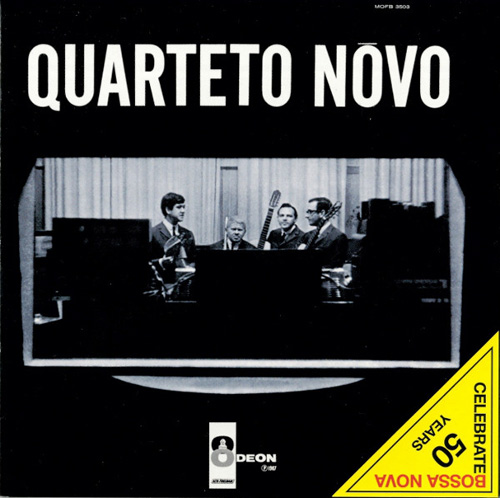
The sole album by the legendary Quarteto Novo was released by the Odeon label in 1967 and was accorded various coveted Brazilian artistic prizes, including the Troféu Roquette Pinto and the Troféu Imprensa. The band was made up of four now legendary Brazilian musicians: percussionist Airto Moreira; bassist, guitarist, and violinist Theo de Barros; guitarist, violinist, violist, and sometimes banjo player Heraldo do Monte (these three musicians all being members of the previous Trio Novo); and later arrival Hermeto Pascoal. Coming from the northeastern part of the nation, all of these men were intimately familiar with baião music, the danceable rhythmic style comprised of a syncopated 2/4 time signature that could be played on the double-skinned zabumba drum and harmonic and melodic structures written around a Lydian flat seventh scale; it is derived from the tuning of the pífano flute, which has a raised fourth and flattened seventh. The chord structure is based on a dominant seventh. And while the style is not well-known outside Brazil, it nonetheless influenced a host of popular songwriters in America, England, and Europe, who scored hits with tunes utilizing the style's elements. (A couple of examples are the Burt Bacharach tune "Do You Know the Way to San Jose?" and "Save the Last Dance for Me," written by Doc Pomus and Mort Schulman and recorded by the Drifters.) Quarteto Novo -- and their patron and songwriting collaborator Geraldo Vandré -- had a deep, some would say obsessional, interest in American bebop; combine them and you have something very special indeed. Though in many ways, these eight songs sound somewhat quaint to undisciplined in the 21st century, the opposite is actually quite true. This meld of styles and the deep interest in subtle yet innovative rhythmic interplay, counterpoint, and taut song structures are to this day quite revolutionary. The soulfulness at the heart of this music is a far cry from the breeziness of bossa nova, and there are no lyrics. Instead, on tunes like "Fica Mal com Deus," a 12-string guitar, a nylon-string guitar, and the pífano flute of Pascoal all enter in a head line like a bop composition. Within a chorus, the flute moves to a different melody, guitars accent two different parts of the rhythm, and Airto allows timekeeping and rhythmic invention to flow toward the melody instead of framing its outside. The listener is completely caught up in the joy and drama of the tune -- this also goes for the much more intricate and haunting "Canto Geral," which begins much more slowly but quickly weaves a pair of melodic intricacies together and frames them with a samba feel, which is stretched and cast off as three voices wordlessly create a third melody in the middle as a bridge, followed by a minor seventh interlude that is utterly forlorn before the pastoral open country feel returns. Amazing! The set closes with the popping "Vim de Sant'Ana," where piano, double bass, nylon-string guitars, and Airto's percussion magic are woven inseparably with a contrapuntal Wes Montgomery swinging soul-styled melody. Over its five minutes the track changes considerably, moving from one mode to another with seamless transitions until the listener is left breathless by its end. This record is difficult to find at times, and keeps getting reissued on CD in small batches. Look for it. One can hear so many things in this music that deserve a place on the sacred shelf. One can think of producers like Creed Taylor and his original idea for CTI and know he heard this music; one can hear the very foundation of Egberto Gismonti's music inside this record; and it can also be credited with much of the killer '70s jazz and Brazilian fusions that occurred on records by everyone from Joe Farrell and Chick Corea to Gary Burton and Freddie Hubbard. And then there are those brilliant albums by Airto, Dom Um Romão, Flora Purim, and so many others that came directly from the sounds displayed here so generously and ingeniously. -> This comment is posted on Allmusic by Thom Jurek, follower of our blog 'O Púbis da Rosa' <- Tracklist : 1. O Ôvo 2:17 Geraldo Vandré / Hermeto Pascoal 2. Fica Mal Com Deus 3:26 Geraldo Vandré 3. Canto Geral 3:45 Geraldo Vandré / Hermeto Pascoal 4. Algodão 7:19 Luiz Gonzaga / Zê Dantas 5. Canta Maria 2:45 Geraldo Vandré 6. Síntese 2:37 Heraldo Do Monte 7. Misturada 4:15 Geraldo Vandré / Airto Moreira 8. Vim De Sant'Ana 5:09 Theo de Barros Credits : Acoustic Guitar – Heraldo Do Monte Bass, Violão – Théo De Barros Drums, Percussão – Airto Moreira Flute – Hermeto Pascoal
Adventure Music is promoting Choros & Alegria, its beautifully
rendered follow-up to 2004's critically acclaimed first tribute to
behind-the-scenes Brazilian musical genius Moacir Santos (Ouro Negro),
with the tag line: "You don't have to apologize if you don't know who he
is." The moral of this beautiful Brazilian story is, you don't have to
be a global legend like Sergio Mendes, Milton Nascimento, or Ivan Lins
to inspire the Brazilian music world. A composer, arranger, reed player,
and teacher for many decades, Santos is considered a living monument to
the musical treasures that have come from his country. Producers Mario
Adnet and Ze Nogueira, who also presented the first collection, have put
together magical, often orchestrated traditional arrangements of never
before recorded Santos tunes from various decades, starting in the '40s
(the seductive trumpet-spiced "Cleonix") and continuing through 1991's
lush piano-choir anthem "Felipe." Perfectly in line with the spirit of
discovery that drives the 15-song collection, most of the musicians are
famed Rio cats you've never heard of, with the notable exception of
guitarist Ricardo Silveira and Wynton Marsalis. The material was
recorded in 2005 in Rio and São Paulo under the direct supervision of
the 79-year-old Moacir, who is no doubt too old to tour but can't help
but be pleased by the newfound attention given this most precious work. Jonathan Widran Tracklist :
1Agora Eu Sei (Now I Know) 4:55 Moacir Santos
2Outra Coisa (Another Thing) 3:30 Moacir Santos
3Paraíso (Paradise) 4:41 Moacir Santos
4Vaidoso (Vain) 2:56 Moacir Santos
5Flores (Flowers) 3:28 Moacir Santos
6Saudade de Jacques (Looking for Jaques) 3:40 Moacir Santos
7Cleonix 3:38 Moacir Santos
8Ricaom 2:21 Moacir Santos Credits :
Mario Adnet- Adaptation, Arranger, Guitar, Orchestration, Producer, Re-Orchestration, Transcription
Muiza Adnet -Vocals
Ronaldo Bandolim- Mandolin
Cristóvão Bastos - Keyboards, Piano
Zé Paulo Becker- Guitar
Teco CardosoSax (Baritone)
Andréa Earnest DiasFlute, Piccolo
Phillip Doyle- French Horn
Jorge Helder- Bass (Acoustic)
Armando Marçal - Percussion
Wynton Marsalis- Guest Artist, Soloist, Trumpet
Marcelo Martins- Sax (Tenor)
Jota Moraes- Vibraphone
Jurim Moreira - Drums
Marcos Nimrichter - Piano (Electric)
Zé Nogueira - Arranger, Producer, Sax (Soprano), Transcription
Nailor Proveta - Clarinet, Sax (Alto)
Jessé Sadoc- Trumpet
Moacir Santos - Arranger, Composer, Vocals
Vittor Santos - Trombone
Ricardo Silveira - Guitar (Electric)
Eumir Deodato de Almeida, also known as Eumir Deodato, is a Brazilian pianist, composer, record producer and arranger, primarily based in the jazz realm but who historically has been known for eclectic melding of big band and combo jazz with varied elements of rock/pop, R&B/funk, Brazilian/Latin, and symphonic or orchestral music. Prior to Prelude, Eumir Deodato was primarily known, if at all, as a tasteful, lyrical, bossa nova-based sometime arranger for the likes of Antonio Carlos Jobim, Frank Sinatra, Wes Montgomery, and others. Enter Creed Taylor, who gave Deodato a chance to step out on his own as a pianist/leader, doing a few tunes of his own plus a healthy quota of CTI-patented jazz interpretations of classical pieces by Richard Strauss ("Also Sprach Zarathustra (2001)"), Debussy ("Prelude to the Afternoon of a Faun"), and bowdlerized Borodin ("Baubles, Bangles and Beads"). Well, "2001" -- a clever, up-tempo Latin-groove takeoff on the opening measures of Strauss' tone poem suddenly exploded and became an improbable hit single. In its wake, Prelude soared to number three on the pop LP charts, and Deodato was propelled out of the arranger-for-hire business. Though overshadowed by "2001," the other tracks also hold up well today, being mostly medium-tempo, sometimes lushly orchestrated, conga-accented affairs that provide velvety showcases for Deodato's lyrical electric piano solos. The record also made a temporary star out of John Tropea, whose electric guitar has a lot of rock & rolling zip and fire, and Hubert Laws, Stanley Clarke, and Marvin Stamm each get a little solo room too. This would be the biggest hit Deodato and CTI ever had, and though short on playing time (32 minutes), it still makes enjoyable listening. Richard S. Ginell Tracklist : 1 Also Sprach Zarathustra 9:01 Arranged By, Adapted By – Eumir Deodato
Electric Bass [Solo] – Stanley Clarke Electric Guitar [Solo] – John Tropea Written-By – Richard Strauss 2 Spirit Of Summer 4:14 Guitar [Solo] – Jay Berliner Written-By – E. Deodato 3 Carly & Carole 3:41 Written-By – E. Deodato 4 Baubles, Bangles And Beads 5:20 Electric Bass – Ron Carter Electric Guitar [Solo] – John Tropea Written-By – A. Borodin, G .Forrest, R. Wright 5 Prelude To The Afternoon Of A Faun 5:13 Arranged By, Adapted By – Eumir Deodato Flute [Solo] – Hubert Laws Trumpet [Solo] – Marvin Stamm Written-By – C. Debussy 6 September 13 5:56 Electric Guitar [Solo] – John Tropea Written-By – B. Cobham, E. Deodato Credits : Arranged By, Conductor, Electric Piano, Piano – Eumir Deodato Bass – Ron Carter Cello – Charles McCracken, Harvey Shapiro, Seymour Barab Congas – Ray Barretto Drums – Billy Cobham Electric Bass – Stanley Clarke Electric Guitar – John Tropea Engineer – Rudy Van Gelder Flute – George Marge, Hubert Laws, Phil Bodner, Romeo Penque French Horn – Jim Buffington, Peter Gordon Guitar – Jay Berliner Percussion – Airto Producer – Creed Taylor Trombone – Bill Watrous, Garnett Brown, George Strakey, Paul Faulise, Wayne Andre Trumpet – Joe Shepley, John Frosk, Marky Markowitz, Marvin Stamm Viola – Al Brown, Emanuel Vardi Violin – David Nadien, Elliot Rosoff, Emanuel Green, Gene Orloff, Harry Lookofsky, Max Ellen, Paul Gershman
An all-star cast accompanies Brazilian percussion master Airto Moreira on this percolating collection of jazz fusion pieces. Produced by drummer extraordinaire Billy Cobham, the album locks into a steamy groove on Stanley Clarke's "Stanley's Tune" and never lets up. The Middle Eastern flavor of some of the melodies, Moreira and wife Flora Purim's unique vocalizations, and the use of unusual instrumentation on several cuts help make this recording a unique highlight of the electric fusion era. Standout soloists include Eddie Daniels on clarinet and guitarists David Amaro and Gabriel DeLorme, while bassist Clarke provides his usual stellar performance. Jim Newsom Tracklist : 1 Stanley's Tune 4:31 Arranged, Written-By – Stanley Clarke 2 Musikana 7:03 Written-By – Gabriel DeLorme 3 Virgin Land 8:15 Written-By – Airto Moreira 4 Peasant Dance 3:30 Arranged, Written-By – Milcho Leviev 5 Lydian Riff 7:15 Arranged, Written-By – Milcho Leviev 6 Hot Sand 5:30 Written-By – Airto Moreira 7 I Don't Have To Do What I Don't Want To Do 3:16 Written-By – Airto Moreira, Gabriel DeLorme Credits : Airto Moreira - Vocals, Drums & Percussion Flora Purim - Vocals, Vocal special effects (2, 4, 5), Vocals, Percussion (6) David Amaro - Guitar (1, 3), 12-String Guitar (2) Gabriel DeLorme - Guitar (5-7) George Duke - Keyboards (1, 3) Piano & Arp Synthesizer (6) Milcho Leviev - Keyboards (4, 5) Stanley Clarke - Bass (1-3, 6), Alex Blake (4, 5, 7) George Marge - Oboe (4, 5), Piccolo Flute (4) Eddie Daniels - Clarinet (4, 5) Jane Taylor - Bassoon (5) Kenny Ascher - Piano & Mellotron (7) Billy Cobham - Producer
Important solo album by the late Brazilian virtuoso, dedicated to Tom Jobim's compositions, Todos Os Tons opens with a very uncommon rendition of the broadly familiar Jobim tune "Samba Do Avião" ("Plane Samba"). Abandoning the bossa nova beat, Rabelo embraces the flamenco tradition, very dear to him, and, joined by his guest Paco de Lucia, echoes the gitano expression in a Brazilian setting, in which Bahian berimbau interventions interact with overall samba backing by the percussion. "Samba de Uma Nota Só" ("One Note Samba") also gives up the bossa tradition and attacks with a heavily syncopated samba rhythm for Rabello's virtuosic soloing. Enigmatic "Passarim receives an elaborated transcription for violão trio. "Retrato Em Preto E Branco" ("Portrait in Black and White") is sensitively interpreted by Rabello in a dialogue with guest soloists Jacques Morelenbaum (cello) and Luiz Avelar (piano). "Modinha" is performed solo in ad-lib tempo. "Garota de Ipanema" ("Girl From Ipanema") has a more powerful samba rhythm approach in which the bass contributes for a contemporary feel, and the introduction/interlude brings a new way of listening to this classic. The sensitive "Anos Dourados" is romantically exposed by Rabello with the help of Luiz Avelar emulating a string orchestra always carefully avoiding the clichés. "Garoto," an energetic tribute in moderate tempo to the great violonista has Tom Jobim himself at the piano. "Pois É" surprises in a flamenco-based introduction renewed by guest alto Paulo Moura improvising over a bossa nova beat, soon replaced by a doleful violão. "Luíza" receives a romantic and longing solo violão treatment that includes a tremolo ending directly reminiscent of classic tradition. The album is an opportunity for catching classic bossa nova themes reread through the unconventional yet creative and always competent lenses of an exceptional Brazilian virtuoso, unfortunately so young deceased. Alvaro Neder Tracklist : 1 Samba Do Avião 5:20 (Antônio Carlos Jobim) Arranged By – Raphael Rabello (Violão Ramirez 1969) feat: Paulinho Braga (d), Dininho (b) Paco de Lucía (Violão Hermanos Conde) Marçalzinho (perc.) 2 Samba De Uma Nota Só 2:00 (Antônio Carlos Jobim / Newton Mendonça) Arranged By – Raphael Rabello (Violão Ramirez 1969) feat: Dininho (b), Mamão (d) 3 Passarim 4:41 (Antônio Carlos Jobim) Arranged By – Raphael Rabello (Violão Ramirez 1969) feat: Dininho (b), Mamão (d) 4 Retrato Em Branco E Preto 3:55 (Chico Buarque / Antônio Carlos Jobim) Arranged By – Raphael Rabello (Violão Ramirez 1969) feat: Luiz Avellar (p), Paulo Jobim (arr.) Jaques Morelenbaum (cello) 5 Mondinha 3:29 Antônio Carlos Jobim / Vinícius de Moraes Arranged By – Raphael Rabello (Violão Mario Passos 7 cordas 1986) 6 Garota De Ipanema 4:46 Antônio Carlos Jobim / Vinícius de Moraes Arranged By – Raphael Rabello (Violões Ramirez 1969/88) feat. Luizão Maia (b), Wilson das Neves (d) 7 Anos Dourados 3:56 (Chico Buarque / Antônio Carlos Jobim) Arranged By – Raphael Rabello (Violão Ramirez 1969) feat: Luiz Avellar (p), Dininho (b) 8 Garoto 2:34 (Antônio Carlos Jobim) Arranged By – Raphael Rabello (Violão Mario Passos 7 cordas 1991) feat: Wilson Das Neves (d), Leo Gandelman (s,s), Antônio Carlos Jobim (p), Paulo Jobim (arr.) 9 Pois É 6:41 (Chico Buarque / Antônio Carlos Jobim) Arranged By – Raphael Rabello (Violões Ramirez 1969/88) feat: Paulo Moura (a.s), Nico Assumpção (b) 10 Luiza 2:24 Antônio Carlos Jobim Arranged By – Raphael Rabello (Violão Mario Passos 7 cordas 1991)
BrazilOnGuitar says: This first record for Barclay in 1964 is one of Baden´s most famous records in Europe. The sound of the original record was never the best. To much bad re-printings exist and circled around on vinyl and also on cd. The begin of a much better sound was the japanese cd release in 1999 and the new release in 2005 to the fifth anniversary of Badens passing. Both cds are ways to rediscover this album, which has a exotic mix of brazilian and european compositions. Tracklist : 1 - Deve ser amor 3:52 (Baden Powell-Vinicius de Moraes) 2 - Choro para metronome 2:58 (Baden Powell) 3 - Adágio 3:01 (Giazotto-Albinoni) 4 - Berimbau 3:01 (Baden Powell-Vinicius de Moraes) 5 - Samba em prelúdio 3:28 (Baden Powell-Vinicius de Moraes) 6 - Chanson d'Hiver 2:25 (Baden Powell) 7 - Samba triste 3:31 (Baden Powell-Billy Blanco) 8 - Berceuse a Jussara 2:35 (Baden Powell) 9 - Prelude 2:53 (J.S.Bach) 10 - Euridice 3:03 (Vinicius de Moraes) 11 - Bachiana 4:09 (Villa-Lobos) 12 - Garota de Ipanema 2:59 (Tom Jobim-Vinicius de Moraes) Credits : Baden Powell - Guitar Alphonse Masselier - Bass Arthur Motta - Drums Silvio Silveira - Percussion Paul Mauriat and his Orchestra Francoise Waleh - Vocal (5)
Real Name: Djalma de Andrade. Brazilian guitarist (July 16, 1923 in Rio de Janeiro, Brazil - February 14, 1987 in Greenbrae, California). Having studied the guitar in Brasil, he played locally and in Italy. Later on he was brought to the USA to play in the Sheraton hotel chain, where he was discovered by Dizzy Gillespie (in New York). Gillespie took Sete to the 1962 Monterey Jazz Festival, which meant his breakthrough. Shortly after Bola Sete settled in San Francisco, where he joined the Vince Guaraldi Trio. After a couple of years Sete formed his own trio, with which he performed at the 1966 Monterey Jazz Festival. WEB Tracklist : 1. Jongo 2:06 Written-By – Joao Pernambuco 2. Gaucho/Meu Ogum 5:33 Written-By – Bola Sete 3. Carnival Nights 3:53 Written-By – Bola Sete 4. Flamenco Fantasy 15:08 Written-By – Bola Sete 5. Ocean Waves 6:52 Written-By – Dorival Caymmi 6. Jongada 5:18 Written-By – Baden Powell 7. O Astronauto 2:41 Written-By – Baden Powell 8. Vira Mundo Penba 5:08 Traditional / Arranged By – Bola Sete 9. Guitar Lamento 4:18 Written-By – Bola Sete 10. Tio George 4:53 Written-By – Bola Sete Credits : Performer By – Bola Sete, Solo guitar concert May 21, 1976 at San Francisco's Grace Cathedral. Bola is playing a Ramirez guitar. CD enhanced with the sheet music for Guitar Lamento, six concert performance photos taken by Tom Copi, and the concert program.
On Hub Cap, his third effort as a leader, Freddie Hubbard sticks to the
tried-and-true hard bop formula, which is something of a mixed blessing.
There's no question that much of this music is enjoyable, but it's not
quite up to the standards of its two predecessors. Part of the problem
is Hubbard's sextet, which features tenor saxophonist Jimmy Heath,
trombonist Julian Priester, pianist Cedar Walton, bassist Larry Ridley,
and drummer "Philly" Joe Jones. All of the musicians are talented, but
only a few are inventive, and that becomes a problem, since it becomes
clear that Hubbard is beginning to break free from his influences and
develop his own style. In other words, he's capable of more adventurous
music than this straight-ahead hard bop. That said, Hub Cap is a very
good hard bop date. There is energy to the performances, and the
artist's vigorous, inspired playing continues to impress, as do some of
his original compositions. Only when compared to Hubbard's first two
records, or what would come later, does Hub Cap seem like a lesser
effort. Stephen Thomas Erlewine Tracklist :
1Hub Cap 5:17 Written-By – Freddie Hubbard
2Cry Me Not4:48 Written-By – Randy Weston
3Luana 10:06 Written-By – Freddie Hubbard
4Osie Mae 6:53 Written-By – Freddie Hubbard
5Plexus 9:03 Written-By – Cedar Walton
6Earmon Jr. 6:18 Written-By – Freddie Hubbard Credits :
Bass – Larry Ridley
Drums – Philly Joe Jones
Piano – Cedar Walton
Tenor Saxophone – Jimmy Heath
Trombone – Julian Priester
Synopsis : Considered by many to be the finest silent film ever made
by a Hollywood studio, F.W. Murnau's Sunrise represents the art of the
wordless cinema at its zenith. Based on the Hermann Sudermann novel A
Trip to Tilsit, this "Song of Two Humans" takes place in a colorful
farming community, where people from the city regularly take their
weekend holidays. Local farmer George O'Brien, happily married to Janet
Gaynor, falls under the seductive spell of Margaret Livingston, a
temptress from The City. He callously ignores his wife and child and
strips his farm of its wealth on behalf of Livingston, but even this
fails to satisfy her. One foggy evening, O'Brien meets Livingston at
their usual swampland trysting place. She bewitches him with stories
about the city -- its jazz, its bright lights, its erotic excitement.
Thrilled at the prospect of running off with Livingston, O'Brien stops
short: "What about my wife?" Drawing ever closer to her victim,
Livingston murmurs "Couldn't she just...drown?" (the subtitle bearing
these words then "melts" into nothingness). In his delirium, the husband
agrees. The plan is to row Gaynor to the middle of the lake, then
capsize the boat. Gaynor will drown, while O'Brien will save himself
with some bulrushes that he'd previously hidden in the boat; thus, the
murder will look like an accident. The next day, the brooding O'Brien
begins slowly rowing his unsuspecting wife across the lake. Halfway to
shore, he makes his intentions clear, but is unable to go through with
it. As his wife cringes in terror, O'Brien rows to the other side of
lake. Once ashore, she runs away from him in terror, as he stumbles
after her, trying to apologize. Gaynor boards a streetcar bound for the
city, with O'Brien climbing aboard a few seconds afterward. Upon
reaching the city (a renowned set design), O'Brien continues trying to
make amends to his wife. They sit disconsolately at a table in a
restaurant, unable to eat the plate of cake that is set before them.
Slowly, Gaynor begins overcoming her fear. The couple wander into a
church, where a wedding is taking place. Breaking down in sobs, O'Brien
begins repeating the wedding vows, thereby convincing Gaynor that she
has nothing to fear. Together again, the couple embraces in the middle
of a busy street, oblivious to the honking horns and irate motorists.
Anxious to prove to each other that all is well, the husband and wife
spend a delightful afternoon having their pictures taken and "dolling
up" in a posh barber shop. They cap their unofficial second honeymoon at
a joyous festival in an outsized amusement park. More in love with each
other than ever before, O'Brien and Gaynor head back across the lake in
the dark of night. Suddenly, a storm arises. Pulling out the bulrushes
with which he'd planned to save himself, O'Brien straps them onto Janet,
telling her to swim to shore. The storm passes. Washing up on shore,
the unconscious O'Brien is brought home. But Gaynor is nowhere to be
found, and it is assumed that she has died in the storm. Half-insane,
O'Brien strikes out at Livingston, the instigator of the murder plan.
Just as he is about to throttle the treacherous temptress, he is
summoned home; his wife is alive! As Livingston stumbles out of the
village, O'Brien and Gaynor cling tightly to one another, watching the
sun rise above their now-happy home. Together with Seventh Heaven,
Sunrise earned Janet Gaynor the first-ever Best Actress Academy Award,
while Charles Rosher and Karl Struss walked home with the industry's
first Best Photography Oscar. The film itself was also in the Oscar
race, but lost out to the more financially successful Wings. Hal Erickson
Title : Sunrise 'A Song of Two Humans' (1927) Directed by F.W. Murnau Duration : 95 min. Subtitles : French Spanish / Cards in English Genres : Drama, Romance Countries : USA
Many pure salsa and Latin jazz fans have a difficult time with Ray Barretto's Atlantic Records period in the late 1970s because he was making a deliberate run at the crossover jazz/dance music charts. Who better to strive for such a thing? Barretto established his bona fides in jazz two decades earlier -- and returned to them time and again until the end of his life. He was also one of the prime innovators in New York's salsa explosion, and even played on pop records as a sideman. His credits are book-length. This set from 1977 has dated well. A very large cast date, it features Stix Hooper, Joe Sample, and Wilton Felder of the Crusaders, as well as a host of West Coast session players from the pop, jazz, and Latin worlds: saxophonist Pete Christlieb, trumpeter Louis "Perico" Ortiz, trombonist Garnett Brown, drummers Terry Bozzio and Angel "Cachete" Maldonado, guitarist Ray Gomez, and bassist Jeff Berlin are just a few of the players who appear. The vibe here is more jazz-funk than fusion or salsa. It features loads of keyboards to balance the percussion load, making it more accessible to non-Latin fans, though the grooves balance the smooth with the steamy. The best tracks are "Here We Go Again," Leti," and "Tumbao Africano," while "Señor Funk" and "Expresso" are fine songs as well. -> This comment is posted on Allmusic by Thom Jurek, follower of our blog 'O Púbis da Rosa' <- Tracklist : 1 Here We Go Again 4:59 Baritone Saxophone, Soprano Saxophone – Bill Green Bass – Wilton Felder Guitar – Barry Finnerty Keyboards – Joe Sample Tenor Saxophone – Pete Christalieb Trombone – Garnett Brown Written-By – J. Sample 2 Señor Funk 4:44 Baritone Saxophone, Soprano Saxophone – Roger Rosenberg Bass – Jeff Berlin Drums – Steve Ferrone, Terry Bozzio Guitar – Marcus Fiorillo Keyboards – Gil Goldstein, Joe Sample Tenor Saxophone – Todd Anderson Trombone – Reinaldo Jorge Written-By – M. Fiorillo 3 Eye Of The Beholder 4:25 Baritone Saxophone, Soprano Saxophone – Roger Rosenberg Bass – Jeff Berlin Drums – Steve Ferrone Guitar – Marcus Fiorillo Keyboards – Gil Goldstein Tenor Saxophone – Todd Anderson Trombone – Reinaldo Jorge Written-By – G. Goldstein 4 Salsa-Con-Fusion 6:10 Baritone Saxophone, Soprano Saxophone – Bill Green Bass – Wilton Felder Drums – Terry Bozzio Guitar – Barry Finnerty Keyboards – Joe Sample Tenor Saxophone – Pete Christalieb Trombone – Garnett Brown Trumpet – Gene Goe Written-By – B. Finnerty 5 Numero Uno 4:47 Baritone Saxophone – Bill Green Drums – Steve Ferrone Keyboards – Joe Sample Tenor Saxophone – Pete Christalieb Trombone – Garnett Brown Written-By – W. Felder 6 Expresso 4:05 Baritone Saxophone, Soprano Saxophone – Roger Rosenberg Bass – Jeff Berlin Drums – Steve Ferrone Guitar – Marcus Fiorillo Keyboards – Gil Goldstein Tenor Saxophone – Todd Anderson Trombone – Reinaldo Jorge Written-By – G. Goldstein 7 Leti 6:59 Baritone Saxophone, Soprano Saxophone – Roger Rosenberg Bass – Jeff Berlin Drums – Steve Ferrone Guitar – Marcus Fiorillo Keyboards – Gil Goldstein, Joe Sample Percussion – Rafael Cruz Tenor Saxophone – Todd Anderson Trombone – Reinaldo Jorge Written-By – G. Edgehill 8 Tumbao Africano 4:28 Baritone Saxophone, Soprano Saxophone – Roger Rosenberg Bass – Jeff Berlin Bata – Angel Maldonado, Ray Romero Drums – Steve Ferrone Keyboards – Eddy Martinez Lead Guitar – Ray Gomez Percussion – Rafael Cruz Synthesizer – Clifford Carter Tenor Saxophone – Todd Anderson Timbales – Jimmy Delgado Trombone – Reinaldo Jorge Trumpet – Luis "Perico" Ortiz Written-By – R. Barretto
La Fabulosa Guitarra de Paco de Lucia The role of the flamenco guitar evolved considerably through the playing of Paco de Lucia (born Francisco Sanchez Gomez). The son of flamenco guitarist Antonio Sanchez and the brother of a flamenco guitarist, Ramón de Algeciras, and flamenco singer, Pepe de Lucia, Paco de Lucia extended the former accompaniment-only tradition of flamenco guitar to include deeply personal melodic statements and modern instrumentation. His collaborations included ten albums with flamenco vocalist El Camaron de la Isla and work with American pianist Chick Corea and the Guitar Trio, featuring guitarists John McLaughlin, Larry Coryell, and Al DiMeola. His recordings with his sextet, which included his brothers Ramón and Pepe, include such groundbreaking masterpieces as La Fabulosa Guitarra de Paco de Lucia, Fantasia Flamenca, Fuente y Caudal, Almoraima, and Zyryab. Yet, de Lucia did not completely forsake traditional flamenco. His 1980 album, Interpreta a Manuel de Falla, paid homage to the classical composer and flamenco enthusiast, while his 1987 album, Siroco, marked a return to pure flamenco. "I have never lost the roots in my music," de Lucia said during a late-'90s interview, "because I would lose myself. What I have tried to do is have a hand holding onto tradition and the other scratching, digging in other places, trying to find new things I can bring into flamenco." Born in Algeciras, a small city in southernmost Spain's Cadiz province, de Lucia was bred to be a world-class musician. He trained with his father and brother from the age of five. Mastering the art of flamenco guitar by his 11th birthday, he made his public performance debut on Radio Algeciras in 1958. A year later, he received a special award at the Festival Concurso International Flamenco de Jerez de la Frontera. Heralded as a child prodigy, de Lucia was invited to join the flamenco troupe led by dancer José Greco at the age of 16. He remained with the group for three years. A turning point in de Lucia's musical development came while on tour with Greco's troupe in North America. Meeting Sabicas, the first flamenco guitarist to tour the world, he was instructed to pursue his own style of playing. Although he remained tied to traditional flamenco on his first two solo albums -- La Fabulosa Guitarra de Paco de Lucia in 1967 and Fantasia Flamenca in 1969 -- and recorded ten albums accompanying flamenco vocalist de la Isla, de Lucia continued to seek a personal approach. The renowned guitarist died suddenly and unexpectedly of a heart attack in Mexico in February 2014; he was 66 years old. The city of Algeciras, de Lucia's birthplace, declared two days of official mourning. Craig Harris Tracklist : 1 Entre Dos Aguas (Rumba) 6:03 Accompanied By – Ramón De Algeciras 2 Aires Choqueros (Fandangos De Huelva) 4:14 3 Reflejo De Luna (Granaína) 3:52 4 Solera (Bulerías por soleá) 3:46 5 Fuente Y Caudal (Taranta) 5:12 6 Cepa Andaluza (Bulería) 5:50 7 Los Pinares (Tangos) 3:37 Accompanied By – Ramón De Algeciras 8 Plaza De San Juan (Alegría) 3:10 Credits : Composed By [Canciones Compuestas Por] – J. Torregrosa, Paco De Lucía
Manuel de Falla (1876-1946) 1 Danza De Los Vecinos 3:07 2 Danza Ritual Del Fuego 4:21 Backing Band [Colaboración Del Grupo] – Dolores Guitar [2nd] – Ramón De Algeciras 3 Introductión Y Pantomima 2:58 4 El Paño Moruno 1:26 Written-By – Pepe De Lucia 5 Danza Del Molinero 3:03 6 Danza 3:23 7 Escena 1:14 8 Canción Del Fuego Fatuo 4:04 Backing Band [Colaboración Del Grupo] – Dolores Guitar [2nd] – Ramón De Algeciras 9 Danza Del Terror 1:47 10 Danza De La Molinera 4:00 Credits : Adapted By, Arranged By, Flamenco Guitar – Paco De Lucía
Another flamenco guitar work by the master hands of Paco de Lucia. 'Castro Marin' is the name of his mother's Portuguese hometown, border with Spain and is a remembrance of her. After an American tour in late 1980 Paco recorded over three days in Tokyo this work. Recording really was a preparing his next disc 'Solo quiero caminar', made with the Sextet. The topics run both lead guitar format (five of them, in which Paco bends on another track) as a duet with acoustic guitar Larry Coryell ('Convite') or trio, featuring also John McLaughlin with a tweolve-string acoustic guitar ('Palenque'). Tracklist : 1. Monasterio de Sal (Colombiana) 4:44 2. Gitanos Andaluces (Bulerías) 4:55 3. Castro Marín (Fandangos) 4:13 4. Herencia (Soleá) 5:36 5. Convite (Rumba) 5:08 Acoustic Guitar – Larry Coryell 6. Palenque 7:23 Acoustic Guitar – Larry Coryell Acoustic Guitar, Twelve-String Guitar – John McLaughlin 7. Huida 4:00 Credits : Written-By, Arranged By, Acoustic Guitar – Paco De Lucía
At times, flamenco phenomenon De Lucia has branched out into jazz, bossa nova, and Cuban mixes. Here, however, he plays essentially solo compositions based on pure flamenco, though with a virtuosity and reach that belong in a concert hall rather than in the traditional settings. John Storm Roberts Tracklist : 1. La Cañada (Tangos) 5:15 2. Mi Niño Curro (Rondeña) 3:29 3. La Barrosa (Alegrías) 4:36 4. Caña De Azucar (Rumba) 4:19 5. El Pañuelo (Bulerías) 5:28 6. Callejón Del Muro (Minera) 3:55 7. Casilda (Tanguillos) 3:46 8. Gloria Al Niño Ricardo (Soléa) 5:07 Credits : Composed By, Producer – Paco De Lucia Guitar [2nd] – Jose Maria Bandera (tracks: 4), R. De Algeciras (tracks: 7) Guitar, Percussion [Cajón] – Rubén Dantas (tracks: 1, 7) Handclaps [Talegon Claps] – Pepe De Lucia (tracks: 4) Performer [Dancer] – Juan Rainrez (tracks: 3)
Any and all of his albums have a great blend of traditional elements and virtuoso playing. Ron Wynn Tracklist : 1 Entre Dos Aguas (Rumba) 6:02 Written-By – J. Torregrossa, P. De Lucia 2 Zorongo Gitano 2:55 Written-By – Federico Garcia Lorca 3 Rio Ancho 4:29 Written-By – P. De Lucia, R. Sanchez 4 En La Caleta 3:23 Written-By – F. Sánchez, J. Torregrossa 5 Convite 5:05 Written-By – P. De Lucia 6 Monasterio De Sal 4:52 Written-By – P. De Lucia 7 Panaderos Flamencos 2:36 Written-By – P. De Lucia 8 Punta Umbria 3:23 Written-By – F. Sánchez, J. Torregrossa 9 Chanela 3:57 Written-By – P. De Lucia 10 La Niña De Puerta Oscura 2:59 Written-By – M. Lopez Quiroga 11 Castro Marin 4:12 Written-By – P. De Lucia 12 Gua'Iras De Lucía 3:21 Written-By – F. Sánchez, P. De Lucia 13 Mantilla De Feria 3:17 Written-By – P. De Lucia 14 El Vito 2:51 Written-By – Federico Garcia Lorca Credits : Acoustic Guitar – Larry Corryell (tracks: 5) Guitar [2nd] – Ramón De Algeciras (tracks: 1, 3, 6, 9, 10, 14), Ricardo Modrego (tracks: 2) Guitar [Flamenco] – Paco De Lucía
On his first outing in five years, and the first of the new century, flamenco guitarist Paco De Lucia has given us one of the most sublime recordings in his long career. This collection of "Good Little Things" (Cositas Buenas) is a step away from Nuevo flamenco, and back to the grain of the source music itself. It is a record full of handclapped rhythms, organic spare percussion, and burning, passionate songwriting and singing. The various singers -- including Paco himself -- wail, chant, moan, and ecstatically intone his new songs to the sheer rough-hewn grace of his playing. Most tracks are done in the canonical style of guitar, and voice with handclap accompaniment, but there are two -- the smoking, burning black soul of "El Dengue" and "Que Venga el Alba," on which he is accompanied by another guitarist. On the album's final cut, "Cassa Bernardo," a rumba, Jerry Gonzalez adds his mariachi trumpet to the proceedings. Cositas Buenas is an album that careens across the history of flamenco. While rooted in antiquity, it nonetheless points the way to a new music, one that extrapolates rhythm and harmony and adds syncopation, texture, depth, and multi-layered harmonics to the original framework. It is transcendentally beautiful if overwhelming in its passion and the sheer joy of performance. Indeed, Cositas Buenas sets a new standard for modern flamenco music and acts as the true bridge between the ancient and the future. No one but a master who cares nothing for his laurels could have articulated such a work. -> This comment is posted on Allmusic by Thom Jurek, follower of our blog 'O Púbis da Rosa' <- Tracklist : 1. Patio Custodio (Bulería) 4:44 Vocals [Cante] – Montse Cortés 2. Cositas Buenas (Tangos) 4:23 Vocals [Cante] – Tana 3. Antonia (Bulería Por Soleá) 6:28 Vocals [Cante] – Paco 4. El Dengue (Rumba) 4:03 Guitar – Juan D'Anyelica, Paco De Lucía 5. Volar (Bulería) 5:30 Vocals [Cante] – Potito, Tana, Paco 6. El Tesorillo (Tientos) 4:39 Vocals [Cante] – Diego El Cigala Vocals [Voz Mujer] – Ángela Bautista 7. Que Venga El Alba (Bulería) 4:11 Guitar – Paco De Lucía, Tomatito Vocals [Cante] – Camarón De La Isla 8. Casa Bernardo (Rumba) 4:12 Bass – Alain Pérez Tres – Alejandro Sanz Trumpet – Jerry Gonzáles Credits : Guitar, Laúd, Bouzouki, Mandolin, Producer – Paco De Lucía Handclaps [Palmas], Coro – Antonio El Negro, Potito, Guadiana, Tana, Montse Cortés, Paco, Ángela Bautista Percussion – Piraña
Released
almost three years after Art Zoyd's first LP, Symphonie Pour le Jour où
Brûleront les Cités,Musique Pour l'Odyssée (Music for the Odyssey)
presented a slightly different version of the band. The nucleus of
Gérard Hourbette (violin), Thierry Zaboïtzeff (bass guitar, cello,
vocals), and Jean-Pierre Soarez (trumpet) is joined by percussionist
Daniel Denis (who would remain a core member of the band for two
decades), oboist/bassoonist Michel Berckmans (of Univers Zero and Von
Zamla), saxophonist Michel Thomas, and a second violinist, Franck
Cardon. This lineup recorded an album much more cinematic than the
first. The 17-minute epic "Musique Pour l'Odyssée" is very moody, going
from climactic passages to near silence (something pushed even further
on "Bruit, Silence -- Bruit, Repos"). Its slow development and
ritualistic percussion accompanying prehistoric grunts gives a first
example of the surrealistic soundtrack side of the band's music, which
will become the center of its production in the 1990s (Faust, Haxan).
"Trio 'Lettre d'Automne'" is a quiet string trio bringing the album to
an end on a weaker note. Less impressive than its predecessor, Musique
Pour l'Odyssée remains a very honest item in Art Zoyd's discography and
the title track alone is worth listening to the album. This LP was
reissued in 1999 on a two-CD set together with Symphonie Pour le Jour où
Brûleront les Cités and Génération Sans Futur. In 2013, Sub Rosa
released an edition of Musique Pour l'Odyssée with seven bonus tracks. François Couture Tracklist : 1. Musique Pour L'Odyssée: Odyssée / Falaise / Combat / Etrave / Combat / Voile / Odyssée 17:05 2. Bruit, Silence - Bruit, Repos 10:44 3. Trio "Lettre D'Automne" 7:01 Performer [All Instruments], Recorded By – Thierry Zaboitzeff – BONUS TRACKS – 4. Ba Benzele 8:04 Credits : Bass, Cello, Voice – Thierry Zaboitzeff (tracks: 1 to 3) Composed By – Gérard Hourbette (tracks: 1, 3), Thierry Zaboitzeff (tracks: 2, 4) Oboe, Bassoon – Michel Berckmans (tracks: 1 to 3) Percussion – Daniel Denis (tracks: 1 to 3) Saxophone [Soprano, Tenor] – Michel Thomas (tracks: 1 to 3) Trumpet – Jean Pierre Soarez (tracks: 1 to 3) Viola – Gérard Hourbette (tracks: 1 to 3) Violin – Franck Cardon (tracks: 1 to 3)
Génération Sans Futur (Generation Without a Future), Art Zoyd's third LP, comes back to the sound (and lineup, plus Daniel Denis) of the group's first Symphonie Pour le Jour où Brûleront les Cités. The 17-minute "La Ville" is a powerful epic including Thierry Zaboïtzeff's prehistoric grunts, complex time shifts, and a tribal/ritualistic feel once again close to the spirit of Magma. But unlike "Musique Pour l'Odyssée" (title track of Art Zoyd's second album), the music here is fast-paced, less atmospheric, more organized. It plays on the tension that will remain the basis of Art Zoyd's originality: a tribal, atavistic feel contrasting with contemporary classical aesthetics. Actually, Génération Sans Futur may be leaning more toward the contemporary side, as exemplified by pieces like "Divertissement," "Trois Miniatures," and the manic "Speedy Gonzales." "Génération Sans Futur," on the other hand, taps into a more visceral progressive rock format and percussionist Daniel Denis actually gets to play drums for a couple of minutes, giving the piece an unusual drive. A strong album, Génération Sans Futur would soon be eclipsed by Art Zoyd's next release, the band's two-LP classic Phase IV. Génération Sans Futur was reissued in 1999 on a two-CD set together with Symphonie Pour le Jour où Brûleront les Cités and Musique Pour l'Odyssée. François Couture Tracklist : 1. La Ville 16:51
2. Speedy Gonzales 2:57 3. Divertissement 6:44 4. Trois Miniatures 5:15 5. Génération Sans Futur 9:42 – BONUS TRACKS – Archives 2 (1984-1987) 6. Ex Tractu Do Inocauit 2:56 7. Le Combat Des Dragons - 1 2:46 8. Le Combat Des Dragons - Final 1:52 9. Malbodium - Sommeil Du Noble 0:42 10. Malbodium - Entrée 1:33 11. Malbodium - Eglises 1:18 Credits : Guitar – Alain Eckert Piano – Patricia Dallio Saxophone [Saxes] – Gilles Renard Trumpet [Trompette Si B] – Jean-Pierre Soarez Violin, Viola [Alto] – Gérard Hourbette Violoncello [Violoncelle], Bass, Vocals – Thierry Zaboitzeff
Drummerless French contemporary music ensemble Art Zoyd pursued a unique
and evolving artistic vision during the '70s and '80s, and the
uncompromising classic 1982 opus Phase IV is justifiably considered one
of the group's peak accomplishments. On this sprawling fourth album -- a
two-LP set produced by Henry Cow/Art Bears' Chris Cutler, engineered by
the great Etienne Conod, and released on Recommended Records -- the
Rock in Opposition co-founders marry dark, unsettling atmospherics à la
Univers Zero to precise minimalist constructs with hints of Philip Glass
or Steve Reich. One hears antecedents to Phase IV in the lengthy tracks
penned by Gérard Hourbette or Thierry Zaboitzeff on the group's
preceding albums between 1976 and 1980, with their layered motifs, bold
and crisply defined rhythmic attack despite the lack of drums, and fits
of urgency amidst the general disquiet, but the band could occasionally
seem surprisingly lighthearted on those discs, veering into expressive
chamber music, uptempo jazziness, and Samlas or Gong-style oddball
vocals rather than the more typical ritualistic Magma-esque chanting.
Phase IV found Art Zoyd pursuing a more unified aesthetic. Reduced from
the sextet configuration heard on 1980's Génération Sans Futur to a
quintet with violinist/violist Hourbette, electric bassist/cellist
Zaboitzeff, and trumpeter/flügelhornist Jean-Pierre Soarez the only
holdovers, Art Zoyd were now solidly a vehicle for the compositions of
Zaboitzeff and Hourbette, the latter of whom also played piano and
synthesizer for the first time, joining incoming pianist/keyboardist
Thierry Willems (saxophonist Didier Pietton was the other newcomer,
replacing Gilles Renard). The
stunningly adept Zaboitzeff's 14-plus-minute "État d'Urgence" begins
the album with a tense pulse and rising horns that emerge from an intro
fanfare and undercurrents of agitated crowd noise; later on, a thick
bass drone, insistent keyboard figure, and guttural vocal give way to
riffs and phrases employed by the bandmembers with phenomenal dexterity
and unflagging momentum. The craziness escalates with shouted voices,
cacophonous keys, and squealy free jazz sax, but the underlying pulse is
unrelenting as the dynamic draws down to animated percolations before
gradually gaining force beneath Soarez's multi-tracked canonical
trumpets. For all its shifts in tempo and dynamics, "État d'Urgence"
remains cohesive in its rigorous adherence to structure, astringent
harmonics, and meld of electric and acoustic timbres -- and the same can
be said of Phase IV as a whole. Wailing sax and horns and ghostly
string overtones occasionally draw from the world of creative
improvisation, but they're pitted against bass and keys that refuse to
budge from their implacable course, whether glacially paced or more
frantic. Yet unexpected moments of lyricism and beauty also emerge,
notably in Zaboitzeff's alternately lovely, cinematic, and exuberant
"Ballade," a four-minute track sandwiched amidst a handful of short
pieces on the album's second side. Best of all are the moments when, as
in Hourbette's "Vue d'un Manège" or "La Nuit," Art Zoyd open the door to
consonance and achieve expansive vistas in sound while never
sacrificing the darkness at their music's heart.Dave Lynch Tracklist 1 : 1. État D'Urgence 14:35 Composed By – T. Zaboitzeff 2. Naufrage 6:43 Composed By – G. Hourbette 3. Dernière Danse 4:35 Composed By – T. Zaboitzeff 4. Et Avec Votre Esprit 5:18 Composed By – G. Hourbette 5. Ballade 4:05 Composed By – T. Zaboitzeff 6. Deux Préludes 2:15 Composed By – G. Hourbette 7. La Musique D'Erich Faes 0:14 Tracklist 2 : 1. Chemins De Lumière 15:16 Composed By – G. Hourbette 2. Du Sang Sur La Neige 4:18 Composed By – T. Zaboitzeff 3. Vue D'Un Manège 4:12 Composed By – G. Hourbette 4. La Nuit 13:06 Composed By – G. Hourbette 5. Les Larmes De Christina 3:44 Composed By – G. Hourbette 6. Manège (1975) Live 12:38 Bass Guitar – Thierry Zaboitzeff Cello, Violin – Franck Cardon Composed By – F. Cardon, G. Hourbette, T. Zaboitzeff Trumpet – Jean-Pierre Soarez Violin – Gérard Hourbette Credits : Bass Guitar, Cello, Guitar, Voice – Thierry Zaboitzeff (tracks: 1-1 to 2-5) Piano, Keyboards – Thierry Willems (tracks: 1-1 to 2-5) Saxophone – Didier Pietton (tracks: 1-1 to 2-5) Trumpet, Cornet, Percussion – Jean-Pierre Soarez (tracks: 1-1 to 2-5) Viola, Violin, Keyboards – Gérard Hourbette (tracks: 1-1 to 2-5)




.jpg)


.jpg)


.jpg)


.jpg)
.jpg)


