 The emphasis is on inventive blues/ragtime guitarists on this CD. First there is a previously unreleased alternate take of Blind Blake playing the instrumental "Dry Bone Shuffle." Then there is the complete output of singer/guitarist Bill Moore (eight songs), the team of Tarter and Gay (two selections by the guitarists with Stephen Tarter singing), six cuts by guitarist George "Chicken" Wilson and harmonica/washboard player Jimmy "Skeeter" Hinton, four solo numbers (two of which are instrumentals) by guitarist/singer Bayless Ross, and three performances from singer/guitarist Willie Walker (including two of the "South Carolina Rag"). The obscurity of these performers should not keep vintage blues fans away, for the music is quite enjoyable in addition to being formerly very rare. Scott Yanow
Abridged from this album’s original booklet notes. The syncopated music that its black originators called “ragtime” was developed as a piano music in the last decade of the 19th Century, about the same time that the blues were also taking shape as a musical genre. Ragtime was a coming to terms between African cross-rhythms and the formalised syncopation of European art music and thus served equally as a vehicle for Scott Joplin’s doomed ambition to be taken seriously and as a safely exotic craze for whites. Pop fashion moved on, to take up and dilute other black musical creations but ragtime entered the American folk consciousness, both white and black; in the Eastern states, particularly, it became a vital component in the sound of black blues, its lilting dance rhythms permeating, sometimes dominating, the ideas of the musicians of Virginia, the Carolinas, and Georgia. Of Florida too if, as seems probable, that was Blind Blake‘s home state. Blake’s complete works were thought to have been included on Document albums DOCD-5024 to DOCD-50277, but an alternate take of Dry Bone Shuffle has been found, and is included here to complete the reissue of this great musician’s output. Less extensively recorded, but better documented, is Virginia’s William Moore. Moore recorded 16 titles for Paramount, but only eight were issued. They include blues, minstrel numbers like Tillie Lee, and novelties like Ragtime Millionaire. Also Virginia-based were Steve Tarter and Harry Gay. Tarter played fiddle, piano and banjo as well as guitar, which makes it a matter for regret that they only cut two numbers. Of George “Chicken” Wilson and Jimmy “Skeeter” Hinton, we know only their music, a selection of energetic dance instrumentals interspersed with more reflective blues. Wilson plays guitar and kazoo, while his partner switches between harmonica and two makeshift percussion instruments, a “bellboard” and the more familiar washboard. Also a biographical unknown is Bayless Rose, If not a native of Virginia, he was familiar with that state; the title of his Jamestown Exhibition refers to the 1907 celebrations of the foundation of the Old Dominion, held in Jamestown, at which Rose may have played his “raggy”, music for visitors. Willie Walker, who closes this album, was remembered by Josh White as “the best guitarist I’ve ever heard. . . Blind Blake was fast but Walker was like Art Tatum.” His 1930 recordings have second guitar from Sam Brooks, whose considerable talent has tended to be overshadowed by Walker’s awe inspiring playing, unsurpassed for speed, clarity and invention even by Gary Davis, who was reluctant to play tunes he regarded as Willie Walker‘s. It’s a tragedy that Walker only recorded two numbers, mitigated a little by the existence of a second take of South Carolina Rag. Decide for yourself if Josh White‘s judgement was correct. DOCD-5062
Tracklist :
BLIND BLAKE (1927)
1 Blind Blake– Dry Bone Shuffle [Unissued Take] 2:39
Guitar, Speech – Blind Blake
Rattle [Rattlebones] – Unknown Artist
WILLIAM (BILL) MOORE (1928)
2 William (Bill) Moore– One Way Gal 3:15
3 William (Bill) Moore– Ragtime Crazy 3:01
4 William (Bill) Moore– Midnight Blues 2:42
5 William (Bill) Moore– Ragtime Millionaire 3:07
6 William (Bill) Moore– Tillie Lee 3:00
7 William (Bill) Moore– Barbershop Rag 2:55
8 William (Bill) Moore– Old Country Rock 3:00
9 William (Bill) Moore– Raggin' The Blues 2:57
TARTER AND GAY (1928)
10 Tarter & Gay– Brownie Blues 2:57
Guitar – Harry Gay
Vocals, Guitar – Stephen Tarter
11 Tarter & Gay– Unknown Blues 3:02
Guitar – Harry Gay
Vocals, Guitar – Stephen Tarter
CHICKEN WILSON AND SKEETER HINTON (1928)
12 Chicken Wilson & Skeeter Hinton– Myrtle Avenue Stomp 2:55
Guitar – George "Chicken" Wilson
Instruments [Bellboard], Washboard – Jimmy "Skeeter" Hinton
13 Chicken Wilson & Skeeter Hinton– D.C. Rag 3:17
Guitar, Kazoo – Chicken Wilson
Instruments [Bellboard], Washboard – Jimmy "Skeeter" Hinton
14 Chicken Wilson & Skeeter Hinton– Chicken Wilson Blues 3:06
Guitar – Chicken Wilson
Harmonica – Jimmy "Skeeter" Hinton
15 Chicken Wilson & Skeeter Hinton– House Snake Blues 3:04
Guitar – Chicken Wilson
Harmonica – Jimmy "Skeeter" Hinton
16 Chicken Wilson & Skeeter Hinton– Frog Eye Stomp 2:30
Guitar, Kazoo – Chicken Wilson
Harmonica, Washboard – Jimmy "Skeeter" Hinton
17 Chicken Wilson & Skeeter Hinton– Station House Rag 2:32
Guitar, Kazoo – Chicken Wilson
Instruments [Bellboard], Harmonica, Washboard – Jimmy "Skeeter" Hinton
BAYLESS ROSE (1930)
18 Bayless Rose– Jamestown Exhibition 2:47
19 Bayless Rose– Black Dog Blues 3:07
20 Bayless Rose– Original Blues 2:44
21 Bayless Rose– Frisco Blues 3:05
WILLIE WALKER (1930)
22 Willie Walker– Dupree Blues 3:28
Vocals, Guitar – Sam Brooks, Willie Walker
23 Willie Walker– South Carolina Rag [Take 1] 3:08
Guitar – Sam Brooks
Vocals, Guitar – Willie Walker
24 Willie Walker– South Carolina Rag [Take 2] 3:07
Guitar – Sam Brooks
Vocals, Guitar – Willie Walker 
23.1.25
RAGTIME BLUES GUITAR — Complete Recorded Works In Chronological Order 1927-1930 | DOCD-5062 (1991) RM | FLAC (tracks+.cue), lossless


ISHMAN BRACEY & CHARLEY TAYLOR — 1928-1929 Complete Recorded Works In Chronological Order | DOCD-5049 (1991) RM | FLAC (tracks+.cue), lossless

Bracey's complete recorded works (1928-1929) are presented in chronological order on this single disc, with the bonus of four tracks by the elusive Charley Taylor. Since Bracey only recorded a handful of sides, this compilation is far more accessible than most of Document's Complete Recorded Works discs. Furthermore, Bracey was one of the best Delta blues artists of the '20s and his work is consistently engaging. Complete Recorded Works (1928-1929) is the best compilation available on Bracey -- not only does it work as a concise introduction, it has everything completists will need. Cub Koda
Abridged from this album’s original booklet notes. There is something hard and uncompromising about the personality of Ishmon Bracey, something challenging and direct. It is evident in the known photographs of him when he was in his late twenties, staring fixedly at the photographer. In one shot his expression is steady, even sullen; in the more familiar cut from an old Victor catalogue he struggled a mirthless and unfriendly smile. Dressed in a suit, with collar and tie, in each case he was carefully up-to-date. “A rare combination of braggart, entertainer, musician, showman and eventually an ordained minister” is how Gayle Dean Wardlow, who interviewed him many times, chose to describe him in Blues Unlimited (No. 142). By Ishmon Bracey‘s own account to Dave Evans, he was a fighter too, “mixing it” with Saturday night drunks and the jealous lovers who came after his friend Tommy Johnson. Bracey’s blues are an extension of the man but they come it seems, from two basic sources. “Rock, church, rock…” comments Charlie McCoy at one point, and the moaning of the elders on the “mourner’s” bench at the Baptist church of his childhood can be heard coming through his blues stanzas. His delivery is powerful, the singing of a field hand; the holler is never far away. Ishmon synthesised these two contemporary currents in his youthful experience as a singer in a convincing and personal style. With him on the 1928 sessions was Charlie McCoy: “Charlie couldn’t lead. He just seconded” as Bracey explained. But he was a remarkably sensitive “seconder” and the matching of the two guitars is impeccable. On Leavin’ Town Blues the manner in which one guitar echoes the phrase of the other, and then moves into integrated phrasing is a joy to hear. “44 Charley” Taylor a pianist on the session, worked with Bracey in Mississippi. At this last session we hear Bracey unaccompanied and on Woman Woman Blues introducing a hint of Tommy Johnson‘s falsetto. They worked together intermittently for another ten years or so and must have made a formidable team. DOCD-5049
1 Rosie Mae Moore– Stranger Blues
Guitar – Ishman Bracey
Vocals – Rosie Mae Moore
2 Ishman Bracey– Saturday Blues
Guitar – Charlie McCoy
Guitar, Vocals – Ishman Bracey
3 Ishman Bracey– Left Alone Blues
Guitar – Charlie McCoy (
Guitar, Vocals – Ishman Bracey
4 Ishman Bracey– Leavin' Town Blues (Take 1)
Guitar, Mandolin – Charlie McCoy
Guitar, Vocals – Ishman Bracey
5 Ishman Bracey– Leavin' Town Blues (Take 2)
Guitar, Mandolin – Charlie McCoy
Guitar, Vocals – Ishman Bracey
6 Ishman Bracey– Brown Mamma Blues (Take 1)
Guitar, Mandolin – Charlie McCoy
Guitar, Vocals – Ishman Bracey
7 Ishman Bracey– Brown Mamma Blues (Take 2)
Guitar, Mandolin – Charlie McCoy
Guitar, Vocals – Ishman Bracey
8 Ishman Bracey– Trouble Hearted Blues (Take 1)
Guitar – Charlie McCoy
Guitar, Vocals – Ishman Bracey
9 Ishman Bracey– Trouble Hearted Blues (Take 2)
Guitar – Charlie McCoy
Guitar, Vocals – Ishman Bracey
10 Ishman Bracey– The Four Day Blues (Take 1)
Guitar – Charlie McCoy
Guitar, Vocals – Ishman Bracey
11 Ishman Bracey– The Four Day Blues (Take 2)
Guitar – Charlie McCoy
Guitar, Vocals – Ishman Bracey
12 Ishman Bracey And New Orleans Nehi Boys– Jake Liquor Blues
Clarinet – Kid Ernest Michall
Guitar, Vocals – Ishman Bracey
Piano – Charley Taylor
13 Ishman Bracey And New Orleans Nehi Boys– Family Stirving
Clarinet – Kid Ernest Michall
Guitar, Vocals – Ishman Bracey
Piano, Speech – Charley Taylor
14 New Orleans Nehi Boys– Moblie Stomp
Clarinet – Kid Ernest Michall
Guitar, Speech – Ishman Bracey
Piano – Charley Taylor
15 New Orleans Nehi Boys– Farish St. Rag
Clarinet – Kid Ernest Michall
Guitar, Speech – Ishman Bracey
Piano – Charley Taylor
16 Ishman Bracey– Woman Woman Blues
Guitar, Vocals – Ishman Bracey
17 Ishman Bracey– Suitcase Full Of Blues
Guitar, Vocals – Ishman Bracey
18 Ishman Bracey And New Orleans Nehi Boys– Bust Up Blues
Clarinet – Kid Ernest Michall
Guitar, Vocals – Ishman Bracey
Piano – Charley Taylor
19 Ishman Bracey And New Orleans Nehi Boys– Pay Me No Mind
Clarinet – Kid Ernest Michall
Guitar, Vocals – Ishman Bracey
Piano – Charley Taylor
20 Charley Taylor– Heavy Suitcase Blues
Vocals, Piano – Charley Taylor
21 Charley Taylor– Louisiana Bound
Vocals, Piano – Charley Taylor
22 Charley Taylor– Too Damp To Be Wet
Piano – Charley Taylor
Vocals – Ishman Bracey
23 Charley Taylor– Where My Shoes At?
Piano, Speech – Charley Taylor
Speech – Ishman Bracey
21.1.25
PAPA CHARLIE JACKSON — Complete Recorded Works In Chronological Order ★ Volume 1 ∙ 1924-1926 | DOCD-5087 (1991) RM | FLAC (image+.cue), lossless
 The first 27 of Papa Charlie Jackson's recorded works is, on about ten counts, one of the most important blues documents you can find, dating all the way back to August of 1924, before there was even electrical recording or a true definition to "blues." Indeed, the popular highlight is a dance number called "Shake That Thing," which fairly overwhelmed a lot of Jackson's truer blues records with its beat. The opening number, "Papa's Lawdy Lawdy Blues," shows a kind of formative blues, with it and its B-side "Airy Man (aka "Hairy Man") Blues" closer in spirit to comic novelty numbers. The hybrid banjo-guitar that Jackson played was an absolute necessity on these and his other early records, for it was more audible than any guitar of the era would have been, and serves to keep a beat as well as provide full accompaniment. "Salt Lake City Blues" is closer to our modern definition of blues, a romantic lament that's as honest and cheerful as it is sexist. Jackson's first version of "Salty Dog Blues" is here, along with what is probably the earliest reference to Chicago's outdoor blues Mecca in "Maxwell Street Blues," dating from September of 1925. Other topical references to the future blues capital city can be heard in "Jackson's Blues," dealing with a local politician, and also worth checking out in that regard is "Mama Don't Allow It," telling of a country girl's descent into prostitution after coming to the big city. Also here is one of the earliest known source records for Willie Dixon's composition "Spoonful," tentitled "All I Want Is a Spoonful" (though anyone only familiar with the versions by Cream won't really recognize it), and a primordial incarnation of "I'm Alabama Bound" (later immortalized by Leadbelly). The audio quality is amazingly good throughout this disc (the only big exceptions, unfortunately, being the two duets with Ida Cox and the two takes of "Texas Blues," which are really in rough shape), and the sessionography and annotation are reasonably thorough, given how little we actually know about Jackson. Bruce Eder
Abridged from this album’s original booklet notes. As the first solo, self-accompanied male blues singer to be a record star, Papa Charlie Jackson paved the way for the likes of Blind Blake and Blind Lemon Jefferson on his own label, and for all their successors; but his music was from a different tradition. For one thing, he generally played the banjo-guitar, a hybrid instrument whose six strings were tuned and fingered like a guitar’s, but whose banjo body gave it a light, staccato sound. For another, Jackson’s songs were those of a vaudeville entertainer, with a background in tent, theatre and medicine shows. Airy Man Blues (correctly “Hairy Man Blues”) contains the first of his many references to Chicago landmarks, in this case State Street. Salt Lake City Blues, by Gertrude Davis, was a mildly daring joke at the expense of the Mormons, not known for their tolerance of blacks. Its flipside, Salty Dog Blues, was that song’s debut on disc, and its sales established Papa Charlie Jackson as a star. Takes 1, 2 and 3 are variously shown in the wax of surviving copies, though they are in fact identical, like all “alternate” takes that could be examined for this album, suggesting that repressing from the original master is indicated, rather than the use of different takes. The Cats Got The Measles, credited to Murphy and Smiley, is largely a collection of traditional verses; its double entendre flipside, unrelated except in its opening line to the Clarence Williams composition later recorded by Bessie Smith, is a woman’s song, which Papa Charlie doesn’t bother to amend. Shave ‘Em Dry had been previously recorded by Ma Rainey, and was probably an attempt to generate further sales; Coffee Pot Blues, on the reverse, starts with traditional verses, but surprisingly becomes a murder ballad. By this time, Papa Charlie Jackson was a big enough name to be coupled in duet with Ida Cox, Paramount’s other female star alongside Ma Rainey, but it was with Shake That Thing that his career really took off. This light-hearted dance tune was the forerunner of the late 20s hokum craze, was widely covered, and is part of the blues to this day: “Old Uncle Jack, the jelly roll king” gave his name to Frank Frost‘s band. When Paramount produced a two-part promotional record in 1929, featuring brief performances by their stars, Papa Charlie Jackson and Shake That Thing opened and closed the Hometown Skiffle. The Faking Blues, on the reverse of Shake That Thing, is largely made up of traditional verses, and uses “faking” as an intensifier, rather like “mamlish” in other contexts. I’m Alabama Bound and Drop That Sack feature two banjos, the unknown duettist often drowning out Jackson’s playing with his excellent flatpicking; to hear that there are, indeed, two banjos, listen to the break just before the last verse of Drop That Sack, where Jackson’s characteristic fast bass runs come through clearly. Alabama Bound is, again, the song’s debut on record. The 12-bar Hot Papa Blues was backed with the cheerful eight-bar insult song Mama Don’t You Think I Know?. Similarly, the traditional Take Me Back Blues was coupled with a remarkable rewrite of the jazz warhorse Mama Don’t Allow, which turns the song into a tale of a country girl coming to town and being entrapped by a pimp. This topic continues on Maxwell Street Blues, as Jackson asks the desk sergeant to release his girl, arrested for soliciting at the famous Sunday market. That song’s reverse was yet another first recording of a famous song, All I Want Is A Spoonful, like Salty Dog an obscurely sexual lyric. Paul Carter‘s I’m Going Where The Chilly Winds Don’t Blow, on the other hand, was an original lyric in an unusual 12- bar verse plus 16-bar chorus format, and has affinities with hillbilly music (compare Earl Johnson‘s All Night Long). On Texas Blues, Jackson plays guitar, although he achieves an unusual sound, allegedly by using a banjo g’ string, an octave higher than the guitar’s normal third string. Intriguingly, Jackson’s Blues features a piano walking bass on guitar; equally intriguing is its lyric, praising the ability of a Chicago ward heeler, coincidentally named Palmer Jackson, to get people out of jail and look after their rights (a sadly rare word in blues). DOCD-5087
Tracklist :
1 Charlie Jackson – Papa's Lawdy Lawdy Blues 2:32
Vocals, Banjo – Papa Charlie Jackson
2 Charlie Jackson – Airy Man Blues 2:39
Vocals, Banjo – Papa Charlie Jackson
3 Charlie Jackson – Salt Lake City Blues 2:44
Vocals, Banjo – Papa Charlie Jackson
4 Charlie Jackson – Salty Dog Blues 3:03
Vocals, Banjo – Papa Charlie Jackson
5 Charlie Jackson – The Cats Got The Measles 2:57
Vocals, Banjo – Papa Charlie Jackson
6 Charlie Jackson– I Got What It Takes But It Breaks My Heart To Give It Away 3:02
Vocals, Banjo – Papa Charlie Jackson
7 Charlie Jackson – Shave 'Em Dry 2:40
Vocals, Banjo – Papa Charlie Jackson
8 Charlie Jackson – Coffee Pot Blues 2:15
Vocals, Banjo – Papa Charlie Jackson
9 Ida Cox And Papa Charlie Jackson– Mister Man -- Part I 2:56
Vocals [vocal duet] – Ida Cox
Vocals [vocal duet], Banjo – Papa Charlie Jackson
10 Ida Cox And Papa Charlie Jackson– Mister Man -- Part II 2:43
Vocals [vocal duet] – Ida Cox
Vocals [vocal duet], Banjo – Papa Charlie Jackson
11 Papa Charlie Jackson– Shake That Thing 2:57
Vocals, Banjo – Papa Charlie Jackson
12 Papa Charlie Jackson– The Faking Blues 2:36
Vocals, Banjo – Papa Charlie Jackson
13 Charlie Jackson – I'm Alabama Bound 3:01
Banjo [2nd bj.] – Unknown Artist
Vocals, Banjo – Papa Charlie Jackson
14 Charlie Jackson – Drop That Sack 2:28
Banjo [2nd bj.] – Unknown Artist
Vocals, Banjo – Papa Charlie Jackson
15 Charlie Jackson – Hot Papa Blues 2:44
Vocals, Banjo – Papa Charlie Jackson
16 Charlie Jackson – Take Me Back Blues 3:03
Vocals, Banjo – Papa Charlie Jackson
17 Charlie Jackson – Mama Don't Allow It (And She Ain't Gonna Have It Here) 2:50
Vocals, Banjo – Papa Charlie Jackson
18 Charlie Jackson – Mama, Don't You Think I Know? 2:49
Vocals, Banjo – Papa Charlie Jackson
19 Ida Cox– How Long Daddy, How Long?
Banjo – Papa Charlie Jackson
Vocals – Ida Cox
20 Charlie Jackson – Maxwell Street Blues 2:45
Vocals, Banjo – Papa Charlie Jackson
21 Charlie Jackson – All I Want Is A Spoonful 2:38
Vocals, Banjo – Papa Charlie Jackson
22 Charlie Jackson – I'm Going Where The Chilly Winds Don't Blow 3:22
Vocals, Banjo – Papa Charlie Jackson
23 Charlie Jackson – Texas Blues (Take 1) 2;38
Vocals, Banjo – Papa Charlie Jackson
24 Charlie Jackson – Texas Blues (Take 2) 2:51
Vocals, Guitar – Papa Charlie Jackson
25 Papa Charlie Jackson– I'm Tired Of Fooling Around With You 2:39
Vocals, Banjo – Papa Charlie Jackson
26 Papa Charlie Jackson– Jackson's Blues 2:48
Vocals, Guitar – Papa Charlie Jackson
27 Charlie Jackson – Let's Get Along 2:36
Vocals, Banjo – Papa Charlie Jackson
PAPA CHARLIE JACKSON — Complete Recorded Works In Chronological Order ★ Volume 2 ∙ 1926-1928 | DOCD-5088 (1991) RM | FLAC (image+.cue), lossless

Twenty-six of Papa Charlie Jackson's recordings dating between February 1926 and September 1928, and an extraordinary volume this is. Now firmly ensconced in the electrical recording era, the sound on these records brings out the rich texture of Jackson's banjo playing, and his singing is thoroughly enjoyable, as he runs through thinly veiled topical songs ("Judge Cliff Davis Blues"), playful romantic pieces ("Butter and Egg Man Blues"), bouncy rags ("Look Out Papa Don't Tear Your Pants"), and more ambitious remakes of his early songs, most notably an outtake of "Salty Dog," cut with Freddie Keppard's Jazz Cardinals (with New Orleans jazz great Johnny Dodds on clarinet). The two-part "Up the Way Bound," dating from the spring of 1926, isn't quite as well recorded as some of the rest, featuring Jackson on guitar, but his vocal performance carries the song well enough -- unfortunately, the second half of this piece, from side two of the original Paramount release, is neither as well recorded nor as well preserved as the first half. There's lots of little slice-of-black-urban-life material here worth noting as well, including Jackson's homage to the numbers racket, "Four Eleven Forty Four." Jackson's vocal skills are vividly displayed in his extraordinarily impassioned singing on "Bad Luck Woman Blues," one of his finest performances. We also get his first version of "Skoodle-Um-Skoo," an upbeat dance number reminiscent of his earlier "Shake That Thing," awhich he recut some seven years later -- this record also demonstrates better than almost any other side the full measure of advantage that the banjo had over the guitar in those days of blues recording, with a solo that fairly leaps out at the listener. Bruce Eder
Abridged from this album’s original booklet notes. Papa Charlie Jackson‘s recordings often have the magpie eclecticism of the songster generation. Mumsy Mumsy Blues, for instance, owes something melodically to the composed blues “Beale Street Papa”, quotes “Careless Love” in the break, and puts together traditional verses, including a line usually associated with Blind Lemon Jefferson. Butter And Egg Man Blues, composed by Everett Murphy, is more routine; a butter and egg man is the same thing as a sugar daddy. Mumsy Mumsy Blues was coupled on disc with The Judge Cliff Davis Blues, with writer credits to Harry – Philwin. The song has some fun with Memphis Police Commissioner Clifford Davis’s law and order crackdown in that city, pointedly announcing the first case as “City of Memphis against Mr. Crow” – which wasn’t going to happen – and obliquely commenting on Southern standards of evidence: “After every case was tried, the prisoners were let inside.” On Up The Way Bound, Jackson plays euphonious guitar, reverting to banjo to accompany a song about policy, titled after a favourite play, 4-11-44, associated in dream books with the phallus. Composer Ezra Shelton uses an unusual structure of three eight-bar segments, comprising verse, chorus and reprised chorus. Your Baby Ain’t Sweet Like Mine is a vaudevillian number, and a showcase for Jackson’s flatpicking, and his fast bass runs. Bad Luck Woman Blues was written by Paramount staffer Aletha Dickerson, but Papa Charlie‘s interpretation sounds quite impassioned. There is a witty reference to sympathetic magic: “She keeps a rat’s foot in her hand at night when she goes to sleep, To keep me with her, so I don’t make no midnight creep.” Charlie Jackson was one of Paramount’s major record stars, and in mid-1926, the company brought him in to a session by Freddie Keppard’s Jazz Cardinals, to do the vocal duties on a re-recording of one of his hits, “Salty Dog”. Take 2 is included on this album, and if the disc has been most celebrated for the presence of the great Johnny Dodds on clarinet, Jackson’s contribution shouldn’t be overlooked; like him, Keppard and Dodds were New Orleanians transplanted to Chicago, and Jackson was clearly at ease in their company. It was back to solo blues for “Gay Cattin'”, an eight-bar celebration of having a good time till the money runs out; despite the original label’s ‘assertion of guitar accompaniment, Jackson plays banjo both here and on the flipside, “Fat Mouth Blues”. For his next disc – which was his first electrically recorded one – Jackson was joined by a second banjoist. This individual sounds to me like the same player who had earlier appeared on I’m Alabama Bound and Drop That Sack (see DOCD-5CI87), but with electric recording, the two instruments are much better balanced, and their excellent interplay can be more readily heard; the quadruple time instrumental break on She Belongs To Me Blues is simply astonishing. Coal Man Blues makes one wonder if Papa Charlie really operated a coal cart as his day job, so circumstantial is his account of the work. Skoodle Um Skoo, perhaps an attempt to repeat the success of Shake That Thing, reverts to solo banjo; Jackson conducts both sides of the conversation at the beginning of the performance. The record seems to have sold quite well; Jackson remade it in 1934 (see DOCD-5089). Look Out Papa Don’t Tear Your Pants, with guitar accompaniment, is a cultural ragout, mixing black comic song with a “Hawaiian” intro and a snatch of “Spanish Flangdang” in the break. Baby Don’t You Be So Mean is another vaudevillian piece, with engaging falsetto passages; as so often with Jackson, it refers to Chicago locations, and also to trouble among pimps, their women, and the police. Very much less expected is Bright Eyes; accompanied, like its flip, by some splendid guitar (contrary to the original label information). The playing on Blue Monday Morning Blues shows a clear influence from Jackson’s label mate Blind Blake, and one which was to persist on his later recordings. I’m Looking For A Woman Who Knows How To Treat Me Right was the A-side of Paramount 12602, but Long Gone Lost John is the title of more interest to historians of folk music, being the most complete recorded version of this tale of a Kentucky trickster. Very different is the sentimental Ash Tray Blues, which deploys a rather obscure, possibly sexual metaphor. Different again is the cante-fable No Need Of Knockin’ On The Blind which has been collected from white American singers and British gypsies. I Like To Love My Baby is less startling; with its bouncy chords, cheerful, pop-tinged vocals and passages of scat and stoptime, it’s typical Papa Charlie Jackson, although it may be wondered if there is such a thing: the man who could record Bright Eyes, No Need Of Knocking On The Blind, Long Gone Lost John and The Judge Cliff Davis Blues within about 12 months was predictable only in his unpredictability.
Baby – Papa Needs His Lovin, proclaimed Papa Charlie Jackson, in a wistful little song that owed quite a bit to the vocal delivery of Blind Blake, whose guitar playing also seems to have been much admired by Jackson. On Lexington Kentucky Blues, though, he was his unmistakable self, cheerily recounting his trip to the Kentucky State Fair; “here’s a blues that’s quite different, and it’s based on a true story,” said Paramount in their advertising, accompanying the text with a drawing of Jackson performing in a fairground setting. DOCD-5088
Tracklist :
1 Papa Charlie Jackson– Mumsy Mumsy Blues (Take 2) 2:35
2 Papa Charlie Jackson– Butter And Egg Man Blues 2:55
3 Papa Charlie Jackson– The Judge Cliff Davis Blues 3:03
4 Papa Charlie Jackson– Up The Way Bound (Take 1) 2:30
5 Papa Charlie Jackson– Up The Way Bound (Take 2) 3:01
6 Papa Charlie Jackson– Four Eleven Forty Four 2:58
7 Papa Charlie Jackson– Your Baby Ain’t Sweet Like Mine 2:51
8 Papa Charlie Jackson– Bad Luck Woman Blues 2:59
9 Freddie Keppard's Jazz Cardinals– Salty Dog (Take 2) 2:33
10 Papa Charlie Jackson– Gay Cattin’ (Take 2) 3:06
11 Papa Charlie Jackson– Fat Mouth Blues 2:51
12 Papa Charlie Jackson– She Belongs To Me Blues 2:43
13 Papa Charlie Jackson– Coal Man Blues 3:05
14 Papa Charlie Jackson– Skoodle Um Skoo 2:43
15 Papa Charlie Jackson– Sheik Of Displaines Street 2:36
16 Papa Charlie Jackson– Look Out Papa Don’t Tear Your Pants 3:05
17 Papa Charlie Jackson– Baby Don’t You Be So Mean 2:58
18 Papa Charlie Jackson– Bright Eyes 2:56
19 Papa Charlie Jackson– Blue Monday Morning Blues 3:20
20 Papa Charlie Jackson– Long Gone Lost John 2:42
21 Papa Charlie Jackson– I’m Looking For A Woman Who Knows How To Treat Me Right 3:07
22 Papa Charlie Jackson– Ash Tray Blues 2:54
23 Papa Charlie Jackson– No Need Of Knockin’ On The Blind 3:03
24 Papa Charlie Jackson– I Like To Love My Baby 3:00
25 Papa Charlie Jackson– Baby - Papa Needs His Lovin’ 3:14
26 Papa Charlie Jackson– Lexington Kentucky Blues 3:03
PAPA CHARLIE JACKSON — Complete Recorded Works In Chronological Order ★ Volume 3 ∙ 1928-1934 | DOCD-5089 (1991) RM | FLAC (image+.cue), lossless
 Papa Charlie Jackson's last 25 recordings, dating from September of 1928 through November of 1934, and doing more proper blues here than on either previous volume. By the time of the release of the material here, Jackson was one of the most seasoned of studio bluesmen, with nearly half a decade recording experience behind him -- his vocal presence on all of these records is extraordinary, and he knows how to get the most out of his instrument, guitar or banjo. "Ma and Pa Poorhouse Blues" and "Big Feeling Blues," both duets with Ma Rainey, present him at his most mature and naturally expressive vocally, in sharp contrast to the almost perfunctory vocals on volume one of this set. The Hattie McDaniels duets, two halves of "Dentist Chair Blues," are also extremely worthwhile as far more than novelty numbers. In addition to some priceless topical songs, such as "You Got That Wrong," there are some notable re-recordings here, including a killer 1934 remake of Jackson's earlier hit "Skoodle-Um-Skoo" (which by then had entered the repertory of Big Bill Broonzy, who was taught guitar by Jackson), and his last follow-up to "Shake That Thing," "What's That Thing She's Shakin'." The delightfully risqué-sounding "You Put It In, I'll Take It Out" closes this collection. The only drawback to any of this is that, despite the fact that it consists of material recorded much later than anything on volumes one or two, the sound quality on this disc is far lower, with lots of distracting surface noise on many of the sources used for individual songs -- the most disappointing of these are the two sides that Jackson cut with Blind (Arthur) Blake, who was very much an influence on Jackson; two of the greatest blues/ragtime guitarists and songsters of the early blues era together on record, and the scratchiness is nearly maddening. Only the four final 1934 sides really come up to the level one would wish on this stuff. Bruce Eder
Abridged from this album’s original booklet notes. Paramount seem still to have regarded Papa Charlie Jackson as one of their stars, for his next release found him teamed with the great Ma Rainey (albeit with second billing). These two songs have been described as comic duets, but in fact they give serious treatment to the serious topics of poverty and love. Ma And Pa Poorhouse Blues uses the T. B. Blues tune that Victoria Spivey had made a hit in 1927. The boastful Good Doing Papa Blues reflects a frequent side of Papa Charlie’s recorded persona, that of the ladies’ man, effortlessly detaching women from their sweethearts. Similarly boastful, though in more fantastic vein, was the Blind Blake-influenced Jungle Man Blues. Corn Liquor Blues supplied a slow, rather lacklustre flipside, with Jackson sounding unimpressed by his own lyrics, which advertise his bootleg liquor. Don’t Break Down One Me is a gentle piece of hokum, using ingenious baseball metaphors, and a tune popular among medicine show entertainers; Hambone Willie Newbern used it for Nobody Knows What The Good Deacon Does, for instance. Baby Please Loan Me Your Heart is a sentimental little piece, with a simple, strummed accompaniment. It was as Dentist Jackson that Charlie next recorded, in duet with the first black person, and so far the only blues singer, to win an Oscar – Hattie McDaniel, later to find fame as Mammy in “Gone With The Wind”. Hot Papa Blues No. 2 and Take Me Back Blues No. 2 were both remakes of titles which had been issued back-to-back in 1925, although in 1929 they were issued separately. Hot Papa was accompanimentally quite different, replacing high speed banjo flatpicking with a chordal, and very Blind Blakeish, guitar accompaniment. Jackson continues to play guitar on We Can’t Buy It No More, which takes close notice of the incipient hokum craze; records by The Hokum Boys, which disguised a variety of lineups, were beginning to appear in early 1929, when this song was waxed, and evidently Papa Charlie Jackson was aware of their hit potential. Also topical in its reference to unemployment was Tailor Made Lover, by La Moore (sic), though it swiftly turns to sexual boasting. Like Take Me Back Blues No. 2, this song has guitar accompaniment; as had happened before, Paramount gave incorrect information on the label. As he had done on Jackson’s Blues (see DOCD-5087), Charlie plays a guitar boogie, remarkably prefiguring Leadbelly at one point. Tain’t What You Do But How You Do It starts off in apparently serious vein, but soon becomes a typically light-hearted piece, with Papa Charlie scatting his way through the verses. The Blind Blake influence was once again in evidence on the more downhearted Forgotten Blues, which features a couple of spectacular bass string slides. Also bass- orientated is Papa Do Do Do Blues, which neatly updates an old line: “I can get more women, than a passenger Zeppelin can haul.” I’ll Be Gone Babe has a sombre lyric, but Jackson’s natural exuberance works effectively against its tone, and once again he hits a flashy bass lick. On his next record, Jackson got to work with the man who seems to have been his musical hero for a while, Blind Blake. The meeting was one of musical equals, though; Jackson plays in a higher register than usual to prevent Blake’s guitar overwhelming his banjo, and it is he who plays the bugle call on which the two of them improvise, briefly but dazzlingly, in the first part of Papa Charlie And Blind Blake Talk About It. The two men sound thoroughly relaxed, and one has the sense of eavesdropping on a genuine jam session, not of an event staged by Paramount. This was to be Jackson’s penultimate record for Paramount. You Got That Wrong and Self Experience are both guitar-accompanied, the former an uncharacteristically sour attack on a girlfriend, the latter a truly remarkable, and surely autobiographical song, whose cryptic title conceals an account of a brush with the police and the courts. Jackson didn’t record again until late 1934 and early 1935, when he made four solo sides for Okeh, which were issued, and three with his friend Big Bill Broonzy, which weren’t. Skoodle-Um-Skoo was a remake of his 1927 recording (see DOCD-5088), played and sung with undiminished enthusiasm; the other three were double entendre pieces, and despite the ingenuity of You Put It In, I’ll Take It Out, which turns out to be about M-O-N-E-Y, one feels that Papa Charlie Jackson was a voice from the past. As he himself admits on What’s That Thing She’s Shaking? it was “years ago” that he had written Shake That Thing. DOCD-5089
Tracklist :
1 Papa Charlie Jackson– Good Doing Papa Blues 3:03
2 Ma Rainey And Papa Charlie Jackson– Ma And Pa Poorhouse Blues 3:07
3 Ma Rainey And Papa Charlie Jackson– Big Feeling Blues 2:46
4 Papa Charlie Jackson– Jungle Man Blues 3:03
5 Papa Charlie Jackson– Corn Liquor Blues 3:15
6 Papa Charlie Jackson– Don’t Break Down On Me 2:53
7 Papa Charlie Jackson– Baby Please Loan Me Your Heart 2:58
8 Hattie McDaniels And Dentist Jackson– Dentist Chair Blues - Part 1 2:50
9 Hattie McDaniels And Dentist Jackson– Dentist Chair Blues - Part 2 2:54
10 Papa Charlie Jackson– Hot Papa Blues - No. 2 3:11
11 Papa Charlie Jackson– We Can’t Buy It No More 2:40
12 Papa Charlie Jackson– Tailor Made Lover 3:12
13 Papa Charlie Jackson– Take Me Back Blues No. 2 3:07
14 Papa Charlie Jackson– ‘Tain’t What You Do But How You Do It 2:48
15 Papa Charlie Jackson– Forgotten Blues 2:49
16 Papa Charlie Jackson– Papa Do Do Do Blues 2:48
17 Papa Charlie Jackson– I’ll Be Gone Babe 2:50
18 Papa Charlie Jackson And Blind Blake– Papa Charlie And Blind Blake Talk About It - Part I 3:14
19 Papa Charlie Jackson And Blind Blake– Papa Charlie And Blind Blake Talk About It - Part II 3:16
20 Papa Charlie Jackson– You Got That Wrong 2:36
21 Papa Charlie Jackson– Self Experience 3:00
22 Papa Charlie Jackson– Skoodle-Um-Skoo 3:12
23 Papa Charlie Jackson– If I Got What You Want 3:24
24 Papa Charlie Jackson– What’s That Thing She’s Shaking? 3:05
25 Papa Charlie Jackson– You Put It In, I’ll Take It Out 3:08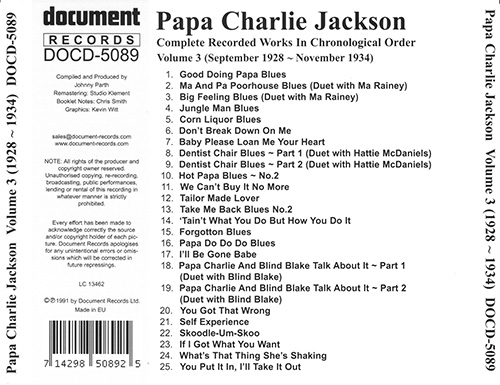
+ last month

.jpg)


JOSEPH GABRIEL RHEINBERGER : Organ Works • 3 (Wolfgang Rübsam) (2001) The Organ Encyclopedia Series | Two Version | WV (image+.tracks+.cue), lossless
Organist, conductor, composer and teacher, Rheinberger was born in Vaduz, in Liechtenstein, where he held his first appointment as organist....
