 The final of Document's prewar Big Bill Broonzy CDs (documenting all of his 1927-42 recordings) features Broonzy playing in a timeless style. Most of the performances could be considered goodtime music, with Broonzy sounding as if he were ready to party. On three of the four complete sessions that are included (plus "Rockin' Chair Blues," left over from the 1940 date otherwise included on Vol. 10), Broonzy is joined by either Memphis Slim, Horace Malcolm or Blind John Davis on piano, plus Washboard Sam (his half-brother) on washboard; Jazz Gillum sits in on harmonica during "Key to the Highway." The final set has Broonzy, pianist Memphis Slim and drummer Judge Riley joined by trumpeter Punch Miller and altoist Buster Bennett. Overall, this is a pretty strong program, with such numbers as "Sweet Honey Bee," "When I Been Drinking," "Key to the Highway," "Conversation With the Blues," "All By Myself," "I Feel So Good," "I'm Gonna Move to the Outskirts of Town" and "I'm Woke Up Now" being among the 25 selections. Big Bill Broonzy fans will want all of the releases in this remarkable series. Scott Yanow
Abridged from this album;s original booklet notes. The later thirties saw the first sign of economic recovery in America but Europe was in flames and it would only be a matter of time before the USA was drawn into the conflict. It was a time of turmoil but very little of it was reflected in the work of Big Bill Broonzy. He continued to produce good time music, proto R & B, personal blues and hokum with the occasional piece of nostalgia thrown in. After the death of his long-time associate Josh Altheimer, Bill utilized the piano playing talents of Horace Malcolm and the young Memphis Slim, usually filling out the sound with a string bass or his half-brother’s washboard. Malcolm was on the date which produced the untypical Green Grass Blues a piece of nonsense about the rural bliss typified by windmills and wells, owls and roosters and log cabins with dirt chimneys; a never-never land where Bill could “make love on the grass with no bills to pay”. More in line with his usual philosophy is When I Been Drinking, a song much favoured, later, by Sunnyland Slim. It underlines Bill’s comment on the last page of his biography that “some blues singers can and do sing and don’t drink, but not Big Bill”. The last track cut on this session was a one-off on which Bill sang with the support of Jazz Gillum’s harmonica to produce the rural sounding and justly famous Key To The Highway, a song that was to be sung by just about everybody in the 1960’s. His next session produced two of his most successful songs in Double Trouble and All By Myself, the latter to become a standard in the repertoire of Memphis Slim who was responsible for the vigorous piano that appears on this jaunty up-tempo boast. Another Big Bill Broonzy standard, I Feel So Good was cut at the session of 2nd December 1941. At the same time Bill, who had been drafted in 1918, also sang about getting a letter from “a dear old uncle” on In The Army Now. Ironically this session took place just days before the Japanese attacked Pearl Harbor. Two of the recordings made at this session would be featured on V-Discs supplied to the armed forces as a morale booster during the conflict that was about to begin. Big Bill’s last pre-war session was a date with his Chicago Five, a renamed Memphis Five involving the trumpet of Kid Punch Miller and the sometimes filthy alto sax of Buster Bennett. Bill seemed preoccupied by the subject of betrayal at this gig when he sang Casey Bill Weldon‘s Outskirts Of Town (he had played guitar on Casey Bill‘s 1936 recording) and I’m Woke Up Now where he says of his some-time friends “they will hide their hands, boys, – after they throw a brick”. Big Bill Broonzy would resume his career on record as soon as the war ended – at the same time starting a second career that would extend his popularity to make him one of the best-loved blues singers of all time. DOCD-5133
Tracklist :
1 Big Bill Broonzy– Rockin' Chair Blues 2:47
Big Bill Broonzy / Tommy McClennan
2 Big Bill Broonzy– Shine On, Shine On 2:57
3 Big Bill Broonzy– Green Grass Blues 2:59
Big Bill Broonzy
4 Big Bill Broonzy– My Little Flower 2:47
5 Big Bill Broonzy– Sweet Honey Bee 2:58
Big Bill Broonzy
6 Big Bill Broonzy– When I Been Drinking 2:50
Big Bill Broonzy
7 Big Bill Broonzy– Key To The Highway 3:01
Big Bill Broonzy / Charles Segar
8 Big Bill Broonzy– Double Trouble 2:46
9 Big Bill Broonzy– Going Back To My Plow 2:55
10 Big Bill Broonzy– I'm Having So Much Trouble 2:47
11 Big Bill Broonzy– Wee Wee Blues 2:57
Big Bill Broonzy
12 Big Bill Broonzy– Conversation With The Blues 2:34
Big Bill Broonzy
13 Big Bill Broonzy– All By Myself 2:26
Big Bill Broonzy
14 Big Bill Broonzy– Keep Your Hand On Your Heart 2:53
Big Bill Broonzy
15 Big Bill Broonzy– Why Should I Spend My Money? 2:49
16 Big Bill Broonzy– What's Wrong With Me? 2:35
Big Bill Broonzy
17 Big Bill Broonzy– I Feel So Good 2:45
Big Bill Broonzy
18 Big Bill Broonzy– In The Army Now 2:42
Big Bill Broonzy
19 Big Bill Broonzy– Bad Acting Woman 2:44
20 Big Bill Broonzy– Night Watchman Blues 2:48
Big Bill Broonzy
21 Big Bill Broonzy– She's Gone With The Wind 2:41
22 Big Bill And His Chicago Five– I'm Gonna Move To The Outskirts Of Town 2:52
Andy Razaf / Will Weldon
23 Big Bill And His Chicago Five– Tell Me, Baby 2:55
Big Bill Broonzy
24 Big Bill And His Chicago Five– Hard Hearted Woman 3:00
Big Bill Broonzy
25 Big Bill And His Chicago Five– I'm Woke Up Now 2:58
All Credits : 
5.1.25
BIG BILL BROONZY — Complete Recorded Works In Chronological Order ★ Volume 11 • 1940-1942 | DOCD-5133 (1993) FLAC (tracks+.cue), lossless


BIG BILL BROONZY — Complete Recorded Works In Chronological Order ★ Volume 12 • 1945-1947 | BDCD-6047 (1995) MONO | FLAC (tracks+.cue), lossless
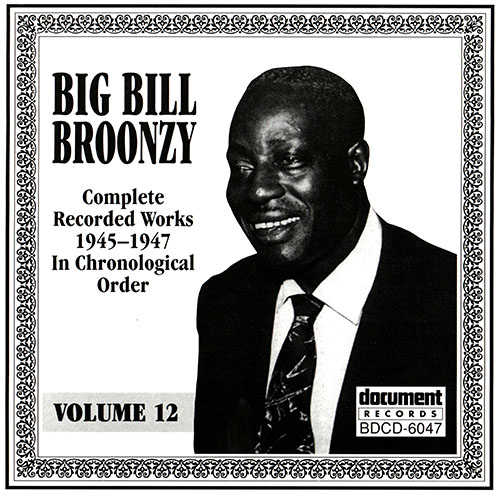 Tracklist :
1 Bull Cow Blues No.3 [Alt. Take] 3:07
2 Married Life Is A Pain [Alt. Take] 2:53
3 Black Mare Blues [Alt. Take] 2:51
4 W.P.A. Blues [Alt. Take] 3:13
5 Oh Babe (Don't Do Me That Way) [Alt. Take] 3:04
6 Little Bug [Alt. Take] 2:50
7 (I'm A) Wanderin' Man 3:06
8 I Love My Whiskey 3:03
9 You've Been Mistreatin' Me 2:53
10 I Stay Blue All The Time 2:27
11 Water Coast Blues 2:49
12 Five Feet Seven 3:21
13 I Wonder 2:52
14 Keep Your Hands Off Her 2:55
15 Mindin' My Own Business 3:09
16 John Henry 3:24
17 In The Evening When The Sun Goes Down 4:46
18 I Feel So Good 2:55
19 Who's Sorry Now 3:04
20 Trouble In Mind 3:07
21 Keep Your Hands Off Her 3:32
22 Mama Don't Allow 5:10
23 When The Saints Go Marching In 2:55
Credits :
Alto Saxophone – Buster Bennett (tracks: 5 - 12), Oett "Sax" Mallard (tracks: 13 - 16, 19 - 25)
Bass – John Levy (tracks: 1 - 4), Ransom Knowling (tracks: 13 - 18, 22 - 25)
Compiled By – Johnny Parth
Drums – Lawrence "Judge" Riley (tracks: 13 - 16, 19 - 25), Slick Jones (tracks: 1 - 4), Tyrell Dixon (tracks: 5 - 11, 17, 18)
Guitar, Vocals – Big Bill Broonzy
Piano – Big Maceo (tracks: 5 - 9), Bob Call (tracks: 19 - 25), Charles Belcher (tracks: 13 - 16), Kenny Watts (tracks: 1 - 4), Memphis Slim (tracks: 17, 18)
Tenor Saxophone – Bill Casimir (tracks: 13 - 16, 19 - 21), Don Byas (tracks: 1 - 4)
Trumpet – Johnny Morton (tracks: 13 - 16, 22 - 25)
BIG BILL BROONZY — Complete Recorded Works In Chronological Order ★ Volume 13 • 1949-1951 | DOCD-5696 (2014) MONO | FLAC (tracks+.cue), lossless

This collection begins, rather retrospectively, by presenting six alternative takes of titles recorded in Chicago for ARC by Big Bill between April, 1936 and January 1937. Other takes of these titles can be found on DOCD-5126 “Big Bill Broonzy Vol 4 1935 – 1936” and DOCD-5127 “Big Bill Broonzy Vol 5 1936 – 1937”. Having filled in some earlier gaps in Big Bill’s recording history, we move on to his first two recording sessions for the then fledgling, yet rapidly expanding, Mercury label, based in Chicago. There he met up with sax player Antonio Casey, pianist Carl Sharp, bass player Ransom Knowling and drummer Alfred Wallace. Big Bill and his colleagues recorded five numbers. All of the performances were of a high and some might say flawless standard.These recordings, made as “Bill Broonzy and his Fat Four”, represent Bill as one of the leading figures of Chicago’s “City” or “Urban Blues”. The band’s “down-home” sound, with Bill’s electric guitar and Knowling’s miked-up bass gives a warm yet energetic feel to the performances. Added to this, the characteristic 1940’s sound of the urban blues is accentuated further by dominant passages, crafted by the cries of Antonio Casey’s alto sax. In the same way that Bill’s earliest recordings, made in the late 1920’s and throughout the 30s, presented him as a fine exponent of the earlier “country blues” style, with, at times, extraordinary acoustic guitar accompaniment to his instantly agreeable vocal style, so did this first powerhouse session for Mercury underline Bill’s successful ability to move with the times and with great authority.
One of the best examples of his willingness to experiment and reinvent his music came with his return visit to the Mercury studios only a month later, this time with just the drummer Alfred Wallace. Following the full, urban, sound that the band had unquestionably produced in the previous session, Bill was about to successfully achieve a remarkable sea change by using a minimalistic approach to this second set of recordings for Mercury.
Track 16 and its subsequent tracks represent the final regeneration of Big Bill’s music, his career as a musician and his private life. In Europe the gathering interest in blues music came from an already large and vibrant fan-base for jazz. The Düsseldorf concert would be significant for two reasons. First, it would be one of the first concerts performed by non-German jazz musicians in Germany after World War Two. Secondly, the recording of the event, presented here, would become the only recording of his “live” performances to survive from his first tour of Europe.
Undoubtedly, compared to playing in the clubs of Chicago, during the twenties, thirties and forties, to stand on a stage in grand concert building in post-war Germany, in front of a large, white, seated audience, must have been a daunting experience for a black American performer who was relatively unknown beyond his own country. Yet, standing there alone in the spot light with only his acoustic guitar between him and his audience, Bill gently laughs and with that his audience gently laughs with him. Perhaps they are both acknowledging the extraordinary situation that they find themselves in. Indeed, Bill sounds genuinely happy as he moves with seemingly great confidence and rapport through his set. Perhaps he had taken a little “preparation” before he walked onto the stage. Who would blame him?
Instead of taking an easy route and easing himself into the set with a calm and gentle number, Bill introduces his first “title” and then opens up with a fizzing version of John Henry, using his rapid plectrum style, which he memorably used with great effect on such titles as “How You Want It Done?” recorded for the Banner label back in 1932. With the first two “thank you”’s of many to follow for his new audience, Bill by contrast, then plays the “calm” number; In The Evening When The Sun Goes Down. With perfect execution Bill has already won them over and one can only imagine the look of wonder and admiration if not curiousness of the faces in front of him as he gently eases his way, without another sound from the hall, through the song written by his old friend, the late Leroy Carr. By the end of the concert this new, enthralled audience, many, perhaps, becoming firm fans of Bill and his music for the first time, leave the hall for the bars or home, happy and satisfied. DOCD-5696
Tracklist :
1 Bull Cow Blues No.3 [Alt. Take] 3:07
2 Married Life Is A Pain [Alt. Take] 2:53
3 Black Mare Blues [Alt. Take] 2:51
4 W.P.A. Blues [Alt. Take] 3:13
5 Oh Babe (Don't Do Me That Way) [Alt. Take] 3:04
6 Little Bug [Alt. Take] 2:50
7 (I'm A) Wanderin' Man 3:06
8 I Love My Whiskey 3:03
9 You've Been Mistreatin' Me 2:53
10 I Stay Blue All The Time 2:27
11 Water Coast Blues 2:49
12 Five Feet Seven 3:21
13 I Wonder 2:52
14 Keep Your Hands Off Her 2:55
15 Mindin' My Own Business 3:09
16 John Henry 3:24
17 In The Evening When The Sun Goes Down 4:46
18 I Feel So Good 2:55
19 Who's Sorry Now 3:04
20 Trouble In Mind 3:07
21 Keep Your Hands Off Her 3:32
22 Mama Don't Allow 5:10
23 When The Saints Go Marching In 2:55
Credits :
Big Bill Broonzy - Vocal, Guitar
Includes : Black Bob - Piano
Charley McCoy - Mandolin
Antonio Casey - Alto Sax
Ransom Knowling - Bass
Alfred Wallace - Drums
Graham Bell’s Australian Jazz Band

4.1.25
SONNY BOY WILLIAMSON — Complete Recorded Works In Chronological Order ★ Volume 1 • 1937-1938 | DOCD-5055 (1991) RM | FLAC (tracks+.cue), lossless
 A comprehensive collection of the highly influential blues pioneer's 25 earliest works, recorded in 1937 and 1938. (Note: This is the Sonny Boy Williamson who was murdered in 1948, not the one who toured England with the Yardbirds in 1963).
Several of these songs, of course, have become blues standards, particularly "Good Morning School Girl," which has been covered countless times (the Yardbirds, Ten Years After, and others), and there's a surprising variety here; "Got the Bottle Up and Gone," for example, has an obvious jug band feel to it that's thoroughly at odds with the haunted sound of "Decoration Blues," or the proto-swamp "Up the Country Blues" (a song that clearly influenced Slim Harpo). AllMusic
Abridged from this album’s original booklet notes. In a brief life of thirty four years Sonny Boy Williamson achieved immortality as the pioneer of what was to become part of the post war electric sound of the Chicago Blues. To allow the harmonica, sometimes described as a ‘semi-legitimate’ instrument, to compete in a band environment, with drums, usually a piano and recently amplified guitars Sonny Boy literally embraced the microphone along with the harmonica to great effect. Often he would dove-tailing and blend the sound of the instrument with the beginning or end his songs lines. His popularity and influence were immense and survive until today. His techniques paved the way for many blues artists, including Sonny Boy (Rice Miller) Williamson, Little Walter, Junior Wells and many others. This, the first of five remarkable volumes from Document of the complete recordings of the father of amplified blues harmonica, demonstrates how Sonny Boy Williamson 1st brought the instrument from the country to the city and turned the small, pocket sized instrument into a major voice in the blues. In 1934 Sonny Boy moved to north to Chicago where he worked Maxwell Street and as a sideman with numerous blues groups at the local clubs. Sonny Boy‘s first recordings (that feature on this album) were accompanied by Big Joe Williams and Robert Lee McCoy (later to become famous as Robert Nighthawk) was made at the Leland Hotel, Aurora, Illinois, on the 5th May 1937 for the Bluebird label. The first track, Good Morning, School Girl, was not an unknown tune but Sonny Boy brought to it a set of lyrics that have stayed with it ever since. His attractive short tongued delivery and clean swinging harp playing became a hit and has since become a much recorded blues classic tune. Other tracks in this first session include the personal Blue Bird Blues dedicated to Sonny Boy‘s wife Lacey Belle, and the perennial Sugar Mama Blues. Sonny Boy went on to record another session in November 1937, Black Gal Blues from this set has become known as “Wild About You Baby”, while Early In The Morning was a reworking of the number usually associated with pianist Walter Roland. It is probably an indication of the interest in their new found star that the Bluebird label offered Sonny Boy another session in March 1938, which saw 10 songs being cut. Tracks from this session include My Little Cornelious (which is another version of “Blue Bird Blues”) and the reflective masterpiece Decoration Day, a markedly up-beat version of “You Can Lead Me”. The Mandolin of Yank Rachell fills out the sound on this set and lends a brittle driving force to the faster numbers. The fastest, I’m Tired Trucking My Blues Away sees Big Joe Williams guitar setting a furious pace behind Sonny Boy‘s virtuoso harmonica playing. This track really rocks and is an indication of the direction in which Sonny Boy Williamson the 1st was to take his music over the next few years. DOCD-5055
Tracklist :
1 Good Morning, School Girl 2:58
Guitar – Joe Williams, Robert Lee McCoy
Vocals, Harmonica – Sonny Boy Williamson
2 Blue Bird Blues 3:04
Guitar – Joe Williams, Robert Lee McCoy
Vocals, Harmonica – Sonny Boy Williamson
3 Jackson Blues 2:53
Guitar – Joe Williams, Robert Lee McCoy
Vocals, Harmonica – Sonny Boy Williamson
4 Got The Bottle Up And Gone 2:30
Guitar – Joe Williams
Guitar, Vocals – Robert Lee McCoy
Vocals, Harmonica – Sonny Boy Williamson
5 Sugar Mama Blues 2:55
Guitar – Joe Williams, Robert Lee McCoy
Vocals, Harmonica – Sonny Boy Williamson
6 Skinny Woman 2:57
Guitar – Joe Williams, Robert Lee McCoy
Vocals, Harmonica – Sonny Boy Williamson
7 Up The Country Blues 3:16
Guitar [probably] – Henry Townsend, Robert Lee McCoy
Piano – Walter Davis
Vocals, Harmonica – Sonny Boy Williamson
8 Worried Me Blues 2:28
Guitar [probably] – Henry Townsend, Robert Lee McCoy
Piano – Walter Davis
Vocals, Harmonica – Sonny Boy Williamson
9 Black Gal Blues 2:45
Guitar [probably] – Henry Townsend, Robert Lee McCoy
Piano – Walter Davis
Vocals, Harmonica – Sonny Boy Williamson
10 Collector Man Blues 3:15
Guitar [probably] – Henry Townsend, Robert Lee McCoy
Piano – Walter Davis
Vocals, Harmonica – Sonny Boy Williamson
11 Frigidaire Blues 2:58
Guitar [probably] – Henry Townsend, Robert Lee McCoy
Piano – Walter Davis
Vocals, Harmonica – Sonny Boy Williamson
12 Suzanna Blues 2:56
Guitar [probably] – Henry Townsend, Robert Lee McCoy
Piano – Walter Davis
Vocals, Harmonica – Sonny Boy Williamson
13 Early In The Morning 2:45
Guitar [probably] – Henry Townsend, Robert Lee McCoy
Piano – Walter Davis
Vocals, Harmonica – Sonny Boy Williamson
14 Project Highway 2:52
Guitar [probably] – Henry Townsend, Robert Lee McCoy
Piano – Walter Davis
Vocals, Harmonica – Sonny Boy Williamson
15 My Little Cornelius 3:07
Guitar – Joe Williams, Elijah Jones
Mandolin – Yank Rachell
Vocals, Harmonica – Sonny Boy Williamson
16 Decoration Blues 3:27
Guitar – Joe Williams, Elijah Jones
Mandolin – Yank Rachell
Vocals, Harmonica – Sonny Boy Williamson
17 You Can Lead Me 3:05
Guitar – Joe Williams, Elijah Jones
Mandolin – Yank Rachell
Vocals, Harmonica – Sonny Boy Williamson
18 Moonshine 2:58
Guitar – Joe Williams, Elijah Jones
Mandolin – Yank Rachell
Vocals, Harmonica – Sonny Boy Williamson
19 Miss Louisa Blues 2:52
Guitar – Joe Williams, Elijah Jones
Mandolin – Yank Rachell
Vocals, Harmonica – Sonny Boy Williamson
20 Sunny Land 3:14
Guitar, Speech [possibly] – Joe Williams, Elijah Jones
Mandolin, Speech [possibly] – Yank Rachell
Vocals, Harmonica – Sonny Boy Williamson
21 I'm Tired Trucking My Blues Away 2:53
Guitar, Speech [possibly] – Joe Williams, Elijah Jones, Yank Rachell
Vocals, Harmonica – Sonny Boy Williamson
22 Down South 3:03
Guitar – Joe Williams, Elijah Jones
Mandolin – Yank Rachell
Vocals, Harmonica – Sonny Boy Williamson
23 Beauty Parlor 3:24
Guitar – Joe Williams, Elijah Jones
Mandolin – Yank Rachell
Vocals, Harmonica – Sonny Boy Williamson
24 Until My Love Come Down 3:09
Guitar, Speech [possibly] – Joe Williams, Elijah Jones
Mandolin, Speech [possibly] – Yank Rachell
Vocals, Harmonica – Sonny Boy Williamson
25 Honey Bee Blues 3:02
Guitar – "Jackson" Joe Williams
Piano – Walter Davis
Vocals, Harmonica – Sonny Boy Williamson
SONNY BOY WILLIAMSON — Complete Recorded Works In Chronological Order ★ Volume 2 • 1938-1939 | DOCD-5056 (1991) RM | FLAC (tracks+.cue), lossless
 Document's Complete Recorded Works, Vol. 2 (1938-1939) picks up where the first volume left off, reissuing 24 tracks from the 13-month period of June 1938 to July 1939. Unfortunately, there weren't as many classic performances during this era, leaving this the odd one out from the many volumes in this set. Serious blues fans will still find much of interest here, including versions of "Susie-Q" and "You've Been Foolin' Round Town," plus a second stab at his classic "Sugar Mama Blues." Thom Owens
Abridged from this album’s original booklet notes. By 1938 any lingering doubts Bluebird might have had about Sonny Boy Williamson had been laid to rest and they had him in the studio three times that year. Sonny Boy was joined by Big Joe Williams and Yank Rachell during his second session in the studio and it is speculated to be the latter playing guitar on the rather hastily arranged title track My Baby I’ve Been Your Slave. For the second number Yank Rachell is on his more usual instrument, the Mandolin, to contribute to the crisp backing of Whiskey Headed Blues, a number that has since been given various treatments by artists such as Tommy McClennan and John Lee Hooker. On Shannon Street Sonny Boy describes getting drunk in Jackson and his wife’s reaction to the event. Alcohol and Sonny Boy Williamson were not a good mix and he would have increasing problems with it throughout his life. Deep Down In The Ground is built on the base of another song “Stack of Dollars”, a song associated with Sleepy John Estes and often performed by Big Joe Williams. For the next session Sonny Boy Williamson found himself in the recording company of Robert Lee McCoy (Nighthawk) on guitar, Rufus ‘Speckled Red’ Perryman on piano and an unknown (speculated to be Willie Hatcher) on mandolin. This time round the songs were more of a mixture and Sonny Boy illustrates that both he and his Harmonica have made the transition from a country style of playing to a big city environment sound. On the tracks Little Girl Blues and Low Down Ways it is almost impossible to believe that the same man can be both playing and singing. Other tracks include the swing dance numbers Susie Q, and Goodbye Red which is a reply to Harlem Hamfats’ hugely successful “Oh Red!”. These upbeat, foot tapping, down-home numbers are balanced by the urban inspired tracks Insurance Man and The Right Kind Of Life. More innovations were to follow on the 1939 session where Sonny Boy was joined by Walter Davis and Big Bill Broonzy. One of the outstanding tracks Little Low Woman Blues has Sonny Boy playing a high register harmonica which foreshadows the sound of Jimmy Reed. Big Bill‘s guitar work is more sophisticated than that of Sonny Boy‘s previous partners, shown to good effect on the tracks Good For Nothing Blues and Sugar Mama Blues No.2 where his delicate runs and fills almost over-shadow the harmonica. On the final track Good Gravy Big Bill and Sonny Boy spark off each other to perform a bravura performance that really swings. DOCD-5056
Tracklist :
1 My Baby, I've Been Your Slave 3:02
Guitar, Speech [possibly] – "Jackson" Joe Williams
Mandolin, Speech [possibly] – Yank Rachell
Piano – Walter Davis
Vocals, Harmonica – Sonny Boy Williamson
2 Whiskey Headed Blues 2:54
Guitar – "Jackson" Joe Williams
Mandolin – Yank Rachell
Vocals, Harmonica – Sonny Boy Williamson
3 Lord, Oh Lord Blues 2:59
Guitar – "Jackson" Joe Williams
Mandolin – Yank Rachell
Vocals, Harmonica – Sonny Boy Williamson
4 You Give An Account 3:10
Guitar – "Jackson" Joe Williams
Mandolin – Yank Rachell
Vocals, Harmonica – Sonny Boy Williamson
5 Shannon Street Blues 3:20
Guitar – "Jackson" Joe Williams
Mandolin – Yank Rachell
Vocals, Harmonica – Sonny Boy Williamson
6 You've Been Foolin' 'Round Town 2:45
Guitar – "Jackson" Joe Williams
Mandolin – Yank Rachell
Vocals, Harmonica – Sonny Boy Williamson
7 Deep Down In The Ground 3:14
Guitar – "Jackson" Joe Williams
Vocals, Harmonica – Sonny Boy Williamson
8 Number Five Blues 3:27
Guitar [probably] – Robert Lee McCoy
Mandolin [probably] – Willie Hatcher
Piano – Speckled Red
Vocals, Harmonica – Sonny Boy Williamson
9 Christmas Morning Blues 3:21
Guitar [probably] – Robert Lee McCoy
Mandolin [probably] – Willie Hatcher
Piano – Speckled Red
Vocals, Harmonica – Sonny Boy Williamson
10 Susie-Q 3:10
Guitar [probably] – Robert Lee McCoy
Mandolin [probably] – Willie Hatcher
Piano – Speckled Red
Vocals, Harmonica – Sonny Boy Williamson
11 Blue Bird Blues - Part 2 3:22
Guitar [probably] – Robert Lee McCoy
Mandolin [probably] – Willie Hatcher
Piano – Speckled Red
Vocals, Harmonica – Sonny Boy Williamson
12 Little Girl Blues 3:17
Guitar [probably] – Robert Lee McCoy
Mandolin [probably] – Willie Hatcher
Piano – Speckled Red
Vocals, Harmonica – Sonny Boy Williamson
13 Low Down Ways 3:10
Guitar [probably] – Robert Lee McCoy
Mandolin [probably] – Willie Hatcher
Piano – Speckled Red
Vocals, Harmonica – Sonny Boy Williamson
14 Goodbye Red 3:10
Guitar [probably] – Robert Lee McCoy
Mandolin [probably] – Willie Hatcher
Piano – Speckled Red
Vocals, Harmonica – Sonny Boy Williamson
15 The Right Kind Of Life 3:20
Guitar [probably] – Robert Lee McCoy
Mandolin [probably] – Willie Hatcher
Piano – Speckled Red
Vocals, Harmonica – Sonny Boy Williamson
16 Insurance Man Blues 3:17
Guitar [probably] – Robert Lee McCoy
Mandolin [probably] – Willie Hatcher
Piano – Speckled Red
Vocals, Harmonica – Sonny Boy Williamson
17 Rainy Day Blues 3:16
Guitar [probably] – Robert Lee McCoy
Mandolin [probably] – Willie Hatcher
Piano – Speckled Red
Vocals, Harmonica – Sonny Boy Williamson
18 Bad Luck Blues 2:39
Guitar – Big Bill Broonzy
Piano – Walter Davis
Vocals, Harmonica – Sonny Boy Williamson
19 My Little Baby 2:56
Guitar – Big Bill Broonzy
Piano – Walter Davis
Vocals, Harmonica – Sonny Boy Williamson
20 Doggin' My Love Around 3:12
Guitar – Big Bill Broonzy
Piano – Walter Davis
Vocals, Harmonica – Sonny Boy Williamson
21 Little Low Woman Blues 2:45
Guitar – Big Bill Broonzy
Piano – Walter Davis
Vocals, Harmonica – Sonny Boy Williamson
22 Good For Nothing Blues 3:01
Guitar – Big Bill Broonzy
Piano – Walter Davis
Vocals, Harmonica – Sonny Boy Williamson
23 Sugar Mama Blues No. 2 3:07
Guitar – Big Bill Broonzy
Piano – Walter Davis
Vocals, Harmonica – Sonny Boy Williamson
24 Good Gravy 2:45
Guitar – Big Bill Broonzy
Vocals, Harmonica – Sonny Boy Williamson
+ last month

.jpg)


JOSEPH GABRIEL RHEINBERGER : Organ Works • 5 (Wolfgang Rübsam) (2003) The Organ Encyclopedia Series | Two Version | WV (image+.tracks+.cue), lossless
Although Rheinberger was successful during his lifetime in a variety of genres, he is remembered today largely for his demanding organ works...
