Mostrando postagens com marcador Bill Bruford. Mostrar todas as postagens

27.3.26

CHRIS SQUIRE — Fish Out of Water (1975-2014) RM | SHM-CD | Serie Yes Solos Collection | Two Version | FLAC (image+.tracks+.cue), lossless


Yes-like in every possible aspect, Chris Squire's Fish out of Water is an album that's typical of his band's progressive formula: softened keyboard extensions à la Patrick Moraz, steady yet atmospheric percussion work from Bill Bruford, and a smattering of flute and saxophone that accompanies a small orchestra, which includes effective horn and harp work. Squire's guitar playing is standard, coming to life the most on "Silently Falling" and "Lucky Seven," with the former boosted by a rather dazzling synthesizer solo from Moraz. Even though there are few surprises laid out on the album's five tracks, the elemental composition of pure '70s progressive rock is strewn across each song from start to finish. Squire even sounds like Jon Anderson, especially on "Hold out Your Hand," and each of the song's melodies cater to Squire's vocal ascent. Fish out of Water harbors some firm instrumental and vocal cross-breeding while remaining well within the prog rock norm. Mike DeGagne 
Tracklist :
1.     Hold Out Your Hand 4:14 

2.     You By My Side 5:03
3.     Silently Falling 11:21
4.     Lucky Seven 6:57
5.     Safe (Canon Song) 14:53
Credits :
Bass, Guitar, Vocals, Arranged By, Producer, Written-By – Chris Squire
Drums, Percussion – Bill Bruford
Flute – Jimmy Hastings
Harp – David Snell
Leader [Brass Sections] – John Wilbraham
Leader [Horn Sections] – Jim Buck
Leader [String Sections] – Julian Gaillard
Leader [Woodwind Sections] – Adrian Brett
Organ [Pipe] – Barry Rose
Organ, Synthesizer [Bass] – Patrick Moraz
Piano, Electric Piano, Conductor – Andrew Pryce Jackman
Saxophone – Mel Collins

6.3.24

KING CRIMSON — Larks' Tongues In Aspic (1981) Three Version (1987, Japan, EMI-Toshiba, 32VD-1122) + (1988, Virgin Japan, VJD-28003 | Serie Big Artist Collection) + (2012, RM | 2CD | King Crimson 40th Anniversary Series) FLAC (image+.cue), lossless

King Crimson reborn yet again -- the then-newly configured band makes its debut with a violin (courtesy of David Cross) sharing center stage with Robert Fripp's guitars and his Mellotron, which is pushed into the background. The music is the most experimental of Fripp's career up to this time -- though some of it actually dated (in embryonic form) back to the tail-end of the Boz Burrell-Ian Wallace-Mel Collins lineup. And John Wetton was the group's strongest singer/bassist since Greg Lake's departure three years earlier. What's more, this lineup quickly established itself as a powerful performing unit, working in a more purely experimental, less jazz-oriented vein than its immediate predecessor. "Outer Limits music" was how one reviewer referred to it, mixing Cross' demonic fiddling with shrieking electronics, Bill Bruford's astounding dexterity at the drum kit, Jamie Muir's melodic and usually understated percussion, Wetton's thundering yet melodic bass, and Fripp's guitar, which generated sounds ranging from traditional classical and soft pop-jazz licks to hair-curling electric flourishes. Bruce Eder
Tracklist :
1. Larks' Tongues In Aspic, Part One (13:36)
Bill Bruford / David Cross / Robert Fripp / Jamie Muir / John Wetton

2. Book Of Saturday (02:56)
Robert Fripp / Richard Palmer-James / John Wetton
3. Exiles (07:41)
David Cross / Robert Fripp / Richard Palmer-James
4. Easy Money (07:53)
Robert Fripp / Richard Palmer-James / John Wetton
5. The Talking Drum (07:27)
Bill Bruford / David Cross / Robert Fripp / Jamie Muir / John Wetton
6. Larks' Tongues In Aspic, Part Two (07:08)
Robert Fripp
Credits :
Robert Fripp – Guitars, Mellotron, Electric Piano, Devices
John Wetton – Bass Guitar, Vocals, Piano on "Exiles"
Bill Bruford – Drums
David Cross – Violin, Viola, Mellotron, Electric Piano, Flute on "Exiles"[9]
Jamie Muir – Percussion, "allsorts"
(assorted found items and sundry instruments)
Producer – King Crimson

KING CRIMSON — Starless And Bible Black (1981) Four Version (1987, Virgin Japan, 32VD-1123) + (1988, Serie Big Artist Collection | Virgin Japan, VJD-28004) + (1990, Virgin Japan, VJCP-2306) + (2011, USA | RM | Serie King Crimson 40th Anniversary Series) FLAC (image+.cue), lossless

Starless and Bible Black is even more powerful and daring than its predecessor, Larks' Tongues in Aspic, with jarring tempo shifts, explosive guitar riffs, and soaring, elegant, and delicate violin and Mellotron parts scattered throughout its 41 minutes, often all in the same songs. The album was on the outer fringes of accessible progressive rock, with enough musical ideas explored to make Starless and Bible Black more than background for tripping the way Emerson, Lake & Palmer's albums were. "The Night Watch," a song about a Rembrandt painting, was, incredibly, a single release, although it was much more representative of the sound that Crimson was abandoning than where it was going in 1973-1974. More to that point were the contents of side two of the LP, a pair of instrumentals that threw the group's hardest sounds right in the face of the listener, and gained some converts in the process. Bruce Eder
Tracklist :
1. The Great Deceiver (04:03)
Robert Fripp / Richard Palmer-James / John Wetton

2. Lament (04:05)
Robert Fripp / Richard Palmer-James / John Wetton
3. We'll Let You Know (03:42)
Bill Bruford / David Cross / Robert Fripp / John Wetton
4. The Night Watch (04:40)
Robert Fripp / Richard Palmer-James / John Wetton
5. Trio (05:41)
Bill Bruford / David Cross / Robert Fripp / John Wetton
6. The Mincer (04:11)
Bill Bruford / Richard Palmer-James / Robert Fripp / John Wetton
7. Starless And Bible Black (09:10)
Bill Bruford / David Cross / Robert Fripp / John Wetton
8. Fracture (11:15)
Robert Fripp
Credits :
Bass, Voice – John Wetton
Guitar, Mellotron, Electronics [Devices] – Robert Fripp
Lyrics By – Richard Palmer-James
Percussion [Percussives] – William Bruford
Producer – King Crimson
Violin, Viola, Keyboards – David Cross (tracks: 3, 5 to 7)

KING CRIMSON — Red (1981) Four Version (1987, Japan EMI-Toshiba, 32VD-1086) + (1988, Serie Big Artist Collection | Japan, Virgin, VJD-28021) + (1990, RM | Serie The Definitive Edition | Japan, Virgin, VJCP-2307) + (2013, USA | RM | 2CD | Serie King Crimson 40th Anniversary Series) FLAC (image+.cue), lossless


King Crimson fell apart once more, seemingly for the last time, as David Cross walked away during the making of this album. It became Robert Fripp's last thoughts on this version of the band, a bit noiser overall but with some surprising sounds featured, mostly out of the group's past – Mel Collins' and Ian McDonald's saxes, Marc Charig's cornet, and Robin Miller's oboe, thus providing a glimpse of what the 1972-era King Crimson might've sounded like handling the later group's repertory (which nearly happened). Indeed, Charig's cornet gets just about the best showcase it ever had on a King Crimson album, and the truth is that few intact groups could have gotten an album as good as Red together. The fact that it was put together by a band in its death throes makes it all the more impressive an achievement. Indeed, Red does improve in some respects on certain aspects of the previous album – including "Starless," a cousin to the prior album's title track – and only the lower quality of the vocal compositions keeps this from being as strongly recommended as its two predecessors. Bruce Eder
Tracklist :
1. Red (6:17)
2. Fallen Angel (6:03)
3. One More Red Nightmare (7:10)
4. Providence (8:10)
5. Starless (12:17)
Credits :
Alto Saxophone – Ian McDonald
Bass, Vocals – John Wetton
Cornet – Marc Charig
Guitar, Mellotron – Robert Fripp
Oboe – Robin Miller
Percussion [Percussives] – William Bruford
Soprano Saxophone – Mel Collins
Violin – David Cross

5.3.24

KING CRIMSON — Discipline (1981) Four Version (1987, Virgin Japan, 32VD-1087) + (1988, Virgin Japan – VJD-28022 | Serie Big Artist Collection) + (1990, RM | Virgin Japan – VJCP-2308) + (2004, RM | HDCD | 30th Anniversary Edition) FLAC (image+.cue), lossless


When King Crimson leader Robert Fripp decided to assemble a new version of the band in the early '80s, prog rock fans rejoiced, and most new wave fans frowned. But after hearing this new unit's first release, 1981's Discipline, all the elements that made other arty new wave rockers (i.e., Talking Heads, Pere Ubu, the Police, etc.) successful were evident. Combining the futuristic guitar of Adrian Belew with the textured guitar of Fripp doesn't sound like it would work on paper, but the pairing of these two originals worked out magically. Rounding out the quartet was bass wizard Tony Levin and ex-Yes drummer Bill Bruford. Belew's vocals fit the music perfectly, sounding like David Byrne at his most paranoid at times (the funk track "Thela Hun Ginjeet"). Some other highlights include Tony Levin's "stick" (a strange bass-like instrument)-driven opener "Elephant Talk," the atmospheric "The Sheltering Sky," and the heavy rocker "Indiscipline." Many Crimson fans consider this album one of their best, right up there with In the Court of the Crimson King. It's easy to understand why after you hear the inspired performances by this hungry new version of the band. Greg Prato
Tracklist :
1. Elephant Talk (04:43)
2. Frame By Frame (05:09)
3. Matte Kudasai (03:47)
4. Indiscipline (04:33)
5. Thela Hun Ginjeet (06:26)
6. The Sheltering Sky (08:22)
7. Discipline (05:13)
8. Matte Kudasai (Alternative version) (03:51)
Credits :
Chapman Stick, Bass, Vocals [Support] – Tony Levin
Drums [Batterie] – Bill Bruford
Guitar, Lead Vocals – Adrian Belew
Guitar, Performer [Devices] – Robert Fripp
Music By – Belew (tracks: 1)
Music By, Written-By – King Crimson

KING CRIMSON — Beat (1982) Three Version (1987, Virgin Japan – 32VD-1088) + (1990, RM | Virgin Japan – VJCP-2309) + (2005, RM | HDCD | 30th Anniversary Edition) FLAC (image+.cue), lossless

Beat is not as good as its predecessor (1981's Discipline), but it's not too shabby, either. The '80s version of King Crimson (Robert Fripp, guitar; Adrian Belew, vocals/guitar; Tony Levin, bass; and Bill Bruford, drums) retains the then-modern new wave sound introduced on Discipline. The band's performances are still inspired, but the songwriting isn't as catchy or strong. The moody love song "Heartbeat" has become a concert favorite for the band, and contains a Jimi Hendrix-like backward guitar solo. Other worthwhile tracks include "Waiting Man," which features world music sounds (thanks to some stunning bass/percussion interplay), and "Neurotica" does an excellent job of painting an unwavering picture of a large U.S. city, with its jerky rhythms and tense vocals. With lots of different guitar textures, bass explorations, and uncommon drum rhythms present, King Crimson's Beat will automatically appeal to other musicians. But since they're fantastic songwriters as well, you don't have to be a virtuoso to feel the passion of their music. Greg Prato
Tracklist :
1. Neal And Jack And Me (04:23)
2. Heartbeat (03:54)
3. Sartori In Tangier (03:35)
4. Waiting Man (04:24)
5. Neurotica (04:49)
6. Two Hands (03:23)
7. The Howler (04:12)
8. Requiem (06:35)
Credits :
Chapman Stick, Bass, Backing Vocals – Tony Levin
Drums – Bill Bruford
Guitar, Lead Vocals – Adrian Belew
Guitar, Organ, Other [Frippertronics] – Robert Fripp
Lyrics By – Adrian Belew (tracks: 1, 2, 4, 5, 7)

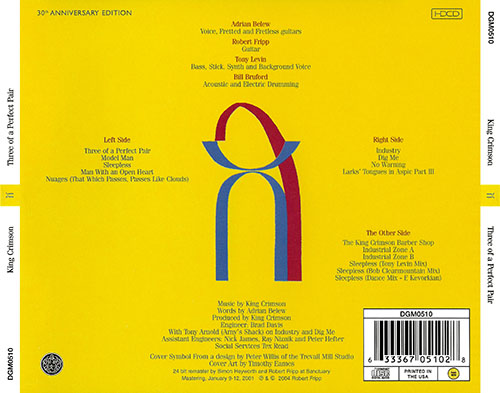
KING CRIMSON — Three of a Perfect Pair (1984) Three Version (1986, Japan EG – VJD-28005) + (1994, EG – EGCD 55 | Serie The Definitive Edition) + (2004, RM | HDCD | Serie 30th Anniversary Edition) FLAC (image+.cue), lossless


Upon its release in 1984, Three of a Perfect Pair caused some unrest among fans of King Crimson. Most of their audience felt that the band had made a conscious and obvious decision to try to break through to a more mainstream pop audience. But in hindsight, this is hardly the case; it sounds unlike anything that was out at the time. Like 1982's Beat, Three of a Perfect Pair doesn't quite meet the high standards set by 1981's Discipline, but does contain a few Crimson treats. The opening title track has an unrelenting groove that never seems to let up, while "Sleepless" starts off with Tony Levin laying down some funky bass until Adrian Belew's trademark paranoid vocals kick in and assure the listener that "it's alright to feel a little fear." Also included are the seven-minute instrumental soundscape "Industry," and the cautionary tale of a "Model Man." This would prove to be the new King Crimson's last release for nearly ten years; the group disbanded soon after as its members concentrated on solo careers and other projects, until a mid-'90s reunion brought them all back together. Greg Prato
Tracklist :
1. Three Of A Perfect Pair (04:13)
2. Model Man (03:51)
3. Sleepless (05:19)
4. Man With An Open Heart (03:05)
5. Nuages (That Which Passes, Passes Like Clouds) (04:46)
6. Industry (07:20)
7. Dig Me (03:01)
8. No Warning (03:29)
9. Larks' Tongues In Aspic Part 3 (06:03)
Credits :
Bass, Chapman Stick [Stick], Synthesizer, Voice [Background] – Tony Levin
Drums [Acoustic Drumming], Electronic Drums [Electric Drumming] – Bill Bruford
Guitar – Robert Fripp
Guitar [Fretted, Fretless], Voice, Words By – Adrian Belew
Producer, Music By – King Crimson

KING CRIMSON — THRAK (1995) Two Version (2004, RM | HDCD | Serie 30th Anniversary Edition) + (2006, Japan, WHD Entertainment, IECP-10045) FLAC (image+.cue), lossless


The only progressive rock band from the '60s to be making new, vital, progressive music in the '90s, King Crimson returned from a ten-year exile in 1995 with THRAK, their first album since 1984's Three of a Perfect Pair. As with the '80s band, guitarist/ringleader Robert Fripp recruited singer/guitarist Adrian Belew, bassist Tony Levin, and drummer Bill Bruford for this incarnation of his classic band. However, he added to this familiar quartet two new members: Chapman Stick player Trey Gunn and ex-Mr. Mister drummer Pat Mastelotto. Effectively, Fripp created a "double trio," and the six musicians combine their instruments in extremely unique ways. The mix is very dense, overpoweringly so at times, but careful listens will reveal that each musician has his own place in each song; the denseness of the sound is by design, not the accidental result of too many cooks in the kitchen. Sometimes, as in "THRAK," the two trios are set against each other, in some sort of musical faux combat. In others, they just combine their respective sounds to massive effect. On "Dinosaur," perhaps the strongest track on the record, Mastelotto and Bruford set up an ominous tom-tom groove that supports an even more ominous guitar figure. The vocal, the musings of a long-dead sauropod, are vintage Belew, just as the freaky, falling-down-the-stairs solo in the middle is vintage Fripp. Other high points include the drum duet "B'Boom" and the two Belew/Fripp "Inner Garden" pieces. Allusions to earlier Crimson abounds, such as the form of "VROOM," for example, which is suspiciously reminiscent of "Red" (from the 1974 album of the same name), or the shout-out to "The Sheltering Sky" (from 1981's Discipline) in "Walking on Air." Thankfully, this never gets annoying, but instead acts as a subtle nudge and a wink to faithful fans. King Crimson came back in a major way with THRAK, and proved that, even in its fourth major incarnation, Fripp and company still had something to say. High-quality prog. Daniel Gioffre
Tracklist :
1    VROOOM    4:37
2    Coda: Marine 475    2:41

3    Dinosaur    6:35
4    Walking On Air    4:34
5    B'Boom    4:11
6    THRAK    3:58
7    Inner Garden I    1:47
8    People    5:53
9    Radio I    0:43
10    One Time    5:21
11    Radio II    1:02
12    Inner Garden II    1:15
13    Sex Sleep Eat Drink Dream    4:48
14    VROOOM VROOOM    5:37
15    VROOOM VROOOM: Coda    3:00
Credits :
Backing Vocals, Chapman Stick [Stick] – Trey Gunn
Backing Vocals, Electric Upright Bass [Upright Bass], Electric Bass – Tony Levin
Guitar, Effects [Soundscapes], Mellotron – Robert Fripp
Guitar, Voice, Words By – Adrian Belew
Music By – King Crimson
Percussion [Acoustic & Electronic] – Bill Bruford, Pat Mastelotto 

13.7.22

DAVID TORN - Cloud About Mercury (1987-2019) APE (image+.cue), lossless

“Everything is in a state of transition,” David Torn explained. “Mercury is an element that captures the essence of change.” The changing soundscape of improvisation in the mid-1980s informs the textures and colours of Cloud About Mercury, whose sonorities are closely related to progressive rock (the rhythm section is half of one incarnation of King Crimson) and to the experimental end of ambient music. Drummer Bill Bruford’s affection for this album is undying: “To this day, Torn’s guitar on ‘Three Minutes of Pure Entertainment’ from Cloud About Mercury makes the hairs stand up on the back of my neck.” ecm
Tracklist :
1    suyafhu skin... snapping the hollow reed 8'21
(David Torn)
2    the mercury grid 6'33
(David Torn)
3    3 minutes of pure entertainment 7'09
(David Torn)
4    previous man 7'55
(Tony Levin, Bill Bruford, David Torn, Mark Isham)
5    network of sparks: the delicate code 4'52
(David Torn)
6    network of sparks: egg learns to walk - ... suyafhu seal 10'25
(David Torn, Bill Bruford, Mark Isham, Tony Levin)
Credits :
David Torn   Electric Guitar, Acoustic Guitar
Mark Isham   Trumpet, Piccolo Trumpet, Flugelhorn, Synthesizer
Tony Levin   Chapman Stick, Synthesizer Bass
Bill Bruford   Simmons Drums, Synthesizer Drums, Percussion   

27.5.20

BILL BRUFORD - Feels Good To Me (1978) lp [24bits-96hz] FLAC (tracks+.cue), lossless

This is the first solo date by drummer Bill Bruford after the first demise of King Crimson. Feels Good to Me goes far beyond the usual prog rock conceits of its time, and enters fully into the compositional structures and improvisational dynamics of jazz. Here he surrounds himself with various mates from the Canterbury scene -- guitarists Allan Holdsworth (Soft Machine and Tony Williams' Lifetime) and John Goodsall (Brand X), bassist Jeff Berlin, keyboardist Dave Stewart, and ECM flügelhorn stalwart Kenny Wheeler. He also enlisted the enigmatic vocal prowess of poet, singer, and songwriter Annette Peacock.
The opener, "Beelzebub," is a furious staccato workout. Holdsworth trades eights with Bruford and Berlin executes loping basslines as Stewart waxes painterly with both organ and synthesizer. It's knotty and stops on a dime before charging into a beautiful solo by Holdsworth and resolving itself with the ensemble restating the theme. "Back to the Beginning" has one of four vocal performances by Peacock. It's a jazz tune -- funky, syncopated, and heavily and wildly lyrical both in groove and meter. It's a song about addictions and, given Peacock's sultry treatment, it's hard to tell if they are chemical, material, or sexual. The band works hard staying behind the singer but can't help but overshadow her.
On the two-part "Seems Like a Lifetime Ago," musical schizophrenia sets in. After a colorful pastoral intro, Peacock glides beautifully through Bruford's lyric of forlorn reverie accompanied by a gorgeous Wheeler solo. Then "Part Two" begins with her growling out the refrain and the band taking off for parts unknown. Hard funky rhythms call Holdsworth's lead guitar to move flat up against Bruford's frenetic drumming. They challenge each other dynamically as the rest of the rhythm section nervously dances around them. Holdsworth finally grabs the lead and plays a solo that is nothing short of breathtaking, giving way to a restatement of the theme and Bruford opening up the harmonic structure before bringing it to a transcendent close two minutes later. The album's six instrumentals are tight: they hold improvisational breaks to the limits of compositional dictation rather than vice versa. The most beautiful, "Either End of August," features Stewart and Wheeler playing unusual yet melodic solos that entwine with each other as the rest of the band struggles to keep the drama out of the music. They don't succeed entirely and the track is all the better for it.
The set closes with "Adios a la Pasada (Goodbye to the Past)," a collaboration between Peacock and Bruford. It's on Peacock's favorite theme: to emerge from love scraped and beaten, yet resolved to keep an open heart. The opening is spare and strange, coated with whispering keyboards and bass haunting the artist's every word. Then Bruford majestically leads the band, soaring into the heart of her lyric, "What it is/Is this/Is what it is/Forgive yourselves/Release yourselves from the past." The music opens up an entirely new sonic dimension, as if history, both musical and emotional, was being rewritten. And it was. Bruford has yet to issue a solo recording as powerful as Feels Good to Me.  by Thom Jurek  
Tracklist:
A1 - Beelzebub 3:16
Written-By - Bill Bruford
A2 - Back To The Beginning 7:09
Words By, Music By - Bill Bruford
A3 - Seems Like A Lifetime Ago (Part One) 2:30
Words By, Music By - Bill Bruford
A4 - Seems Like A Lifetime Ago (Part Two) 4:25
Written-By - Bill Bruford
A5 - Sample And Hold 5:12
Written-By - Bill Bruford, Dave Stewart

B1- Feels Good To Me 3:49
Guitar [Additional] - John Goodsall / Written-By - Bill Bruford
B2 - Either End Of August 5:27
Written-By - Bill Bruford
B3 - If You Can't The Heat 3:20
Written-By - Bill Bruford, Dave Stewart
B4 - Springtime In Siberia 2:43
Written-By - Bill Bruford, Dave Stewart
B5 - Adios A La Pasada (Goodbye To The Past) 7:56
Music By - Bill Bruford / Words By - Annette Peacock
Credits
Bass – Jeff Berlin
Featuring [With], Flugelhorn – Kenny Wheeler
Guitar – Allan Holdsworth
Keyboards – Dave Stewart
Percussion [Tuned And Untuned Percussion], Drums [Kit Drums] – Bill Bruford
Vocals – Annette Peacock
 

BRUFORD - One of a Kind (1979) FLAC (image+.cue), lossless

Bill Bruford ended his brief affair with U.K. and condensed his original outfit to a quartet, releasing a second album of sinewy, celebratory jazz/rock fusion, One of a Kind. Good-humored twists and turns abound in the music, punctuated by Bruford's steadying if slightly subversive rhythms, Allan Holdsworth's flashes of fire, Jeff Berlin's insistent bass, and Dave Stewart's remarkably colorful keyboards. At the heart of many of these songs is an uplifting melody, a trait shared with fusion artists like Weather Report and Jean-Luc Ponty, though Bruford's outfit favors a faster pace than the former and pursues more musical avenues in a single song than the latter. When he takes to tuned percussion, Bruford can even sound like Frank Zappa (both bands have a funky side to them). Standout cuts this time include "Hell's Bells," "Fainting in Coils" (which, in an indirect link to his previous employers, would have felt at home on Robert Fripp's Exposure), "Five G," and "The Sahara of Snow." The remaining tracks are a little less muscular, and the band's strength would seem to lie in fusion propelled by the complex rhythmic patterns of Bruford and Berlin (i.e., when the band leans closer to the rock side of the fusion family). Those who enjoy their fusion with a healthy dose of rock will find One of a Kind a fair match for anything from Return to Forever or Brand X. Note that many of these songs also appear in live versions on the beat-the-boots release The Bruford Tapes. by Dave Connolly  
Tracklist:
1 Hell's Bells 3:33
Written-By – Gowen, Stewart
2 One Of A Kind - Part One 2:20
Written-By – Bruford
3 One Of A Kind - Part Two 4:04
Written-By – Bruford, Stewart
4 Travels With Myself - And Someone Else 6:13
Written-By – Bruford
5 Fainting In Coils 6:33
Narrator – Sam Alder
Voice [Alice] – Anthea Norman Taylor
Voice [The Mock Turtle] – Bill Bruford
Words By – Lewis Carroll
Written-By – Bruford
6 Five G 4:46
Written-By – Bruford, Stewart, Berlin
7 The Abingdon Chasp 4:54
Written-By – Holdsworth
8 Forever Until Sunday 5:51
Written-By – Bruford
9 The Sahara Of Snow - Part One 5:18
Written-By – Bruford
10 The Sahara Of Snow - Part Two 3:24
Written-By – Bruford, Jobson
Credits:
Bass [The Bass], Vocals [The Vocals] – Jeff Berlin
Drums [The Drums] – Bill Bruford
Guitar [The Guitar] – Allan Holdsworth
Keyboards [The Keyboards] – Dave Stewart
Producer – Bill Bruford

13.3.20

ANDERSON · BRUFORD · WAKEMAN · HOWE — Anderson Bruford Wakeman Howe (1989-2010) 2CD | FLAC (tracks+.cue), lossless

File under "Yes." When this version of the band couldn't obtain rights to the name, they put their album out under their combined names, but it's still Yes by any other name. Jon Anderson's tenor wails through spacy lyrics, Rick Wakeman constructs cathedrals of synthesized sound, Steve Howe rips high-pitched guitar leads, and Bill Bruford makes his drums sound like timpani. For all that, it's a pedestrian effort for these veterans, not as bombastic as some of their stuff, not as inspired as others, but it definitely has the "Yes" sound. "She Gives Me Love" even refers to "Long Distance Runaround." by William Ruhlmann

ANDERSON · BRUFORD · WAKEMAN · HOWE — Brother of Mine (1989) Single | FLAC (image+.cue), lossless


ANDERSON · BRUFORD · WAKEMAN · HOWE — An Evening of Yes Music Plus (1993) 2CD | APE (image+.cue), lossless

Recorded live on the final night of the 1989 Anderson/Bruford/Wakeman/Howe tour, this two-CD set offers both oldies and improvements upon their new material. You'll probably find yourself listening only to the second CD, as the first CD largely consists of shaky solo medleys. Howe fares the best with delicate renditions of "Mood for a Day" and "The Clap." Anderson's guitar and vocal turn comes off like a coffeehouse gig -- not bad, especially when he samples "Teakbois," but not riveting. Wakeman's "Merlin" and "Catherine Parr" solo trades speed for precision, and the crowd is unaccountably thrilled when he wrenches unimpressive blow-bottle sounds out of a keyboard. Bruford blows his solo yet again, just as in Yessongs; infatuated with electronic percussion, he produces a grating assortment of clanks and conks. Once past the solos, though, this set picks up steam. The ABWH album was a soulless-sounding production; songs like "Soul Warrior" and "Brother of Mine" are both warmer in sound and more lively in rhythm when performed on-stage. Fans may also appreciate Bruford's unprecedented live appearance on "Close to the Edge"; though he played on the 1972 studio album, he had left the band before ever getting to play it live. Paul Collins 

12.3.20

RICK WAKEMAN — The Six Wives of Henry VIII (1973-2009) RM | SHM-CD | FLAC (image+.cue), lossless

Not only did this album help pave the way for progressive rock, but it also introduced the unbridled energy and overall effectiveness of the synthesizer as a bona fide instrument. Six Wives gave Wakeman his chance to break away from the other instrumental complexities that made up Yes and allowed him to prove what a driving force the keyboard could truly be, especially in full album form. More than just synthesized wandering, Wakeman astoundingly conjures up a separate musical persona by way of an instrumental ode to each of Henry VIII's wives through his dazzling use of the Mellotron, Moog, and Hammond C-3 organ. For example, Wakeman's fiery runs and fortissimo thwarting of the synthesizer throughout "Anne Boleyn" is a tribute to her feisty temper and valiant courage that she maintained while standing up to her husband. With "Jane Seymour," on the other hand, Wakeman's playing is somewhat subdued and gentle, which coincides with her legendary meekness and frailty, as well as her willingness to cater to Henry VIII. Wakeman's masterful use of his synthesizers is instrumentally stunning, as is his talent of magically shaping the notes to represent behavioral idiosyncrasies of his characters. Yes bassist Chris Squire lends a hand on "Catherine of Aragon," while guitarist Steve Howe and drummer Bill Bruford appear on a few tracks as well, as does former Strawbs member Dave Cousins, playing the electric banjo. The Six Wives of Henry VIII unleashes the unyielding power of the keyboard as a dominant instrument, but also displays Wakeman at the beginning of an extremely resplendent career as a solo musician. Mike DeGagne  
Tracklist :
1.    Catherine Of Aragon 3:41
Bass – Chris Squire, Les Hurdle
Drums – Bill Bruford
Engineer, Mixed By – Ken Scott
Guitar – Mike Egan, Steve Howe
Percussion – Ray Cooper
Vocals – Barry St. John, Judy Powell, Liza Strike

2.    Anne Of Cleves  7:50
Bass – Dave Winter
Drums – Alan White
Guitar – Mike Egan
Percussion – Frank Riccotti

3.    Catherine Howard  6:35
Banjo [Electric] – Dave Cousins
Bass – Chas Cronk
Drums – Barry De Souza
Guitar – Dave Lambert (4)
Percussion – Frank Riccotti

4.     Jane Seymour 4:44
Drums – Alan White
5.     Anne Boleyn 'The Day Thou Gavest Lord Hath Ended' 6:30
Arranged By [End Hymn] – Rick Wakeman
Bass – Les Hurdle
Drums – Bill Bruford
Engineer – Ken Scott
Guitar – Mike Egan
Mixed By – Dave Henshall
Percussion – Ray Cooper
Vocals – Laura Lee, Liza Strike, Sylvia McNeill
Written-By [End Hymn] – E.J. Hopkins

6.     Catherine Parr 7:03
Bass – Dave Winter
Drums – Alan White
Guitar – Mike Egan
Percussion – Frank Riccotti

25.1.20

YES — Yes (1969-2009) RM | SHM-CD | FLAC (image+.cue), lossless

Yes' debut album is surprisingly strong, given the inexperience of all those involved at the time. In an era when psychedelic meanderings were the order of the day, Yes delivered a surprisingly focused and exciting record that covered lots of bases (perhaps too many) in presenting their sound. The album opens boldly, with the fervor of a metal band of the era playing full tilt on "Beyond and Before," but it is with the second number, a cover of the Byrds' "I See You," that they show some of their real range. The song is highlighted by an extraordinary jazz workout from lead guitarist Peter Banks and drummer Bill Bruford that runs circles around the original by Roger McGuinn and company. "Harold Land" was the first song on which Chris Squire's bass playing could be heard in anything resembling the prominence it would eventually assume in their sound and anticipates in its structure the multi-part suites the group would later record, with its extended introduction and its myriad shifts in texture, timbre, and volume. And then there is "Every Little Thing," the most daring Beatles cover ever to appear on an English record, with an apocalyptic introduction and extraordinary shifts in tempo and dynamics, Banks' guitar and Bruford's drums so animated that they seem to be playing several songs at once. This song also hosts an astonishingly charismatic performance by Jon Anderson. There were numerous problems in recording this album, owing to the inexperience of the group, the producer, and the engineer, in addition to the unusual nature of their sound. Many of the numbers give unusual prominence to the guitar and drums, thus making it the most uncharacteristic of all the group's albums. Bruce Eder  
Tracklist :
1.     Beyond And Before (Squire / Bailey) (4:56)
2.     I See You (McGuinn / Crosby) (6:53)
3.     Yesterday And Today (Anderson) (2:52)
4.     Looking Around (Anderson / Squire) (4:20)
5.     Harold Land (Anderson / Squire / Bruford) (5:47)
6.     Every Little Thing (Lennon / McCartney) (5:47)
7.     Sweetness (Anderson / Squire / Bailey) (4:35)
8.     Survival (Anderson) (6:23)
– BONUS TRACKS –
9.     Everydays (Single Version) (Stills) (6:24)
10.     Dear Father (Early Version #2) (Anderson / Squire) (5:52)
11.     Something's Coming (Bernstein / Sondheim) (7:10)
12.     Everydays (Early Version) (Stills) (5:19)
13.     Dear Father (Early Version #1) (Anderson / Squire) (5:32)
14.     Something's Coming (Early Version) (Bernstein / Sondheim) (8:03)
Musicians :
Jon Anderson - Vocals, Percussion
Chris Squire - Bass, Vocals
Bill Bruford - Drums, Vibraphone
Peter Banks - Guitar, Vocals
Tony Kaye - Organ, Piano 

YES — Time And A Word (1970-2009) RM | SHM-CD | FLAC (image+.cue), lossless

Yes' second (and least successful) album was a transitional effort; the group trying for a more produced and sophisticated sound through the use of an orchestra. Even so, the results weren't conventional, because the group didn't tone down or turn down its sound. Much of Time and a Word relies on bold, highly animated performances by Bill Bruford, Chris Squire, and Tony Kaye. Additionally, by this time the group was developing a much tauter ensemble than was evident on their first LP, so there's no lack of visceral excitement. "No Opportunity Necessary, No Experience Needed" was a bold opening, a highly amplified, frenzied adaptation of the Richie Havens song, melded with Jerome Moross's title music from the movie The Big Country. Somewhat more successful musically is "Then," which keeps the orchestral accompaniment to a minimum and allows Kaye and Banks to stretch out on organ and guitar. "Everydays" is highlighted by Anderson's ethereal vocals and Kaye's dueting with the orchestra. A surprising amount of the material here seems rather tuneless, but the group was solidifying its sound and, in the process, forcing Banks out of the lineup, despite some beautiful moments for him (and Tony Kaye) on the prettiest parts of "The Prophet," a piece that also contains fragments of music that anticipate Yes' work right up through Tales from Topographic Oceans. "Astral Traveller," as a title, anticipates the themes of future group work, though they still don't have the dexterity to pull off the tempo changes they're trying for. By the time the record was completed, Banks was out of the band, which is why Steve Howe, his successor, ended up pictured on the cover of most editions. Bruce Eder  
Tracklist :
1.     No Opportunity Necessary, No Experience Needed (Havens) (4:53)
2.     Then (Anderson) (5:50)
3.     Everydays (Stills) (6:12)
4.     Sweet Dreams (Anderson / Foster) (3:52)
5.     The Prophet (Anderson / Squire) (6:39)
6.     Clear Days (Anderson) (2:09)
7.     Astral Traveller (Anderson) (5:57)
8.     Time And A Word (Anderson / Foster) (4:40)
– BONUS TRACKS –
9.     Dear Father (Anderson / Squire) (4:15)
10.     No Opportunity Necessary, No Experience Needed (Original Mix) (Havens) (4:46)
11.     Sweet Dreams (Original Mix) (Anderson / Foster) (4:21)
12.     The Prophet (Single Version) (Anderson / Squire) (6:36)
Musicians :
Jon Anderson - Vocals, Percussion
Chris Squire - Bass, Vocals
Peter Banks - Electric and Acoustic Guitars, Vocal
Tony Kaye - Piano, Organ
Bill Bruford - Drums, Percussion

YES — The Yes Album (1971-2009) RM | SHM-CD | FLAC (image+.cue), lossless

On Yes' first two albums, Yes (1969) and Time and a Word (1970), the quintet was mostly searching for a sound on which they could build, losing one of their original members – guitarist Peter Banks – in the process. Their third time out proved the charm – The Yes Album constituted a de facto second debut, introducing the sound that would carry them forward across the next decade or more. Gone are any covers of outside material, the group now working off of its own music from the ground up. A lot of the new material was actually simpler – in linear structure, at least – than some of what had appeared on their previous albums, but the internal dynamics of their playing had also altered radically, and much of the empty space that had been present in their earlier recordings was also filled up here – suddenly, between new member Steve Howe's odd mix of country- and folk-based progressive guitar and the suddenly liberated bass work and drumming of Chris Squire and Bill Bruford, respectively, the group's music became extremely busy. And lead singer Jon Anderson, supported by Squire and Howe, filled whatever was left almost to overflowing. Anderson's soaring falsetto and the accompanying harmonies, attached to haunting melodies drawn from folk tunes as often as rock, applied to words seemingly derived from science fiction, and all delivered with the bravura of an operatic performance – by the band as well as the singer – proved a compelling mix. What's more, despite the busy-ness of their new sound, the group wasn't afraid to prove that less could sometimes be more: three of the high points were the acoustic-driven "Your Move" and "The Clap" (a superb showcase for Howe on solo acoustic guitar), and the relatively low-key "A Venture" (oddly enough, the latter was the one cut here that didn't last in the group's repertory; most of the rest, despite the competition from their subsequent work, remained in their concert set for years to come). The Yes Album did what it had to do, outselling the group's first two long-players and making the group an established presence in America where, for the first time, they began getting regular exposure on FM radio. Sad to say, the only aspect of The Yes Album that didn't last much longer was Tony Kaye on keyboards: his Hammond organ holds its own in the group's newly energized sound, and is augmented by piano and other instruments when needed, but he resisted the idea of adding the Moog synthesizer, that hot instrument of the moment, to his repertory. The band was looking for a bolder sound than the Hammond could generate, and after some initial rehearsals of material that ended up on their next album, he was dropped from the lineup, to be replaced by Rick Wakeman. Bruce Eder  
Tracklist :
1.     Yours Is No Disgrace (Anderson-Squire-Howe-Kaye-Bruford) 9:41
2.     Clap (Howe) 3:17
3.     Starship Trooper (Music: Anderson-Squire-Howe; Lyrics: Anderson-Squire) 9:29
    a) Life Seeker (Anderson)
    b) Disillusion (Squire)
    c) Wurm (Howe)
4.     I've Seen All Good People 6:57
    a) Your Move (Anderson)
    b) All Good People (Squire)
5.     A Venture (Anderson) 3:19
6.     Perpetual Change (Anderson-Squire) 8:58
– BONUS TRACKS –
7.     Your Move (single version) (Anderson) 2:59
8.     Starship Trooper: Life Seeker (single version) (Anderson) 3:28
9.     Clap (studio version) (Howe) 4:02
Musicians :
Jon Anderson - Vocals, Percussion
Chris Squire - Bass Guitars, Vocals
Steve Howe - Electric & Acoustic Guitars, Vachalia, Vocals
Tony Kaye - Piano, Organ, Moog
Bill Bruford - Drums, Percussion

YES — Fragile (1971-2019) UHQCD | FLAC (image+.cue), lossless

Fragile was Yes' breakthrough album, propelling them in a matter of weeks from a cult act to an international phenomenon; not coincidentally, it also marked the point where all of the elements of the music (and more) that would define their success for more than a decade fell into place fully formed. The science-fiction and fantasy elements that had driven the more successful songs on their preceding record, The Yes Album, were pushed much harder here, and not just in the music but in the packaging of the album: the Roger Dean-designed cover was itself a fascinating creation that seemed to relate to the music and drew the purchaser's attention in a manner that few records since the heyday of the psychedelic era could match. Having thrown original keyboard player Tony Kaye overboard early in the sessions -- principally over his refusal to accept the need for the Moog synthesizer in lieu of his preferred Hammond organ -- the band welcomed Rick Wakeman into its ranks. His use of the Moog, among other instruments, coupled with an overall bolder and more aggressive style of playing, opened the way for a harder, hotter sound by the group as a whole; bassist Chris Squire sounds like he's got his amp turned up to "12," and Steve Howe's electric guitars are not far behind, although the group also displayed subtlety where it was needed. The opening minute of "Roundabout," the album opener -- and the basis for the edited single that would reach number 13 on the Billboard charts and get the group onto AM radio in a way that most other prog rock outfits could only look upon with envy -- was dominated by Howe's acoustic guitar and Bill Bruford's drums, and only in the middle section did the band show some of what they could do with serious amperage. Elsewhere on the record, as on "South Side of the Sky," they would sound as though they were ready to leave the ground (and the planet), between the volume and intensity of their playing. "Long Distance Runaround," which also served as the B-side of the single, was probably the most accessible track here apart from "Roundabout," but they were both ambitious enough to carry most listeners on to the heavier sides at the core of this long-player. The solo tracks by the members were actually a necessity: they needed to get Fragile out in a hurry to cover the cost of the keyboards that Wakeman had added to the group's sonic arsenal. But they ended up being more than filler. Each member, in effect, took a "bow" in mostly fairly serious settings, and Squire's "The Fish" and Howe's "Mood for a Day" pointed directly to future, more substantial projects as well as taking on a life of their own on-stage. If not exactly their peak, Fragile was as perfect a rQ2ecord as the group would ever make, and just as flawless in its timing as its content. Bruce Eder  
Tracklist :
1.     Roundabout (Anderson-Howe) 8:36
2.   Cans And Brahms (Extracts From Brahms' 4th Symphony in E minor Third Movement) (Brahms, arr. Wakeman) 1:43
3.     We Have Heaven (Anderson) 1:40
4.     South Side of the Sky (Anderson-Squire) (7:58
5.     Five Per Cent for Nothing (Bruford) 0:38
6.     Long Distance Runaround (Anderson) 3:30
7.     The fish (Schindleria Praematurus) (Squire) 2:42
8.     Mood For A Day (Howe) 3:03
9.     Heart Of The Sunrise (Anderson-Squire-Bruford) 11:27
Musicians :
Jon Anderson - Vocals
Bill Bruford - Drums, Percussion
Steve Howe - Electric and Acoustic Guitars, Vocals
Chris Squire - Bass Guitars, Vocals
Rick Wakeman - Organ, Grand Piano (Electric Piano and Harpsichord), Mellotron, Synthesizer

24.1.20

YES — Close To The Edge (1972-2019) UHQCD | FLAC (image+.cue), lossless

With 1971's Fragile having left Yes poised quivering on the brink of what friend and foe acknowledged was the peak of the band's achievement, Close to the Edge was never going to be an easy album to make. Drummer Bill Bruford was already shifting restlessly against Jon Anderson's increasingly mystic/mystifying lyricism, while contemporary reports of the recording sessions depicted bandmate Rick Wakeman, too, as little more than an observer to the vast tapestry that Anderson, Steve Howe, and Chris Squire were creating. For it was vast. Close to the Edge comprised just three tracks, the epic "And You and I" and "Siberian Khatru," plus a side-long title track that represented the musical, lyrical, and sonic culmination of all that Yes had worked toward over the past five years. Close to the Edge would make the Top Five on both sides of the Atlantic, dispatch Yes on the longest tour of its career so far and, if hindsight be the guide, launch the band on a downward swing that only disintegration, rebuilding, and a savage change of direction would cure. The latter, however, was still to come. In 1972, Close to the Edge was a flawless masterpiece. Dave Thompson 
Tracklist :
1.     Close To The Edge (Anderson / Howe) (18:43)
     1.I The Solid Time Of Change
     1.II Total Mass Retain
     1.III I Get Up I Get Down
     1.IV Seasons Of Man
2.    And You And I (10:12)
    2.I Cord Of Life
    2.II Eclipse
    2.III The Preacher The Teacher
    2.IV Apocalypse
3.     Siberian Khatru 8:56
    I. The Solid Time Of Change
    II. Total Mass Retain
    III. I Get Up I Get Down
    IV. Seasons Of Man
Musicians :
Jon Anderson - Vocals
Bill Bruford - Drums, Percussion
Steve Howe - Guitars, Vocals
Chris Squire - Bass, Vocals
Rick Wakeman - Keyboards
+ Série: – The Steven Wilson Remixes


JEFF BECK — Wired (1976-2013) RM | Blu-spec CD2 | Serie Legacy Recordings | Two Version | FLAC (image+.tracks+.cue), lossless

Released in 1976, Jeff Beck's Wired contains some of the best jazz-rock fusion of the period. Wired is generally more muscular, albeit l...